Introduction
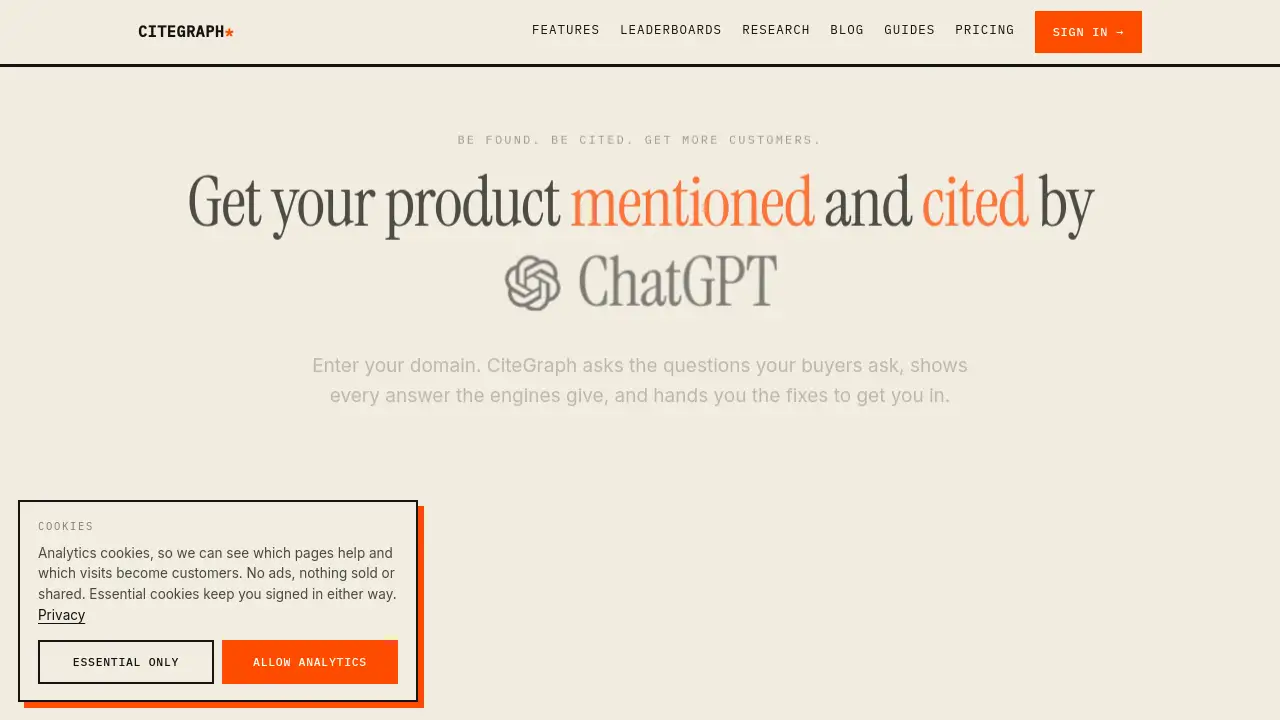
CiteGraph is an AI visibility tool that helps brands get cited by ChatGPT, Claude, Gemini, and Perplexity. It finds the buyer questions where competitors are named instead, shows the exact lost answer, and provides sentence-level fixes to win the citation. For teams working on answer engine optimization, this makes AI search visibility measurable and actionable.
What is CiteGraph?
CiteGraph is an AI visibility tool and answer engine optimization platform. It solves a common problem: ChatGPT and other AI assistants often name a competitor in product recommendations while ignoring your brand. CiteGraph asks the questions buyers actually type, records which products are named and which URLs are cited, and then shows the missing claim that could earn a mention.
The platform is built for builders, marketers, SEO teams, and agencies that want to understand AI search visibility. Instead of tracking only rankings or vanity mentions, it focuses on AI citation tracking: which pages the engines use to build an answer, who owns those pages, and what sentence would put your product into the recommendation. This matters because AI assistants usually give one answer, not a list of blue links.
Key Features of CiteGraph
Buyer Question Scans
CiteGraph writes ten buyer questions per project and asks each one three times across four AI engines. This reveals the real prompts that shape AI recommendations, not just keywords.
Lost Answer Dossiers
For every question where the brand is skipped, CiteGraph shows the verbatim answer, the rivals named, and the cited page behind the win. This makes AI visibility gaps clear and specific.
Sentence-Level Fixes
Each lost answer includes the one claim that would have earned a mention, where it should live, and a page that can win the citation. Every sentence is traced to its source.
Cited-Source Map
The platform maps the pages each engine pulls from and flags when a competitor owns a source. This turns AI citation tracking into a practical plan instead of a score.
Competitor Share of Voice
Track up to six rivals on the questions that matter. See when a new name appears in AI answers before customers notice.
Weekly Re-Scans with Error Bars
Every number is sampled with a printed margin. A change is flagged only when it moves beyond that margin, so teams know a move is real.
Ask Assistant and MCP Server
Ask reads scans, blind spots, sources, and readiness, then answers in plain words. The same tools run as an MCP server for Claude, Cursor, or VS Code.
Multi-Engine Tracking
CiteGraph tracks ChatGPT, Claude, Gemini, and Perplexity. It records both product mentions and cited URLs, showing where AI search visibility is won or lost.
Use Cases for CiteGraph
Improving AI Search Visibility
Use CiteGraph to find buyer questions where ChatGPT names a competitor instead of your brand. Then apply the sentence-level fixes to get cited by ChatGPT and similar engines.
Competitor Citation Analysis
See which pages every engine relies on and which competitors own them. This helps teams stop pitching the wrong page and focus on sources that influence AI answers.
AEO Content Planning
Turn lost answers into a content plan for answer engine optimization. CiteGraph writes pages for missed questions, so content teams know what to publish next.
Agency Reporting
Agencies can show clients the exact AI answers they lost, who was named instead, and how visibility changes over weekly scans. The public dossier link makes reporting simple.
Tracking AI Recommendations
Monitor how often AI assistants recommend your product across four engines. When a new rival appears, the share-of-voice view shows it early.
How to Use CiteGraph
- Enter your domain on the CiteGraph site. Signing up shows a site readiness score and one live AI answer for free.
- Choose a one-time scan or a monthly plan. The first full scan runs after adding a card, with nothing charged for 7 days on plans.
- Review the buyer questions, lost answers, cited sources, and competitor share of voice.
- Apply the sentence-level fixes and publish the pages CiteGraph drafts for questions you lose.
- Re-scan weekly to prove movement, then use Ask or the MCP server to bring blind spots into your workflow.
Target Audience for CiteGraph
- SaaS founders and indie builders
- SEO and content marketing teams
- AEO specialists and AI search consultants
- Growth and product marketing teams
- Agencies managing AI visibility for clients
- Enterprise teams tracking AI citations at scale
Is CiteGraph Free?
CiteGraph does not have an ongoing free tier. Signing up shows a site readiness score and one live AI answer on your own domain for free. A one-time scan costs $12 with no subscription, and the first purchase gets 2 scans.
| Plan | Price | Features |
|---|---|---|
| Free sign-up | $0 | Site readiness score and one live AI answer |
| One-time scan | $12 | No subscription; first purchase gets 2 scans |
| Starter | $29/month | 2 domains, 10 questions, 3 runs, 4 engines, weekly scans, blind spots, plays, 30 pages/month, Ask, MCP, 6 rivals |
| Growth | $69/month | 3 domains, tighter error bars, more rivals tracked |
| Scale | $149/month | Higher limits and additional reporting features |
Every paid plan carries a 120-day money-back guarantee. If no CiteGraph scan shows ChatGPT, Claude, Gemini, or Perplexity naming your product within 120 days of first payment, the subscription payments from those days are refunded.
CiteGraph's Pros and Cons
| Aspect | Pros | Cons |
|---|---|---|
| Pricing | One-time scan and monthly plans; 120-day guarantee | No ongoing free tier |
| Features | Real lost answers, sentence fixes, cited-source map, multi-engine tracking | Requires publishing fixes to see results |
| Measurement | Sampled numbers with error bars | Limited questions and domains per plan |
| Access | Ask assistant and MCP server for agents | Weekly tracking needs a paid plan |
Frequently Asked Questions about CiteGraph
What is answer engine optimization (AEO)?
AEO is the practice of getting your product named and your pages cited inside AI assistant answers, rather than only in search results. It focuses on the sources an engine reads before writing a recommendation.
Does CiteGraph help get cited by ChatGPT?
Yes. It asks buyer questions across ChatGPT, Claude, Gemini, and Perplexity, then shows which answers mention competitors and which sources were cited. It also writes the sentence that could win the citation.
How does CiteGraph measure AI visibility?
It writes ten buyer questions per project, runs each three times on four engines through official APIs, and records named products and cited URLs. Every rate includes a margin of error.
Is being mentioned by AI the same as being cited?
No. A mention means the assistant named your product. A citation means your page was used as a source. CiteGraph tracks both, because a product can be recommended while its own words never reach the buyer.
Does llms.txt help with AI citations?
No. CiteGraph states that it tested llms.txt and found no measurable effect on citation rates. Assistants cite pages they retrieve and read at answer time.
How much does CiteGraph cost?
Sign-up shows a site readiness score and one live AI answer for free. A one-time scan is $12 without a subscription, and the first purchase gets 2 scans. Plans start at $29/month for Starter, $69/month for Growth, and $149/month for Scale. Every paid plan has a 120-day money-back guarantee.
CiteGraph Tags
AI visibility tool, answer engine optimization, AI citation tracking, get cited by ChatGPT, AI search visibility, ChatGPT visibility, AEO tool, AI mention tracking, competitor citation analysis, AI answer engine tracking, CiteGraph review, monitor AI recommendations