Introduction
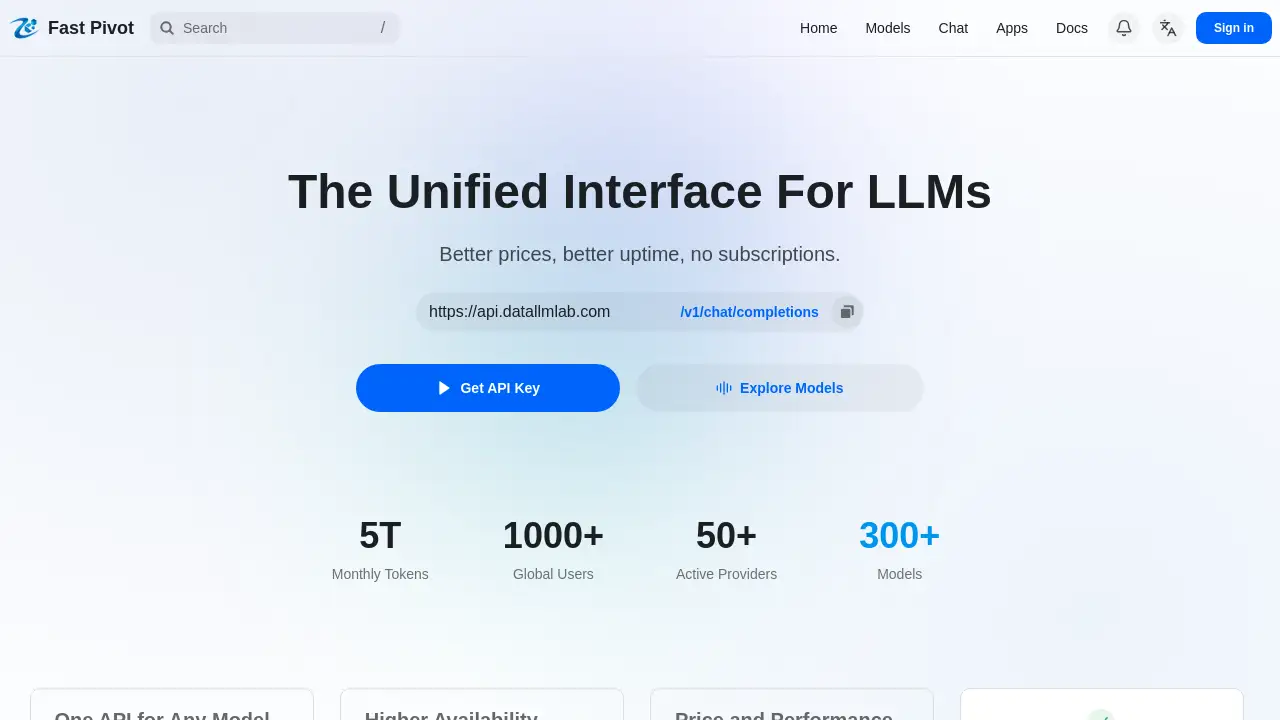
An LLM unified interface platform like datallmlab simplifies how developers connect to multiple large language models. It provides a single API gateway that handles routing, cost optimization, and failover across over 300 models from more than 50 providers. This review explores its features, pricing, and practical benefits.
What is datallmlab?
datallmlab is a unified LLM interface that acts as a smart API gateway for accessing global AI models. It solves the common problem of managing different APIs, pricing, and uptime across providers like OpenAI, Anthropic, Google, and others. Developers can write code once and automatically get the best model for each request – based on current price, latency, and availability. The platform is designed for teams that want to reduce integration costs, avoid vendor lock-in, and maintain high reliability without manual switching. It matters because the LLM landscape changes rapidly, and a single standard interface saves time and money.
Key Features of datallmlab
One API for Any Model
Connect to all major models through one set of endpoints like /v1/chat/completions and /v1/embeddings. The OpenAI SDK works out of the box, so existing applications need minimal changes. This multi-model API approach cuts development effort.
Higher Availability
When one provider goes down, datallmlab automatically routes requests to another provider with a similar model. The distributed infrastructure keeps inference running even during outages, improving uptime for your applications.
Price and Performance Optimization
The platform compares prices in real time and selects the most cost-efficient model that meets your quality and speed needs. Fast Pivot technology runs at the edge to minimize latency. This smart LLM routing helps control spending without sacrificing performance.
Custom Data Policies
You can set fine‑grained data rules to control which models and providers receive your prompts. This protects sensitive information and ensures compliance with internal or regulatory policies. The unified LLM interface gives you full visibility and control over data flow.
Wide Model and Provider Coverage
With over 300 models from 50+ active providers, datallmlab offers one of the broadest selections in the market. It supports text, image, audio, and embedding tasks through consistent API formats.
Use Cases for datallmlab
Application with Fallback Automation
When building a chatbot, you can use datallmlab to automatically switch to a secondary model if the primary provider fails. This keeps the user experience seamless without extra coding.
Cross‑Provider Cost Comparison
A data science team can send the same request to multiple models and compare costs before choosing the cheapest suitable option. The unified LLM interface makes this comparison simple and repeatable.
Centralized API Key Management
Organizations can manage a single API key for all LLM usage, simplifying access control and billing. This reduces the overhead of maintaining dozens of provider keys.
Rapid Prototyping with Many Models
Startups can quickly test different models for tasks like summarization, translation, or image generation without integrating each provider separately. The single endpoint accelerates experimentation.
How to Use datallmlab
- Sign up – Create a free account on the datallmlab website. You can later set up an organization for your team.
- Buy credits – Purchase credits that work with any model. No monthly subscriptions; you pay only for what you use.
- Get your API key – Generate a unique key from the dashboard. It is fully compatible with the OpenAI SDK format.
- Make requests – Send standard API calls to endpoints like
/v1/chat/completions. The platform automatically routes your request to the best provider based on your preferences (price, speed, availability). - Monitor usage – Use the dashboard to see token consumption, cost per request, and provider performance. Adjust routing policies as needed.
Target Audience for datallmlab
- Software developers who build applications that use multiple LLMs.
- DevOps teams that want to automate failover and cost optimization.
- Startups that need to prototype quickly without committing to one provider.
- Enterprise IT managers who require centralized control and data governance.
- Data scientists who compare model outputs and costs for research.
Is datallmlab Free?
Pricing is credit‑based with no fixed monthly fee. According to the homepage, users buy credits (e.g., $20, $100) and spend them across any model. A free tier is available: a new account receives initial credits (often $5–$10) to test the platform. For the latest pricing, refer to the official website.
| Plan | Price | Features |
|---|---|---|
| Free | $0 (starter credits) | Access to limited models, community support |
| Pay‑as‑you‑go | Per credit spend | Full model selection, high availability, custom policies |
| Enterprise | Custom | Dedicated support, negotiated rates, SLA guarantees |
datallmlab's Pros and Cons
| Aspect | Pros | Cons |
|---|---|---|
| Integration | Single API works with OpenAI SDK – minimal code changes | Advanced routing rules may require initial setup |
| Model Choice | Access to 300+ models from 50+ providers | Some niche providers may not be included yet |
| Cost Control | Real‑time price comparisons reduce spending | Credit‑based pricing can be unpredictable for large volumes |
| Reliability | Automatic failover improves uptime | No on‑premise deployment option |
| Data Governance | Custom policies protect sensitive data | Policy configuration requires careful planning |
Frequently Asked Questions about datallmlab
How does datallmlab compare to using a single provider API?
datallmlab provides a unified LLM interface that abstracts multiple providers. Instead of managing separate API keys and endpoints, you use one standard interface. It automatically handles cost optimization and failover, which a single provider cannot do.
Is datallmlab compatible with existing OpenAI code?
Yes. The platform uses the same /v1/chat/completions format and supports the OpenAI SDK. Most code that works with OpenAI will work with datallmlab after changing the base URL and API key.
Can I control which models are used for my requests?
Absolutely. You can set routing policies based on provider, model, latency, and cost limits. The custom data policies also let you restrict which providers can see your prompts.
What happens if all providers are down for a specific model?
If no provider is available for the requested model, datallmlab returns an error. However, the high‑availability feature automatically tries similar models from other providers before failing.
Does datallmlab support image and audio models?
Yes. The platform includes endpoints for image generation, editing, variations, speech synthesis, transcriptions, and translations. All are accessible through the same unified LLM interface.
How are costs calculated with credits?
Each API call consumes credits based on the model’s price per token. datallmlab shows the estimated cost before each request. Credits never expire as long as the account remains active.
datallmlab Tags
unified LLM interface, LLM API gateway, multi-model API, cost-effective LLM routing, high availability LLM, AI model integration, model failover, OpenAI SDK compatible, cross-provider LLM, AI cost optimization, datallmlab review, LLM unified platform