Introduction
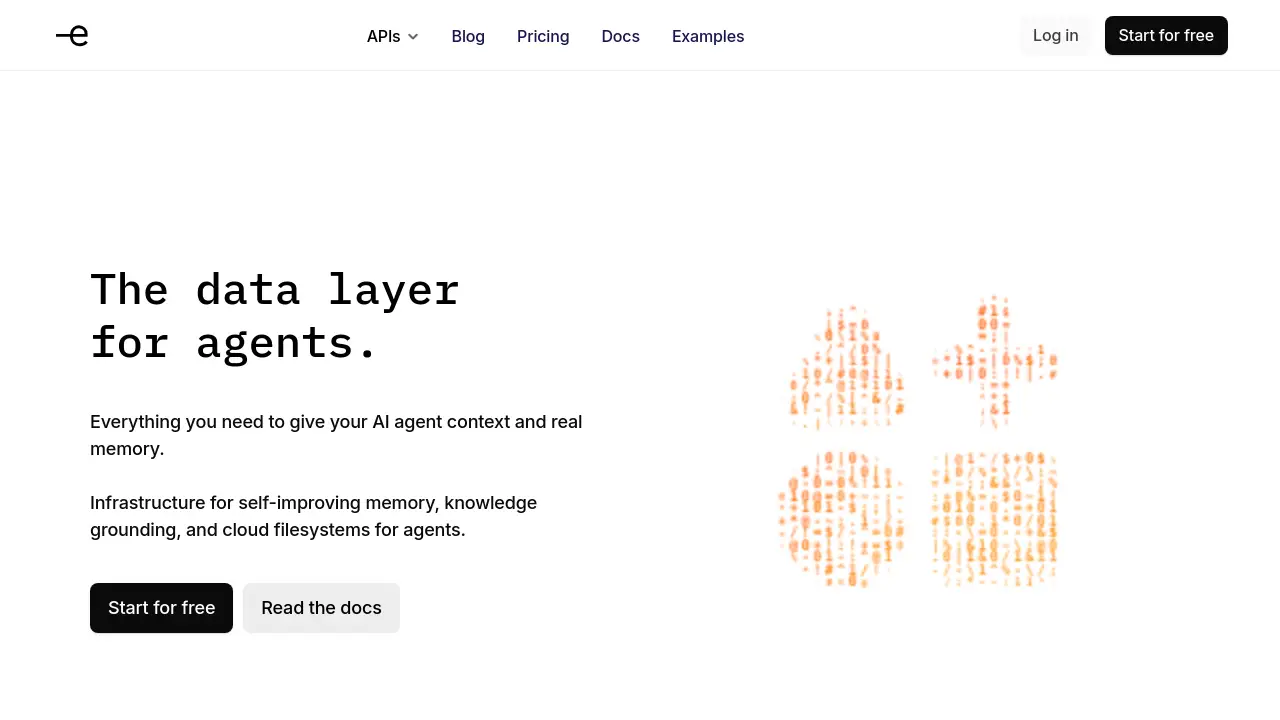
Exabase provides a powerful data layer for AI agents, solving the critical problem of memory and context in AI applications. For developers building intelligent agents, chatbots, or any AI-driven product, Exabase offers the infrastructure for persistent, self-improving memory and cloud filesystem instances.
What is Exabase?
Exabase is an infrastructure platform designed as the data layer for agents. It provides AI developers with the tools to give their applications long-term memory, dynamic knowledge grounding, and structured data environments. The core problem it addresses is the stateless nature of most AI agents—they typically operate in isolation, unable to remember past interactions or user-specific context. Exabase solves this by offering managed services like a self-organizing memory engine, cloud filesystem instances called "Bases," and semantic search APIs. This platform is suitable for developers and companies building AI agents, autonomous applications, or any software requiring persistent, intelligent context. It matters because it allows creators to focus on building their product's unique logic instead of the complex backend plumbing needed for stateful AI.
Key Features of Exabase
Memory API
This feature provides a self-managing, advanced memory system that allows agents to store facts, preferences, and events, building a dynamic ontology that evolves with new information.
Bases API
The Bases API enables the creation and management of on-demand cloud filesystem instances, providing isolated workspaces where agents can store progress, files, and context.
Resources API
Acting as an AI-native filesystem, this API offers full CRUD operations for files, notes, and documents, complete with semantic search, folders, and tags for portable context.
Semantic Search
Integrated semantic and keyword search allows agents to retrieve information by meaning, which has been shown to improve agent accuracy, moving beyond simple keyword matching.
SDKs & CLI Support
Exabase offers Python and JavaScript SDKs, a command-line interface, and MCP support for easy integration with popular tools like Claude Desktop and Cursor.
Security & Scalability
The platform is built with security-first principles, featuring encryption in transit and at rest, CASA certification, and is designed for reliability with 99.9% uptime and sub-300ms retrieval.
Use Cases for Exabase
Building Conversational AI Assistants
Developers can use Exabase to create chatbots or virtual assistants that remember user preferences, past conversations, and personal details across sessions, leading to more personalized and coherent interactions.
Creating Autonomous AI Agents
For projects involving agents that perform multi-step tasks, Exabase's Bases provide a dedicated workspace to store intermediate results, reference documents, and maintain state, enabling more complex operations.
Developing Context-Aware Applications
Any application that needs to ground its responses in a user's personal data—like a note-taking app with an AI summarizer or a project management tool with an intelligent assistant—can leverage Exabase's memory and search.
Implementing Knowledge Management Systems
Teams can use Exabase to build internal tools where AI can search through company documents, meeting notes, and resources using semantic understanding to find relevant information quickly.
How to Use Exabase
Getting started with Exabase is designed to be straightforward for developers.
- Sign Up: Create a free account on the Exabase console to get API keys and access the dashboard.
- Integrate the SDK: Install the Python or JavaScript SDK into your project and initialize the client with your API keys.
- Implement Core Features: Start by using the Memory API to store and retrieve agent memories, or provision a Base to create a cloud filesystem instance for your agent's work.
- Build Your Logic: Use the retrieved context and structured data from Exabase's APIs to inform your agent's reasoning and responses within your application.
- Monitor and Scale: Use the Exabase console to audit workspaces, monitor usage, and scale your infrastructure as your agent's needs grow.
Target Audience for Exabase
- AI Agent Developers: Individuals or teams building autonomous or semi-autonomous AI agents that require persistent memory.
- SaaS Companies: Businesses looking to add intelligent, context-aware features to their existing web or mobile applications.
- Startups Building AI Products: New ventures that need a scalable, ready-made backend for memory and data management to move quickly.
- Enterprise AI Teams: Larger organizations implementing internal AI tools, knowledge bases, or customer-facing intelligent assistants.
Is Exabase Free?
Exabase offers a free tier to get started. The homepage prominently features a "Start for free" call-to-action, allowing developers to try the core APIs and features. For specific details on usage limits, paid plans, and enterprise pricing, users should visit the official Exabase pricing page, which is linked from the main website footer.
Exabase's Pros and Cons
| Aspect | Pros | Cons |
|---|---|---|
| Core Value | Solves the complex problem of AI agent memory and state management. | May be overkill for very simple, stateless AI applications. |
| Development Speed | Provides production-ready APIs, allowing developers to ship features faster. | Requires integration work and understanding of the API model. |
| Features | Combines memory, filesystem, and advanced search into a unified platform. | The breadth of features (Memory, Bases, Resources) might have a learning curve. |
| Security & Compliance | Emphasizes security with encryption and certifications like CASA. | Specific compliance details (like GDPR) should be verified for critical use cases. |
Frequently Asked Questions about Exabase
What exactly is the "data layer for agents"?
The "data layer for agents" refers to the backend infrastructure that handles an AI agent's need for memory, file storage, and context retrieval. Exabase provides this layer as a service, so developers don't have to build and maintain their own databases, vector search, and file systems specifically for AI state management.
How is Exabase's Memory different from a vector database?
While both can power semantic search, Exabase's Memory API is described as a "living, addressable network" designed to track relationships between concepts, resolve contradictions, and evolve over time. It's built as a self-organizing memory engine rather than just a storage and retrieval system for embeddings.
Can I use Exabase with any AI model or framework?
Yes, Exabase is model-agnostic and framework-agnostic. It provides standard REST APIs and SDKs, so it can work with OpenAI's models, Anthropic's Claude, open-source LLMs, or any other AI model you choose to build your agent with.
What are "Bases" in Exabase?
Bases are on-demand, cloud filesystem instances. Think of them as dedicated, isolated workspaces or virtual drives that your agent or application can use to store files, maintain state, and organize data for a specific task or user session.
Is my data secure with Exabase?
Based on the provided information, Exabase states it is "private by design" and "security-first," with data encrypted in transit (SSL) and at rest (AES-256). It also mentions being CASA certified, which is a security standard. For specific compliance needs, reviewing their detailed security documentation is recommended.
Does Exabase offer a free tier?
Yes, Exabase has a free plan that allows developers to start building and testing their integrations. This is a common approach for developer-focused platforms to lower the barrier to entry.
Exabase Tags
Exabase, data layer for agents, AI agent memory, cloud filesystem for AI, semantic search API, AI infrastructure, stateful agents, autonomous AI, AI context management, AI development platform, AI memory API, Bases API, agent workspace