Introduction
Factory is an AI coding agent platform that automates software development tasks, helping developers build faster.
What is Factory?
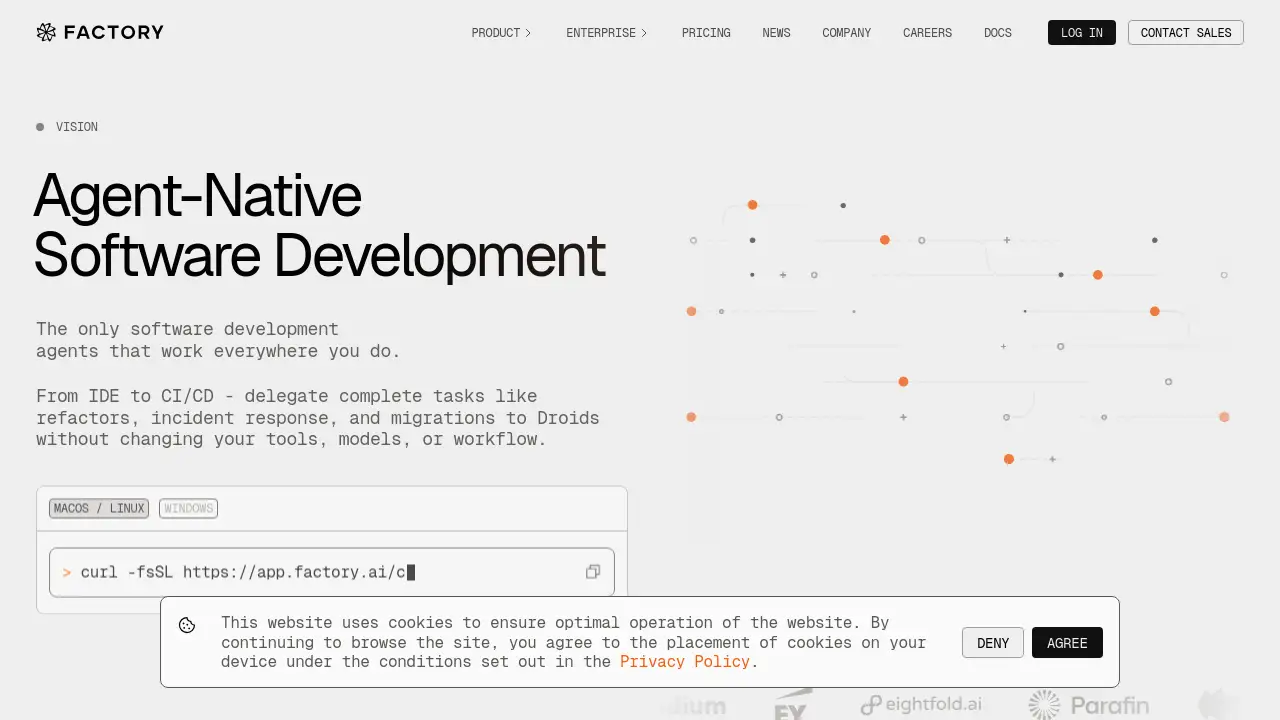
Factory is an agent-native software development platform designed to automate coding, testing, and deployment. It solves the problem of repetitive, time-consuming development tasks by introducing intelligent AI coding agents called "Droids." These Droids can be delegated complete tasks like code refactoring, incident response, and migrations without forcing developers to change their existing tools, models, or workflow. The product is suitable for startups and enterprise teams looking to accelerate their development cycles and improve engineering efficiency. Its significance lies in seamlessly integrating AI agents into the entire development lifecycle, from the IDE to CI/CD pipelines.
Key Features of Factory
AI Coding Agents (Droids)
Factory's core feature is its autonomous AI coding agents, known as Droids, which can handle complex development tasks delegated by engineers.
Multi-Platform Integration
Droids embed directly into a developer's existing workflow, integrating with popular environments like Terminal/IDE, Web Browser, Command Line, Slack/Teams, and Project Management tools.
Terminal and IDE Integration
Developers can delegate tasks to Droids directly within their preferred Integrated Development Environment (IDE) or terminal, including VS Code, JetBrains, and Vim, without disrupting their workflow.
Web-Based Interface
A browser-based interface allows for instant delegation of complex coding tasks, refactors, or debugging to agents, offering a fast, no-setup-required experience for agent-driven development.
Command-Line Interface (CLI) for Scale
The CLI enables scripting and parallelization of Droids at massive scale, making it ideal for automating CI/CD processes, large-scale migrations, and maintenance tasks.
Slack and Teams Integration
This feature provides support teams and engineers a shared channel to interact with Droids using plain English, enabling faster incident triage, bug fixes, and reducing Mean Time to Resolution (MTTR).
Project Management Automation
Droids can be automatically triggered from issue assignments or mentions in project management tools, pulling context, implementing solutions, and creating Pull Requests (PRs) with full traceability.
Enterprise-Grade Security
Factory employs state-of-the-art security protocols and compliance measures to protect sensitive data and intellectual property, making it suitable for enterprise use.
Model and Tool Agnosticism
The platform is designed to be flexible and extensible, working with any AI model provider and any existing development tooling, ensuring long-term adaptability.
Use Cases for Factory
Automated Code Refactoring
Teams can delegate large-scale code refactoring tasks to Droids, which analyze the codebase and implement improvements automatically, saving significant developer hours.
Incident Response and Debugging
During production incidents, engineers or support staff can use Slack integration to quickly delegate debugging tasks to Droids, accelerating the resolution process.
CI/CD Pipeline Enhancement
Development teams can integrate Droids into their CI/CD pipelines via the CLI to automate code reviews, run tests, and implement self-healing builds.
Backlog and Ticket Management
Product managers and engineers can connect Factory to tools like Linear or Jira, where Droids automatically handle assigned tickets, from understanding requirements to submitting code changes.
Large-Scale Data Migrations
Enterprises undertaking complex system migrations can use Factory's scalable CLI to script Droids that handle the data transformation and transfer processes in parallel.
How to Use Factory
Getting started with Factory involves a few straightforward steps:
- Sign Up: Create an account on the Factory platform.
- Install Integration: Choose and install the integration method that fits your workflow (e.g., CLI, IDE extension, Slack app). For example, install the CLI on macOS/Linux with the command:
curl -fsSL https://app.factory.ai/cli | sh - Connect Your Tools: Authenticate and connect Factory to your existing development tools, repositories, and communication platforms.
- Delegate a Task: Start by delegating a simple coding or debugging task to a Droid via your chosen interface (terminal, web, Slack).
- Review and Iterate: Review the Droid's proposed code changes or solutions, provide feedback, and iterate as needed.
Target Audience for Factory
- Software Development Teams in startups and scale-ups looking to accelerate product velocity.
- Enterprise Engineering Organizations requiring secure, scalable automation for complex development processes.
- DevOps and Platform Engineers focused on optimizing CI/CD pipelines and infrastructure code.
- Engineering Managers and Tech Leads seeking to improve team efficiency and reduce technical debt.
- Support and Reliability Engineers who need faster tools for incident management and bug resolution.
Is Factory Free?
Factory offers a tiered pricing model to cater to different team sizes and needs. For the most accurate and current pricing details, it is recommended to visit the official Factory pricing page.
| Plan | Price | Features |
|---|---|---|
| Free Tier | $0 | Likely includes basic access to Droids with limited tasks or concurrency, suitable for individual developers or small teams to try the platform. |
| Pro / Team | Custom Quote | Typically includes higher usage limits, advanced features, priority support, and enterprise-focused capabilities like enhanced security and SLA guarantees. |
Factory's Pros and Cons
| Aspect | Pros | Cons |
|---|---|---|
| Integration & Workflow | Seamlessly integrates into existing developer tools and workflows without disruption. | May require initial setup and configuration for each integrated tool. |
| Automation Capability | Powerful AI agents can automate a wide range of complex coding, testing, and deployment tasks. | The effectiveness of AI-generated code must be reviewed and validated by human engineers. |
| Scalability | CLI and enterprise features allow for scripting and parallelization at a massive scale. | Advanced scaling and enterprise features come at a higher cost. |
| Accessibility | Multiple access points (Web, CLI, Slack) make it easy to delegate tasks from anywhere. | The breadth of features might have a learning curve for teams new to AI-assisted development. |
| Security | Built with enterprise-grade security and compliance protocols for data protection. | As with any cloud-based AI tool, organizations must trust the vendor's security practices. |
Frequently Asked Questions about Factory
What exactly are Factory Droids?
Factory Droids are autonomous AI coding agents that can execute complete software development tasks. They are not just code completers; they can understand a task's context, plan a solution, write the code, and often test it, acting as an automated engineering assistant.
Does Factory require me to change my current development tools?
No, a core principle of Factory is to work within your existing ecosystem. Its Droids are designed to integrate with popular IDEs, terminals, version control systems, project management tools, and communication platforms like Slack without forcing you to switch.
Is Factory suitable for large enterprises?
Yes, Factory offers enterprise-grade features including advanced security protocols, compliance readiness, and the ability to operate at scale. Its model-agnostic and tool-agnostic design also allows it to fit into complex, established tech stacks.
How does the Slack/Teams integration work?
The integration creates a bot within your Slack workspace or Microsoft Teams channel. Team members can delegate tasks in plain English (e.g., "debug the login error"). The Droid analyzes the request, accesses relevant code (with permissions), and provides a code-level solution or fix directly in the chat.
Can I use my own AI models with Factory?
Yes, Factory is promoted as being model-agnostic. This means it is designed to work with various AI model providers, allowing enterprises to use their preferred or proprietary models alongside the platform's agent framework.
What kind of tasks can Factory Droids automate?
Droids can handle a variety of tasks including code refactoring, writing tests, debugging, generating documentation, managing incident response, executing data migrations, and even creating pull requests from assigned tickets in project management tools.
Factory Tags
AI coding agents, software development automation, agent-native development, Factory Droids, automate coding, AI development platform, DevOps AI, CI/CD automation, enterprise AI tools, coding assistant, Slack coding bot, IDE integration, refactoring automation