Introduction
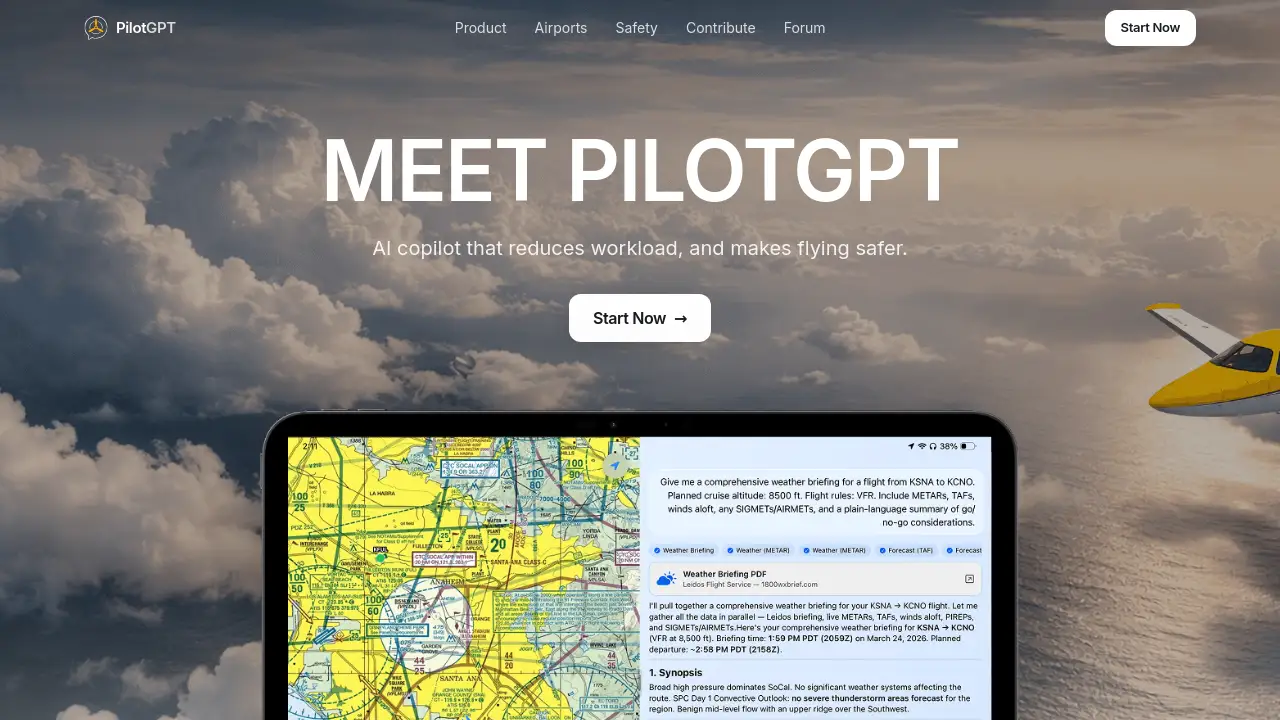
PilotGPT is an AI copilot designed to reduce pilot workload and enhance aviation safety.
What is PilotGPT?
PilotGPT is a specialized artificial intelligence tool created for pilots. It functions as a digital copilot, providing instant access to critical flight information. The primary problem it solves is the high workload and information overload that pilots, especially those flying solo or in general aviation (GA), often face. By using official aviation documents as its knowledge base, it delivers accurate, tailored guidance to help with everything from pre-flight planning to in-cockpit procedures. This product is suitable for student pilots, private pilots, and professional aviators who seek to improve their situational awareness and operational safety. Its focus on verified, aircraft-specific information makes it a reliable alternative to general-purpose AI models that may produce inaccurate or "hallucinated" data for aviation use.
Key Features of PilotGPT
Access to Official Aviation Data
PilotGPT uses official FAA sources for airport data, VFR/IFR maps, and other critical information, ensuring pilots have accurate and up-to-date resources for their flight planning and navigation.
Aircraft-Specific Guidance
The AI is trained directly on official Pilots Operating Handbooks (POH), aircraft manuals, and regulatory documentation, delivering precise answers and procedures tailored to the specific make and model of aircraft being flown.
Fully Offline Functionality
A key safety feature, PilotGPT works completely without an internet connection, providing instant responses and reliable access to information in remote areas or when connectivity is unavailable.
Extensive Aircraft Model Support
With compatibility for over 500 aircraft models—including popular series from Cirrus, Cessna, Piper, Diamond, Beechcraft, and Mooney—and growing weekly, it offers broad utility for a wide range of pilots.
Safety-First Design Philosophy
Unlike general large language models, PilotGPT grounds every response in verified source material, significantly reducing the risk of AI hallucination and making it a trustworthy tool for aviation safety.
Use Cases for PilotGPT
In-Flight Checklist Management
Pilots can quickly pull up and run through standardized or emergency checklists specific to their aircraft model, reducing cockpit workload during critical phases of flight.
Pre-Flight and En-Route Planning
The tool assists with comprehensive flight planning tasks, including accessing weather briefs, calculating performance data, and reviewing airport diagrams and procedures before and during a flight.
Quick Regulatory and Procedure Reference
When unsure about a regulation or a specific aircraft procedure, pilots can query PilotGPT for instant, sourced answers from official manuals, aiding in decision-making.
High-Workload and Solo Flight Operations
Especially beneficial for single-pilot operations, it acts as a second set of "eyes," helping manage tasks and maintain situational awareness to prevent task saturation.
How to Use PilotGPT
Using PilotGPT is designed to be straightforward for pilots:
- Select Your Aircraft: Upon setup, specify the exact make and model of your aircraft so the AI can tailor its knowledge base to your specific POH and manuals.
- Download for Offline Use: Ensure the application and its database are fully downloaded to your device to enable offline functionality.
- Ask Your Questions: Interact with the AI copilot using natural language. You can ask for checklists, performance calculations, regulatory clarifications, or airport information.
- Integrate into Workflow: Use the provided, sourced information during pre-flight planning, in the cockpit for quick references, or for post-flight review.
Target Audience for PilotGPT
- Student Pilots: Learning aircraft systems, procedures, and regulations.
- Private & General Aviation (GA) Pilots: Especially those flying single-pilot operations who need to manage all cockpit tasks alone.
- Low-Time Pilots: Building experience and confidence with a reliable digital reference tool.
- Professional Aviators: Seeking an efficient, offline-available backup for manuals and quick data lookup.
Is PilotGPT Free?
Specific pricing details for PilotGPT are not provided on the referenced homepage. Interested users should visit the official website at https://www.pilotgpt.com/ for the most current information on free trials, subscription plans, and pricing.
PilotGPT's Pros and Cons
| Aspect | Pros | Cons |
|---|---|---|
| Information Accuracy | Grounded in official POHs and FAA data, reducing AI hallucination risk. | Dependent on the quality and completeness of the uploaded source documents for each aircraft. |
| Accessibility & Safety | Works fully offline, ensuring availability in all flight conditions. | Requires a compatible electronic device in the cockpit. |
| Utility | Supports 500+ aircraft models and aids in numerous flight phases from planning to cockpit checks. | Effectiveness is tied to the user's ability to phrase queries effectively. |
| Target Audience | Highly valuable for solo and low-time pilots in general aviation. | May offer less novel utility for pilots in highly automated, multi-crew aircraft with integrated systems. |
Frequently Asked Questions about PilotGPT
What makes PilotGPT different from ChatGPT or other AI?
PilotGPT is specifically fine-tuned for aviation. Unlike general AI models that can generate plausible but incorrect information (hallucinate), it grounds every response in the official Pilots Operating Handbook (POH), aircraft manuals, and FAA data for a specific aircraft, making it reliable for flight safety.
Does PilotGPT really work without any internet connection?
Yes, a core feature of PilotGPT is its fully offline functionality. Once the app and its database are installed on your device, it can provide instant responses and access to all its trained information without any cellular or Wi-Fi connection, which is crucial for flying in remote areas.
How many aircraft models does PilotGPT support?
PilotGPT currently supports over 500 aircraft models and is expanding its compatibility weekly. This includes popular series from manufacturers like Cessna (172, 182), Piper (PA-28, Arrow), Cirrus (SR20, SR22), Diamond, Beechcraft, and Mooney.
Can student pilots benefit from using PilotGPT?
Absolutely. Student pilots can use PilotGPT as a learning aid to quickly access aircraft-specific procedures, understand regulations, and practice flight planning. It helps reinforce knowledge from their POH and can serve as a helpful reference during training flights.
Is the information provided by PilotGPT legally authoritative for flight?
While PilotGPT sources its information from official documents, the pilot-in-command is always ultimately responsible for the safety of the flight. The tool is designed as a reliable aid and reference, but pilots must always defer to the latest official publications, manuals, and ATC instructions.
What kind of questions can I ask PilotGPT?
You can ask a wide range of aviation-related questions, such as requesting a before-landing checklist for your specific plane, asking for the best glide speed, getting the latest NOTAMs for an airport (if data is current), understanding a system limitation, or planning a cross-country route.
PilotGPT Tags
AI copilot, aviation AI, pilot assistant, flight safety tool, offline flight app, POH digital assistant, general aviation software, cockpit workload reduction, aircraft-specific AI, flight planning tool, student pilot aid, FAA data access, solo pilot tool