Introduction
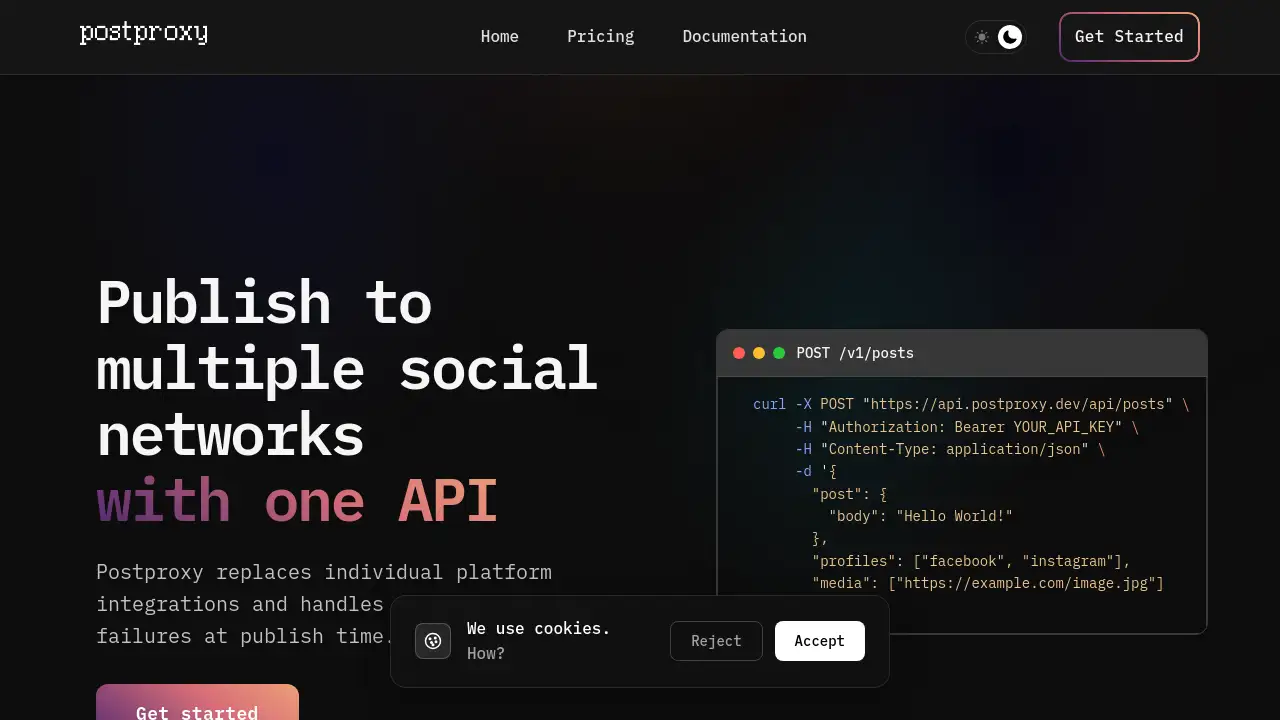
Postproxy is a unified API for publishing content to multiple social media platforms.
What is Postproxy?
Postproxy is a developer-first API service designed to simplify and stabilize social media publishing. It solves a critical pain point for businesses and developers: the operational complexity of managing multiple, fragile social platform APIs. Instead of integrating directly with Facebook, Instagram, LinkedIn, and others, users integrate once with Postproxy. This single API layer automatically handles platform-specific failures, format conversions, authentication, and delivery guarantees. The product is particularly suitable for teams that automate content creation, manage multiple brands, or rely on event-driven workflows to publish content. For anyone tired of debugging broken posts, silent failures, and last-minute publishing errors, Postproxy turns social publishing from a chaotic chore into a predictable infrastructure component.
Key Features of Postproxy
Unified Social Media API
Postproxy provides one stable API endpoint to publish to multiple social networks, eliminating the need for separate integrations with each platform's unique API.
Automatic Format Conversion
The service intelligently transforms your content, including text and media, to meet the specific requirements and limits of each target social media platform.
Managed Authentication
Postproxy handles OAuth flows, secure token storage, and automatic refresh for all connected social media accounts, removing a significant maintenance burden.
Reliable Delivery Guarantees
The system includes automatic retries, rate limit handling, quota awareness, and clear status reporting to ensure posts are delivered or failures are explicitly communicated.
Explicit Publish State Reporting
You always receive a clear, deterministic report on what succeeded, what failed, and why, eliminating the need for manual checks across different platforms.
Designed for Automation
Postproxy is built as a publishing primitive for automated workflows, making it ideal for integration into tools like n8n, Zapier, or custom scripts and agents.
Use Cases for Postproxy
Automated Content Publishing from AI
Generate posts using LLMs or AI agents and automatically publish the finalized content across selected social networks without manual reformatting or intervention.
CMS-to-Social Media Integration
Connect your content management system to social media, automatically sharing new blog posts or updates to multiple platforms as soon as they are published internally.
Multi-Brand & Multi-Account Management
Easily manage publishing for dozens of pages, brands, or client accounts from a single, centralized workflow with configurable routing rules.
Product Launch and Update Automation
Trigger social media announcements directly from your product release pipeline, CI/CD system, or version control commits for synchronized, reliable communications.
How to Use Postproxy
Using Postproxy involves a straightforward integration process:
- Sign Up & Get API Key: Create an account on the Postproxy website to obtain your unique API key for authentication.
- Connect Social Accounts: Use Postproxy's interface to authorize and connect the social media profiles (e.g., Facebook Page, Instagram Professional account) you want to publish to.
- Integrate the API: In your application or workflow tool (like n8n), send a single HTTP POST request to the Postproxy API endpoint with your post content, target profiles, and media URLs.
- Handle the Response: Postproxy will return a clear status indicating success or failure for each platform, which you can use to update your system or trigger notifications.
Target Audience for Postproxy
- Developers and Engineering Teams building automated publishing features into their applications.
- Marketing Operations and Automation Specialists managing complex, multi-channel content calendars.
- Agencies handling social media for multiple clients and brands.
- Product Teams automating launch announcements and update communications.
- Content Creators and Teams using AI tools for content generation who need a reliable publishing endpoint.
Is Postproxy Free?
Postproxy offers a free plan to get started, with scalable paid plans as needs grow. The reference information confirms a free tier is available with no credit card required to begin. For specific details on limits, features, and pricing for higher tiers, users should visit the official Postproxy pricing page.
Postproxy's Pros and Cons
| Aspect | Pros | Cons |
|---|---|---|
| Reliability | Handles platform-specific failures, rate limits, and retries automatically. | Dependent on a third-party service for critical publishing functions. |
| Development Efficiency | Drastically reduces integration and maintenance time for multi-platform publishing. | May add cost compared to direct, minimal free-tier API use. |
| Operational Clarity | Provides explicit publish states and failure reasons, eliminating guesswork. | Requires initial setup and connecting social accounts. |
| Scalability | Offers a single, stable contract to scale publishing volume across platforms. | For very simple, single-platform needs, it might be overkill. |
Frequently Asked Questions about Postproxy
What social media platforms does Postproxy support?
Based on the homepage example, Postproxy supports major platforms like Facebook and Instagram. For the most current and complete list of supported social networks, it is best to check the official Postproxy documentation.
How does Postproxy handle media and attachments?
You can include media in your publish request by providing public URLs to images or videos. Postproxy's format conversion feature will then handle the platform-specific requirements for media size, aspect ratio, and type automatically.
Is my data and social media login information secure with Postproxy?
Postproxy manages OAuth tokens securely. You authorize your social accounts via the official platform's OAuth flow, and Postproxy stores the resulting access tokens to perform actions on your behalf, adhering to standard security practices for such integrations.
Can I use Postproxy with automation tools like n8n or Zapier?
Absolutely. Postproxy is explicitly designed as an API primitive for automation. The product showcase highlights an n8n workflow, and its API can be integrated into Zapier, custom scripts, or any system that can make HTTP requests.
What happens if a social media platform's API changes?
A core value of Postproxy is providing a stable publishing layer. When a social platform updates its API, Postproxy updates its internal integration so that your API calls and publishing pipeline remain unchanged and functional.
Does Postproxy offer scheduling for future posts?
The primary focus from the provided information is on real-time, API-driven publishing. For scheduling, you would use your own scheduler (like a cron job, n8n schedule trigger, or a queue) to send the publish request to Postproxy's API at the desired time.
Postproxy Tags
social media API, unified publishing API, automate social media posting, multi-platform publishing, API for Facebook Instagram, social media automation tool, n8n integration, reliable social posting, developer API for social media, content publishing pipeline, social media management API, automate content sharing