Introduction
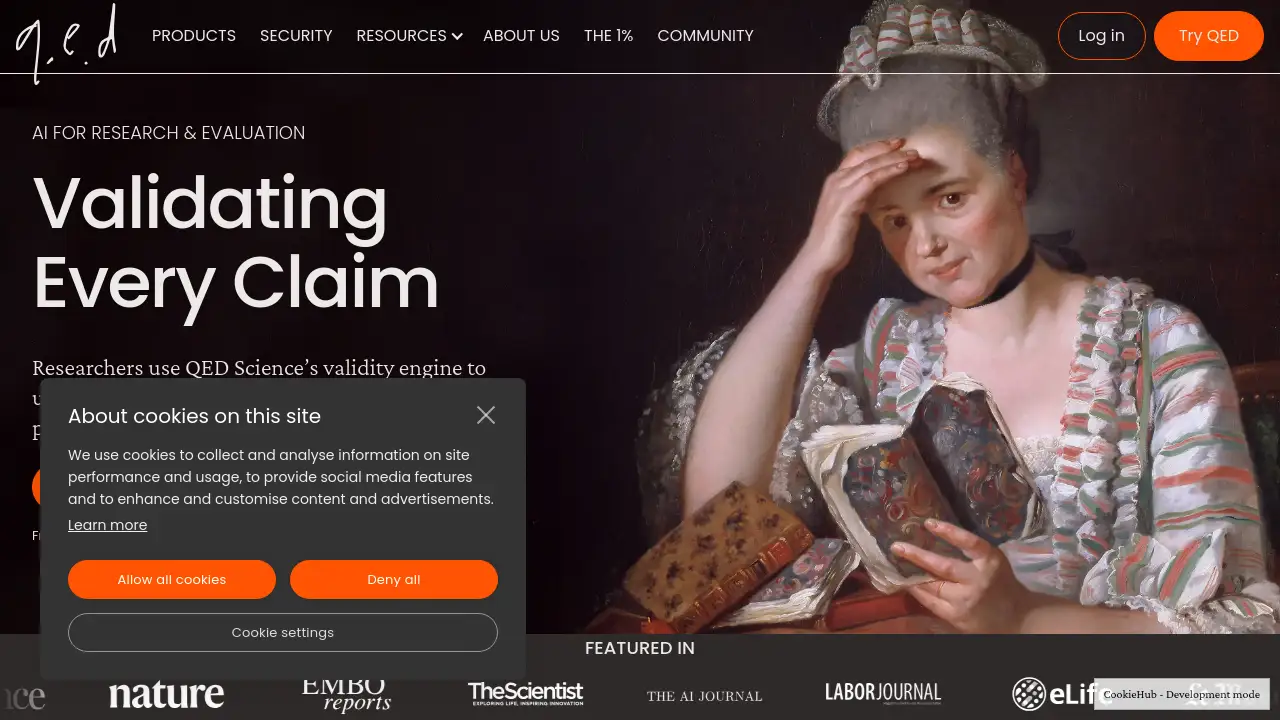
QED Science is a critical thinking AI platform built for research validation and science evaluation. It helps researchers see which scientific claims hold up, where gaps exist, and how to strengthen papers and grant proposals before submission.
What is QED Science?
QED Science is an AI platform for research and evaluation, described by its developer as a critical thinking AI designed to validate scientific claims rather than simply summarize them. Instead of producing fluent but unverified answers, it breaks research into its core claims, scores each claim for validity, and highlights contradictions across the wider body of literature.
The problem it addresses is familiar to anyone working in science: a paper or grant proposal can look polished while still containing logical gaps, unsupported assumptions, or claims that conflict with existing findings. QED Science aims to surface those weaknesses early, when they can still be fixed.
It is positioned as AI for research that serves scientists rather than replaces them. The platform does not train on uploaded manuscripts or grants, and the developer states it is SOC 2 Type 2 compliant, ISO 27001 certified, and GDPR compliant.
QED Science is suitable for academic researchers, editors, and life-science R&D teams. A free account is available for academic researchers, while a Premium tier called the Validity Machine is aimed at pharma and biotech organizations making high-stakes decisions.
Key Features of QED Science
Critical AI Paper Reviews
QED Science splits a manuscript into its core claims, surfaces gaps with tailored fixes, and separates novel contributions from what is already known. It also ranks the work against studies in the same field to help authors judge potential impact.
Critical AI Grant Reviews
The platform reviews proposals for weaknesses in logic, background, feasibility, methodology, and internal consistency. Researchers can address these issues before submitting, which may improve their chances of funding.
AI-Powered Insights Feed
A personalized feed delivers updates on new findings relevant to a researcher's work. It highlights studies that fill knowledge gaps and labs working on the same questions.
The Validity Machine
The Premium validity engine extracts explicit and implicit claims from the full body of research, scores each one, and resolves contradictions between them. It returns a structured answer backed by valid science rather than a summary.
Claim-Level Validity Scoring
Every claim receives a validity score, so users can see precisely where the science holds up and where it does not. This claim-level view is what distinguishes QED Science from general-purpose chatbots.
Privacy and Security by Design
Uploaded manuscripts and grants are not used for model training. Enterprise-grade protections, including SOC 2 Type 2 and ISO 27001 controls, are built in from the start.
Use Cases for QED Science
Strengthening a Paper Before Submission
Authors can run a critical AI paper review to catch logical gaps and unsupported claims while revisions are still cheap. This can reduce reviewer pushback and clarify the paper's novel contribution.
Improving Grant Proposals
Applicants use the AI grant review workflow to test feasibility arguments, methodology, and internal consistency. Fixing these weaknesses before submission is often more effective than rewriting after rejection.
Staying Current With Relevant Literature
The insights feed keeps researchers informed about new findings tied to their specific questions. This supports science evaluation without requiring constant manual searching.
Supporting Pharma and Biotech R&D Decisions
R&D teams use the Validity Machine to build a trusted data layer for critical scientific decisions. It provides structured, claim-scored answers rather than unverified text.
Editorial and Peer Review Support
Editors can use QED Science to check submissions more consistently. A published case study describes how Life Science Editors used the platform to strengthen submissions and client relationships.
How to Use QED Science
- Create an account. Academic researchers can sign up for free access using an institutional email and describe their intended use.
- Upload a paper or grant. Submit a manuscript or proposal for analysis; the content stays private and is not used for training.
- Review the claim breakdown. Examine how the document is divided into core claims, along with validity scores and flagged gaps.
- Apply the tailored fixes. Address the weaknesses identified in logic, background, feasibility, or methodology.
- Track new findings. Use the insights feed to monitor relevant studies and follow up on the Validity Machine for deeper questions.
Target Audience for QED Science
- Academic researchers preparing papers or grant applications
- Principal investigators managing multiple submissions
- Scientific editors and peer review teams
- Pharma and biotech R&D teams
- Life-science consultants and research foundations
- Graduate students and postdocs building publication records
Is QED Science Free?
QED Science offers free access for academic researchers, with no credit card and no commitment required to validate a first paper or grant. Premium access, which includes the Validity Machine, is available through an early access request, and public pricing is not listed in the reference information.
| Plan | Price | Features |
|---|---|---|
| Free (Academic) | $0 | Validate research, strengthen grant proposals, access scientific insights |
| Premium | Request early access | Validity Machine, claim extraction and scoring, contradiction resolution for pharma and biotech R&D |
For current pricing details, check the official QED Science website.
QED Science's Pros and Cons
| Aspect | Pros | Cons |
|---|---|---|
| Approach | Claim-level validity scoring instead of summaries | Validity scoring may need expert interpretation |
| Features | Paper reviews, grant reviews, insights feed, Validity Machine | Premium features require an early access request |
| Privacy | No training on uploaded manuscripts; SOC 2 Type 2 and ISO 27001 | Certification details are self-reported on the site |
| Pricing | Free tier for academic researchers | Public pricing not available |
| Audience | Built for scientists and life-science R&D | Less relevant for non-research users |
Frequently Asked Questions about QED Science
What is QED Science used for?
QED Science is used to validate research claims, review papers and grant proposals, and support science evaluation. It extracts claims, scores their validity, and resolves contradictions across the literature.
Does QED Science train on my uploaded papers?
No. According to the developer, the platform does not train on any manuscripts or grants uploaded by users. It comes pre-trained on input from thousands of scientists worldwide.
Is QED Science free for researchers?
Yes, academic researchers can create a free account to validate research, strengthen grant proposals, and access scientific insights. No credit card or commitment is required.
Who is QED Science designed for?
It is designed for scientists, including academic researchers, editors, and pharma or biotech R&D teams. The platform is positioned as AI for research that supports experts rather than replacing them.
How is QED Science different from general AI chatbots?
General chatbots produce answers that might be true. QED Science focuses on critical thinking AI that scores each claim for validity, avoids summarization and hallucination, and shows where science holds up.
Is my data secure with QED Science?
The developer states the platform is SOC 2 Type 2 compliant, ISO 27001 certified, and GDPR compliant. Data protections are designed to match the rigor expected in scientific work.
QED Science Tags
QED Science, critical thinking AI, AI for research, AI paper review, AI grant review, validity engine, research validation, science evaluation, claim validity scoring, AI for scientists, grant proposal review tool, research paper review AI