Introduction
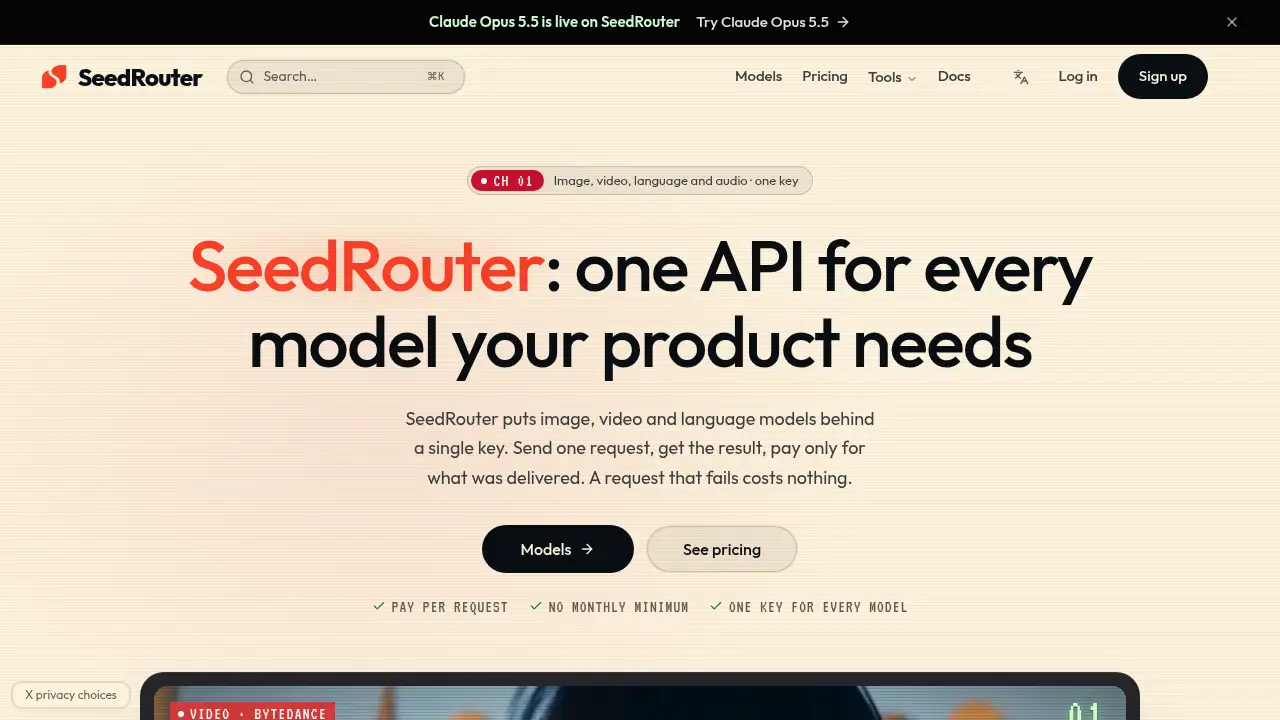
SeedRouter API: one key for every AI model.
What is SeedRouter?
SeedRouter is a unified AI model API platform that puts image, video, language, and audio models behind one API key. This SeedRouter API review looks at how the platform helps teams call different AI models without managing separate vendor accounts, keys, and billing flows. The SeedRouter API uses pay-per-request billing, and failed requests cost nothing. According to the product homepage, SeedRouter is not a bargain aggregator or a model showroom; it is a platform layer that makes model access clear before integration. That matters because product teams often need to test, compare, and switch models as requirements change. SeedRouter is built around one API for AI models, with documented interfaces and visible pricing. The platform lists 41 models from families such as OpenAI, Google, Anthropic, xAI, ByteDance, MiniMax, DeepSeek, and others. For language workflows, the SeedRouter API provides an OpenAI-compatible endpoint, so existing SDKs can work after changing the base URL. For media workflows, it offers task-based jobs for image, video, and audio generation.
Key Features of SeedRouter
One API Key for Multiple Model Types
SeedRouter puts image, video, language, and audio models behind a single unified API key. This reduces key management and lets teams switch model families without rebuilding their stack.
Pay-Per-Request Billing
The SeedRouter API bills on delivery, so a failed request costs nothing. There is no monthly minimum, and users pay per request based on the model price listed on the platform.
OpenAI-Compatible LLM Endpoint
Language models on SeedRouter are served through an OpenAI-compatible endpoint. Existing SDKs and HTTP clients can work by changing the base URL and API key.
Async Jobs with Webhooks
Video and long image jobs return a task id that can be polled or delivered by webhook. This is useful for production workflows that need status updates and CDN output links.
Transparent Model Pricing and Dashboard
The SeedRouter API shows the price before a call and tracks usage in one dashboard. Teams can see cost per request across models and top up their balance in USD.
Model Coverage and Flexibility
The platform lists 41 models across image, video, LLM, and audio categories. Users can move between GPT, Claude, Gemini, and other families while keeping the SeedRouter API request shape consistent.
Workflow-Oriented Solutions
SeedRouter offers solution pages for product visuals, comic production, video production, ecommerce automation, invoice extraction, and knowledge assistants. These pages describe inputs, quality checks, and implementation options for real projects.
Use Cases for SeedRouter
AI Video Generation Projects
Teams can use the video generation API to turn prompts or a first frame into short clips with optional native audio. This suits marketing, film and animation, and game teams that need repeatable video tasks through the SeedRouter API.
Product and Advertising Visuals
The image generation API supports text-to-image and editing with reference images. Ecommerce and marketing teams can create reviewable campaign variants and product shots using the SeedRouter API.
Chat, Reasoning, and Agent Workflows
Developers can use the LLM API for chat, reasoning, code generation, and agent workflows with tool calls and structured output. The OpenAI-compatible endpoint makes migration simpler for existing applications.
Audio and Music Creation
The audio API can generate songs, voices, and dialogue from prompts, or separate stems from an existing track. SeedRouter returns tracks with duration, lyrics, and cover art when the model provides them.
Document and Knowledge Automation
SeedRouter supports invoice extraction and internal knowledge assistant workflows. Teams can extract invoice fields, validate totals, or build answers around retrieved passages and traceable sources.
How to Use SeedRouter
- Sign up for an account. Create a SeedRouter account and review the available models before loading a balance.
- Create an API key. One key works for every model on SeedRouter, and keys can be managed or revoked from the dashboard.
- Choose an integration path. Use the OpenAI SDK for language models, or the SeedRouter task API for image, video, and audio jobs.
- Change the base URL and key. Existing OpenAI SDK integrations can point to the SeedRouter API after updating the endpoint and credentials.
- Monitor usage and cost. Use the dashboard to track requests, prices, and balance, and use task ids or webhooks for async media jobs.
Target Audience for SeedRouter
- Developers building products that need image, video, LLM, or audio generation
- AI product teams and startups that want to test and switch models
- Marketing and creative teams producing campaign visuals or video
- Ecommerce and retail teams creating product content and images
- Film, animation, and game studios with shot-based production workflows
- Operations teams working on invoice extraction or internal knowledge assistants
Is SeedRouter Free?
SeedRouter is not presented as a free API service. It uses pay-per-request billing, and successful requests are charged against the account balance. Failed requests cost nothing, and there is no monthly minimum. The table below summarizes the access model based on the reference information.
| Plan | Price | Features |
|---|---|---|
| Pay-as-you-go | Usage-based; price varies by model | One API key for every model, pay per delivered request, failed requests $0, no monthly minimum, dashboard usage tracking, top up in USD |
For live SeedRouter API pricing, users should check the official pricing page and each model page. The homepage lists starting prices for models, such as video models priced per second and other models priced per request.
SeedRouter's Pros and Cons
| Aspect | Pros | Cons |
|---|---|---|
| Pricing | Pay only for delivered requests; failed requests cost nothing; no monthly minimum | Costs can vary by model and usage, so teams need to monitor spend |
| Model Access | One API key for image, video, language, and audio models; 41 models listed | Model availability and features depend on each provider |
| Integration | OpenAI-compatible endpoint for LLMs; task API for media jobs | Media workflows still require learning task polling or webhooks |
| Management | Single dashboard for usage and cost per request | Budget control depends on active usage monitoring |
Frequently Asked Questions about SeedRouter
What is SeedRouter API?
SeedRouter API is a unified API that lets developers call image, video, language, and audio models with one key. It uses pay-per-request billing and lists model prices before a request is made.
Do failed requests cost anything on SeedRouter?
No. SeedRouter bills on delivery, so a failed request costs nothing. Users can retry or switch models with the same key.
Does SeedRouter work with existing OpenAI SDKs?
Yes, for language models. SeedRouter provides an OpenAI-compatible endpoint, so existing SDKs can work after changing the base URL and API key. Image, video, and audio jobs use the SeedRouter task API.
What models are available on SeedRouter?
The homepage lists 41 models across image, video, language, and audio categories. Model families include OpenAI, Google, Anthropic, xAI, ByteDance, MiniMax, DeepSeek, and others.
How does SeedRouter pricing work?
SeedRouter uses pay-per-request pricing with no monthly minimum. Each model page lists its live starting price, and the dashboard tracks usage and cost per request. Failed requests are not charged.
Is there a monthly subscription for SeedRouter?
The reference content describes pay-per-use pricing and no subscription requirement. With the SeedRouter API, users top up a balance in USD and pay per delivered request.
SeedRouter Tags
SeedRouter API, SeedRouter review, AI model API, one API for AI models, image generation API, video generation API, LLM API, audio API, pay-per-request API, unified API key, OpenAI-compatible endpoint, AI model platform