Introduction
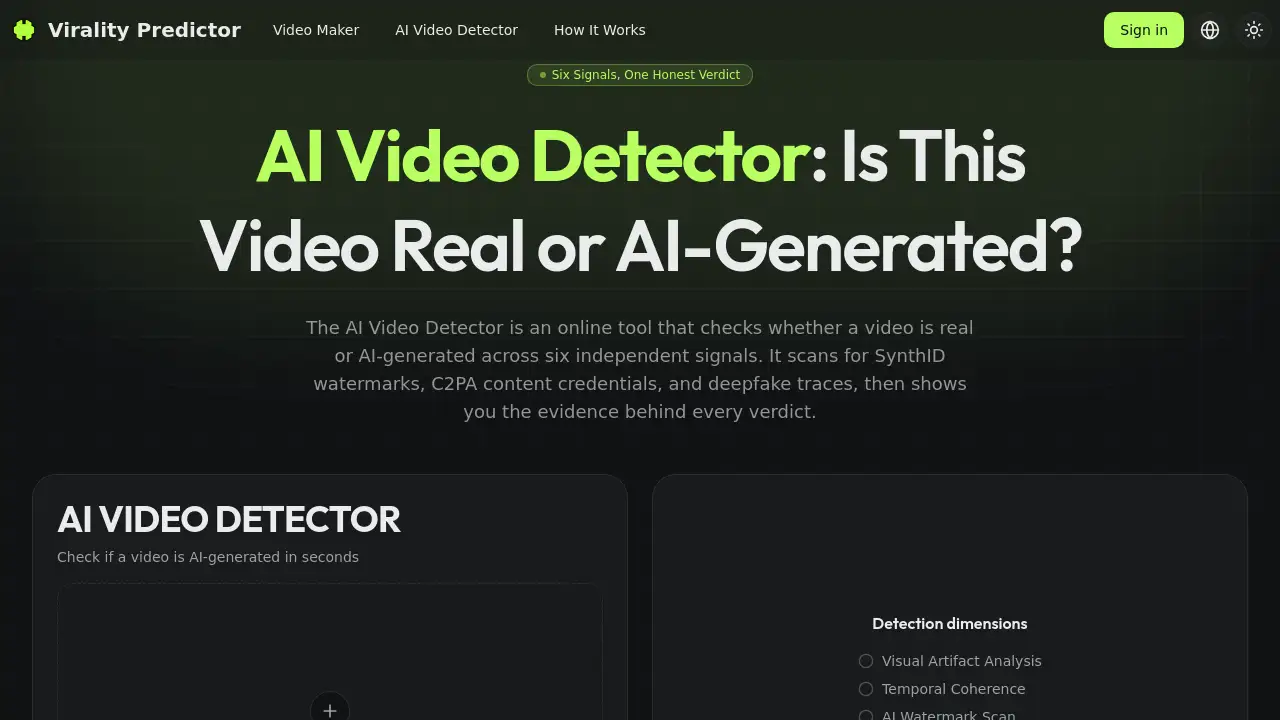
The AI Video Detector is an online tool that checks whether a video is real or AI-generated using six independent detection signals. This AI video detector scans for SynthID watermarks, C2PA credentials, and deepfake traces, delivering a clear verdict with supporting evidence.
What is AI Video Detector?
The AI Video Detector is a specialized online verification tool designed to determine whether a video was created by artificial intelligence or captured with a real camera. As AI-generated video content becomes increasingly convincing, traditional visual tells like inconsistent lighting or unnatural finger counts are disappearing. This tool solves the growing problem of identifying synthetic media by combining six different detection methods into a single analysis pipeline. Instead of relying on gut feeling or manual inspection, users get structured evidence that explains exactly why a video is flagged as AI-generated, likely AI, likely real, or real. The tool is suitable for journalists, content moderators, researchers, and social media professionals who need reliable video authenticity verification under deadline pressure. It matters because AI-generated misinformation spreads quickly, and having a trustworthy video authenticity checker helps maintain content integrity across newsrooms, platforms, and investigations.
Key Features of AI Video Detector
Six-Signal Scan
The tool runs six independent detection dimensions in parallel: visual artifact analysis, temporal coherence, AI watermark scan, C2PA content provenance, deepfake facial analysis, and file forensics. Each signal contributes to the final verdict with a score or status.
Four-Tier Verdict System
Results are grouped into four confidence tiers: AI-Generated, Likely AI, Likely Real, and Real. The tier reflects how many signals fired and how strongly, giving users a clear confidence level instead of a simple yes or no.
Evidence Panel
After analysis, users see a detailed evidence panel showing exactly which signals triggered and their individual scores. This transparency lets users understand why the verdict was reached and cross-reference the findings.
Browser-Based Frame Extraction
Key moments are extracted from the video directly on the user's device before anything is sent to servers. This preserves privacy and reduces upload time while ensuring representative frames are analyzed.
Definitive Signal Detection
The tool includes dedicated scans for SynthID watermarks embedded by Google Veo and C2PA content credentials used by OpenAI Sora. A positive hit on either of these signals provides near-definitive proof of AI origin.
Use Cases for AI Video Detector
Journalism Verification
Newsrooms can verify viral clips before publication by running them through the deepfake detection tool. The evidence panel provides verifiable citations that can be referenced in fact-checking notes and editorial decisions.
Social Media Moderation
Content moderation teams can use this video authenticity checker to flag suspicious uploads across platforms. The six-signal approach reduces false accusations of real footage while catching sophisticated AI-generated content.
Research and Misinformation Studies
Academics and researchers studying AI-generated media can leverage the tool's multi-signal analysis for dataset verification and case studies. The temporal coherence analysis is particularly useful for research on generative model fingerprints.
Legal and Compliance Checks
Organizations subject to AI transparency regulations like the EU AI Act can use the AI video detector to audit content provenance and watermark compliance before publication or distribution.
How to Use AI Video Detector
-
Upload Your Video: Drag or select a video file up to 30 seconds and 150 MB. Supported formats include MP4, WebM, and MOV. Format and duration checks happen instantly in your browser.
-
Automatic Frame Extraction: Key moments are extracted from the video directly on your device. These representative frames, along with container metadata and motion statistics, are prepared for analysis.
-
Six-Signal Analysis Runs: The detector analyzes the extracted frames in parallel for visual artifacts, invisible watermarks, C2PA credentials, deepfake traces, temporal motion coherence, and encoder fingerprints.
-
Review the Evidence Panel: Results from all six dimensions are aggregated into a single verdict with supporting evidence. The panel shows exactly which signals fired and their confidence scores.
-
Cross-Verify if Needed: For high-stakes decisions, pair the result with reverse image search and source checks as recommended by published research.
Target Audience for AI Video Detector
- Journalists and fact-checkers
- Social media moderators and content reviewers
- Researchers studying synthetic media
- Media and publishing professionals
- Legal and compliance teams
- Newsroom editors and producers
Is AI Video Detector Free?
Based on available information, the AI Video Detector appears to offer free access for basic usage. Users can upload videos and run the six-signal scan. For detailed pricing plans, users should visit the official Virality Predictor pricing page.
| Plan | Price | Features |
|---|---|---|
| Free | $0 | Six-signal scan, evidence panel, verdict tiers |
| Pro | Check official site | Higher limits, batch processing, API access |
AI Video Detector's Pros and Cons
| Aspect | Pros | Cons |
|---|---|---|
| Detection Accuracy | Six signals combined reduce false positives | No single method is perfect; accuracy varies with new generators |
| Transparency | Shows evidence behind each verdict | Requires user interpretation of signal scores |
| Privacy | Frame extraction happens on device | Video file still sent to servers for analysis |
| Ease of Use | Simple upload and clear verdict output | Limited to 30 seconds and 150 MB per video |
| Definitive Signals | Detects SynthID and C2PA credentials directly | Not all generators watermark their output |
| Research Support | Built on published academic methods | Detection is an ongoing arms race with generator updates |
Frequently Asked Questions about AI Video Detector
Can the AI video detector detect all types of AI-generated videos?
No single detection method works for every AI video generator. The AI video detector combines six independent signals to achieve higher reliability, but published research confirms detection is an ongoing arms race. The tool is most effective when used as one data point alongside source checks and reverse image search.
How accurate is this AI video detector?
The developers do not advertise a single accuracy percentage because accuracy shifts with every new generator release, re-encode, and compression pass. The tool relies on multi-signal analysis, which research shows is more robust than any single test, but users should treat any detector's results as probabilistic rather than absolute.
Does the AI video detector work on short clips and social media videos?
Yes, the tool accepts videos up to 30 seconds and 150 MB in MP4, WebM, or MOV formats. Social media clips that fall within these limits can be analyzed. Note that heavy compression from platforms may erode some signal traces, but the six-signal approach still provides useful information.
What are the six signals that the AI video detector checks?
The detector scans for visual artifacts (pixel statistics and textures), temporal coherence (motion smoothness and frame-to-frame variance), AI watermarks (SynthID and other invisible watermarks), content provenance (C2PA credentials), facial authenticity (deepfake detection on visible faces), and file forensics (container metadata and encoder signatures).
Can the AI video detector tell if a video was made by Sora, Veo, or other specific tools?
Yes, the tool includes dedicated scans for SynthID watermarks used by Google Veo and C2PA content credentials attached by OpenAI Sora. A positive hit on these signals directly identifies the generator. However, not all AI tools watermark or credential their output, so absence of these signals does not prove the video is real.
What does it mean when a signal shows UNAVAILABLE?
UNAVAILABLE means that a particular signal could not be analyzed for that video. For example, no visible face means the deepfake detection pass cannot run. UNAVAILABLE rows are excluded from the final verdict rather than counted against the video, and the remaining signals determine the outcome.
AI Video Detector Tags
AI video detector, deepfake detection tool, video authenticity checker, AI-generated video verification, SynthID watermark scanner, C2PA credentials checker, temporal coherence analysis, visual artifact detection, file forensics tool, content provenance verification, AI media detector, synthetic video analyzer