Introduction
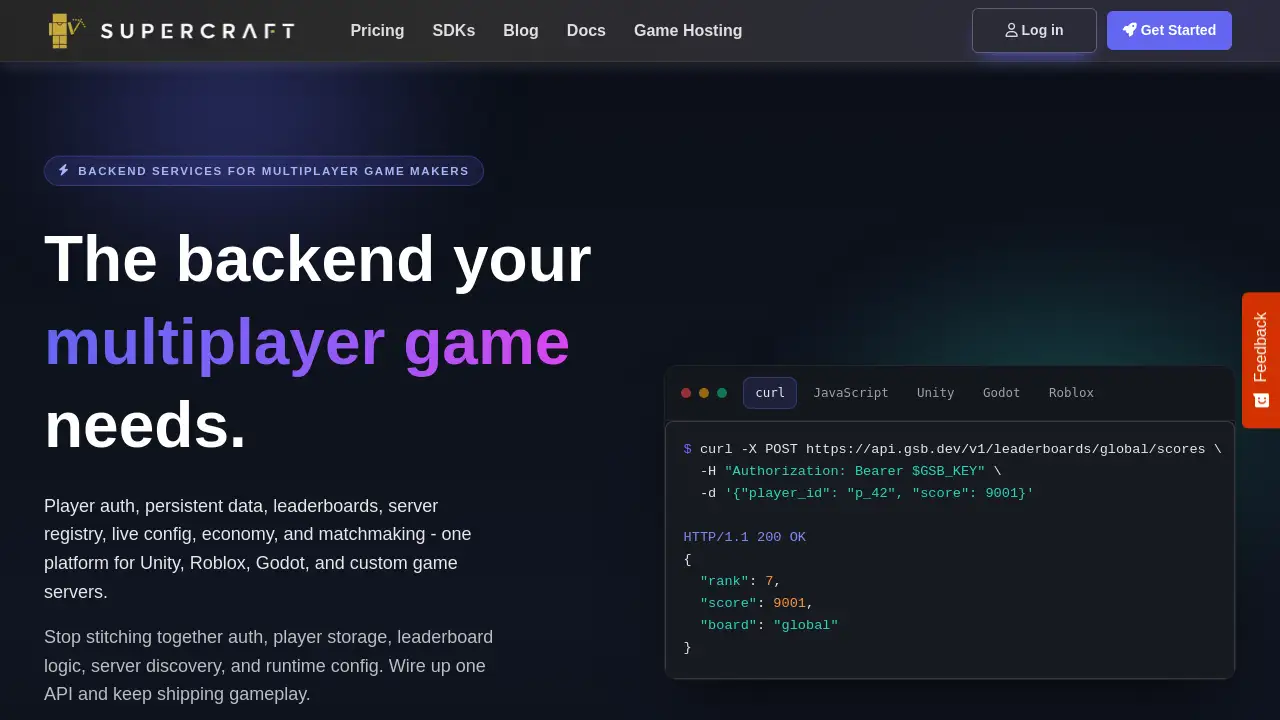
Game Server Backend is a unified platform providing essential online services for multiplayer game development.
What is Game Server Backend?
Game Server Backend (GSB) is a specialized backend-as-a-service platform designed explicitly for multiplayer game developers. It solves the common problem of having to stitch together disparate services like authentication, player data storage, leaderboards, and dedicated server management. By offering these critical runtime services on a single, integrated platform, GSB allows developers to focus on creating gameplay rather than building custom backend infrastructure. This product is best suited for developers working on dedicated-server games, multiplayer co-op titles, and region-based server fleets using engines like Unity, Roblox, or Godot. For indie and mid-size studios seeking development velocity without the overhead of a platform team, GSB acts as a powerful PlayFab and Nakama alternative, streamlining the path from prototype to live operations.
Key Features of Game Server Backend
Player Authentication
GSB supports multiple login methods including email/password, guest sessions, and OAuth through Google or Discord, enabling secure player onboarding without building a custom auth system.
Persistent Player Data
The platform provides secure, server-authoritative JSON storage for player profiles, progression, inventories, and shared game state, ensuring data integrity.
Leaderboards
Developers can implement ranked and seasonal leaderboards with configurable rules, anti-cheat measures, and support for recurring resets or timed events.
Economy System
GSB includes a virtual economy with currencies and items, featuring atomic transactions for rewards and purchases, all audited server-side.
Dedicated Server Registry
This feature allows game servers to register, heartbeat, and be discovered, powering server browsers and enabling clean management of active sessions.
Live Config Delivery
Teams can upload and activate versioned configuration bundles for different environments, allowing live tuning of game balance, loot tables, and events without a client patch.
Matchmaking
GSB provides a matchmaking service with ticket systems, rulesets, and region-aware logic to efficiently pair players, connecting to custom or reserved server pools.
Social Features
Built-in social graph features like friends lists, pending requests, and blocks let players connect without relying on external identity providers.
Use Cases for Game Server Backend
Building Player Progression Systems
Developers can use GSB's persistent player data and economy features to create robust profiles, unlocks, and reward loops that keep players engaged.
Implementing Seasonal Gameplay Loops
The combination of seasonal leaderboards, live config delivery, and economy tools is ideal for creating and managing limited-time events and rank resets.
Powering Server Browsers
For games with player-hosted or dedicated servers, the server registry and discovery APIs enable the creation of functional, region-aware server browsers.
Managing Live Game Tuning
The live config service allows development teams to remotely adjust game parameters, balance, and content, facilitating rapid iteration based on player feedback.
How to Use Game Server Backend
- Sign Up: Create a free account on the GSB website. The Dev plan requires no credit card and offers 2,000 Monthly Active Users (MAU) and 2 million API calls.
- Create a Project: Set up a new project within the dashboard. This automatically creates separate environments for development, staging, and production.
- Integrate the SDK: Download and integrate the appropriate SDK (available for Unity, Roblox, Godot, or use the generic HTTP/JS client) into your game client and dedicated server code.
- Configure Services: Use the dashboard or API to set up the specific services you need, such as defining leaderboard rules, economy items, or matchmaking pools.
- Deploy and Monitor: Launch your game. The GSB dashboard is built to observe live game operations, letting you monitor player activity, server heartbeats, and config deployments.
Target Audience for Game Server Backend
- Indie and mid-size game development studios building multiplayer titles.
- Developers creating games with dedicated servers on Unity, Roblox, Godot, or custom engines.
- Teams focused on live service games who need robust backend tools for live ops but lack a dedicated platform team.
- Game developers looking for a streamlined alternative to larger platforms like PlayFab or Nakama.
Is Game Server Backend Free?
GSB offers a generous free tier to get started, with paid plans for launched games. The pricing scales based on Monthly Active Users (MAU).
| Plan | Price | Key Features & Limits |
|---|---|---|
| Dev | $0 / month | 2,000 MAU, 2M API calls/month. Includes all core services. No credit card required. |
| Launch | $10 / month | 10,000 MAU included. Pay-as-you-go pricing for additional MAU and API calls beyond included limits. |
Game Server Backend's Pros and Cons
| Aspect | Pros | Cons |
|---|---|---|
| Feature Set | Integrated services cover specific multiplayer game needs (matchmaking, server registry). | Less suited for purely single-player games or projects needing only basic auth. |
| Pricing | Very accessible free tier; transparent, usage-based pricing for launched games. | Can become costly at very high scale compared to self-hosted solutions. |
| Ease of Use | Unified API and environment-aware design simplify development and deployment. | Requires integration work; not a zero-code solution. |
| Target Fit | Excellent for its target audience of indie/mid-size multiplayer game developers. | Not designed for highly specialized, custom AAA-scale backend requirements from day one. |
Frequently Asked Questions about Game Server Backend
What engines does Game Server Backend support?
GSB provides official SDKs for Unity, Roblox, and Godot. It also offers a generic HTTP API and JavaScript client, making it compatible with any game engine or custom server that can make web requests.
How does GSB handle dedicated game servers?
GSB provides a dedicated server registry API. Your game servers can register themselves, send heartbeats, and update their status. Game clients can then query this registry to discover available servers, enabling features like server browsers. This is a key differentiator from generic backend services.
Is there a free plan available?
Yes, GSB offers a permanent free "Dev" plan. It includes 2,000 Monthly Active Users and 2 million API calls per month, with access to all core features. No credit card is required to start.
Can I use GSB for a single-player game?
While technically possible, GSB is specifically optimized for the runtime needs of multiplayer games. Its core value lies in services like matchmaking, server registry, and live ops. For a purely single-player project, a simpler backend or local storage might be more appropriate.
How does GSB compare to PlayFab or Nakama?
GSB positions itself as an alternative to these platforms, focusing specifically on the integrated needs of multiplayer games. It aims to provide a more streamlined set of services (like built-in dedicated server support) with a simpler pricing model and a dashboard designed for observing live game operations.
Does GSB support player data migration?
The platform provides APIs for reading and writing all player data. While it offers tools for data management, large-scale migration from another system would typically require a custom script using these APIs. It's recommended to consult the documentation for specific migration strategies.
Game Server Backend Tags
game server backend, multiplayer game backend, backend for games, game server hosting, matchmaking service, dedicated server registry, live ops platform, Unity backend, Roblox backend, Godot backend, PlayFab alternative, Nakama alternative, indie game development, live game configuration