Introduction
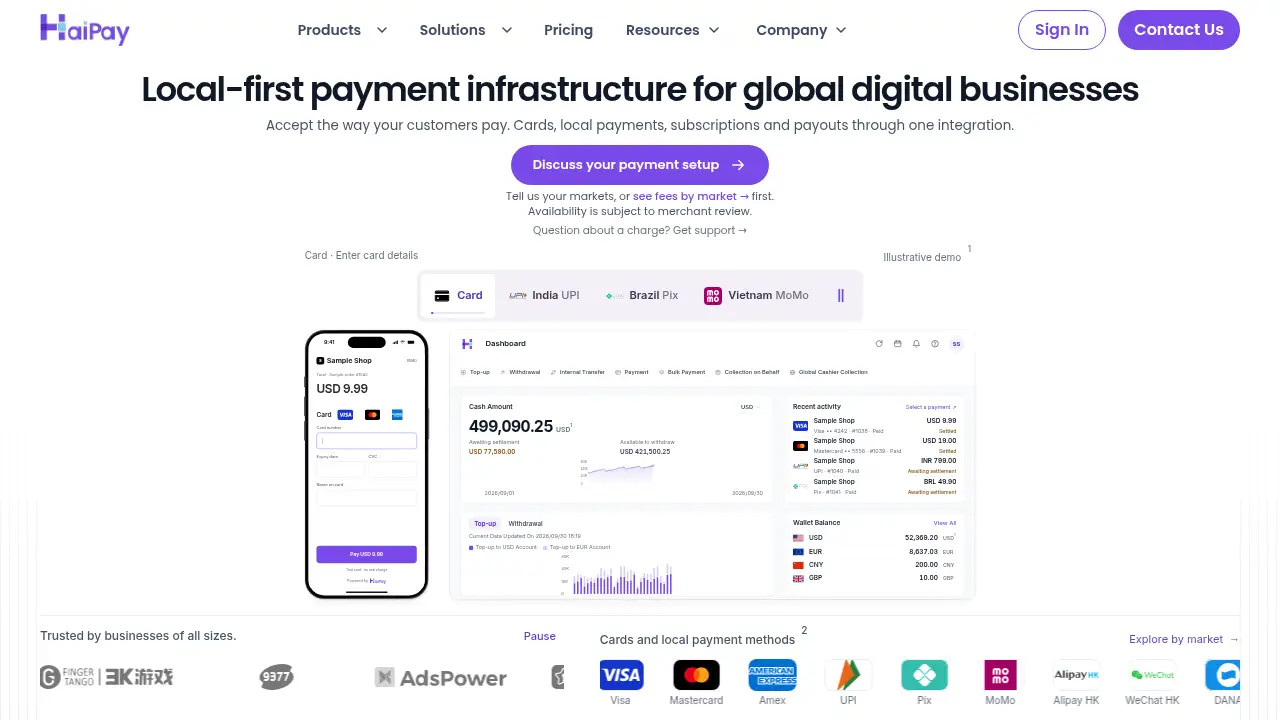
HaiPay is a global payment platform for digital businesses that sell across borders. It brings card processing, local payment methods, recurring billing, and payouts together in one integration, so teams can accept and send money in many markets without juggling separate providers.
What is HaiPay?
HaiPay is a payment infrastructure provider built for global digital businesses. Rather than adding a new processor for every country, merchants connect once and gain access to cards, bank transfers, e-wallets, and other local payment methods across Asia-Pacific, Europe, North America, the Middle East, and Latin America.
The platform solves a familiar problem: customers abandon checkout when they cannot pay the way they normally do. By offering familiar local payment methods and a localized checkout, a global payment platform like HaiPay can help businesses convert more international buyers. It also covers the operational side — subscriptions, settlement, currency balances, and outbound payouts — so finance and engineering teams spend less time on payment plumbing.
HaiPay positions itself as local-first infrastructure for companies that treat payments as a core system rather than an afterthought. Availability is subject to merchant review, and final fees, settlement currencies, and FX terms are confirmed in a merchant quote.
Key Features of HaiPay
One Integration for Cards and Local Payments
Connect once to accept Visa, Mastercard, Amex, and regional methods through a single API or hosted checkout. This cuts engineering effort for teams building a global payment platform.
150+ Local Payment Methods
Reach customers through the e-wallets and bank rails they already use, including Alipay, WeChat Pay, UPI, Pix, MoMo, GCash, DANA, PromptPay, iDEAL, SEPA, and mada. Local payment methods coverage spans APAC, EU/NA, MENA, and LATAM.
Subscription and Recurring Billing
Manage plans, renewals, and recurring charges alongside one-off payments. Subscription billing helps digital businesses keep revenue predictable when selling in multiple currencies.
Mass Payouts and Card Issuing
Send funds to contractors, suppliers, influencers, and ad budgets through bank transfers, local cards, real-time rails, and e-wallets. Payouts draw from the same balance used for collections.
Multi-Currency Wallet
Hold and manage balances in USD, EUR, JPY, SGD, INR, HKD, MYR, BRL, and other currencies. A multi-currency wallet simplifies reconciliation when a business collects in one region and pays out in another.
Localized Checkout Experience
Display prices, currencies, and payment options in formats customers recognize. Multi-language support and real-time FX conversion help reduce friction at the point of payment.
Developer Resources and Coverage Docs
Access API documentation, market coverage details, and implementation guides. Clear documentation matters when a payment infrastructure spans dozens of markets and payment types.
Use Cases for HaiPay
Global SaaS and Digital Subscriptions
Software companies can bill customers in local currencies and manage recurring revenue through one global payment platform instead of several regional gateways.
AI and Digital Content Businesses
AI tools, courses, and digital goods often sell in many countries at low ticket sizes. Local payment methods and faster settlement help keep small transactions viable.
Marketplaces and Creator Platforms
Platforms can collect from buyers and pay sellers or creators through mass payouts, using a multi-currency wallet to track balances across regions.
Cross-Border Contractor and Supplier Payments
Finance teams can pay international contractors, agencies, and advertising platforms without opening a bank account in every market.
Regional Expansion in APAC, LATAM, and MENA
Businesses entering new markets can switch on local payment methods first and test demand before setting up local entities.
How to Use HaiPay
- Contact the HaiPay team and describe your markets, business model, and expected transaction volumes.
- Complete merchant review and receive a quote covering fees, settlement currencies, and FX terms.
- Integrate the API or hosted checkout for collections, and configure subscription plans if required.
- Set up payout flows for contractors, suppliers, or sellers from the multi-currency wallet.
- Monitor transactions and settlements in the dashboard, then add new markets as volume grows.
Target Audience for HaiPay
- Global SaaS and subscription businesses
- AI companies and digital product sellers
- Marketplaces and platforms paying out sellers or creators
- E-commerce brands expanding into APAC, LATAM, or MENA
- Finance teams handling cross-border contractor payments
- Developers building payment flows for multi-market products
Is HaiPay Free?
HaiPay does not publish a standard monthly price list. Fees are quote-based and depend on markets, payment methods, and volume, with a pricing page available on the official website for reference. Access is granted after a merchant review, so not every business will be approved automatically.
| Plan | Price | Features |
|---|---|---|
| Custom quote | Varies by market and volume | Card and local payment acceptance, subscriptions, payouts, multi-currency wallet, market-specific settlement and FX terms |
| Merchant review | Required before onboarding | Availability and final terms confirmed in the quote |
HaiPay's Pros and Cons
| Aspect | Pros | Cons |
|---|---|---|
| Coverage | 150+ local payment methods across four major regions | Depth varies by market, so some methods may not be available everywhere |
| Integration | One connection for collections and payouts | Requires developer resources for a full API build |
| Payouts | Bank transfers, cards, real-time rails, and e-wallets in one place | Payout speed depends on the destination market |
| Pricing | Quote-based pricing can fit different volume levels | No public rate card, so costs need a direct conversation |
| Onboarding | Merchant review clarifies what is supported | Approval is not guaranteed and may take time |
| Transparency | Settlement currencies and FX terms stated in the quote | Fees differ by market, which complicates comparisons |
Frequently Asked Questions about HaiPay
What is HaiPay used for?
HaiPay is used to accept card and local payments, manage subscriptions, and send payouts across markets. A business can run collections and disbursements through one global payment platform rather than separate regional contracts.
Which payment methods does HaiPay support?
The platform lists more than 150 local payment methods, including Visa, Mastercard, Amex, UPI, Pix, MoMo, GCash, DANA, Alipay HK, WeChat HK, iDEAL, SEPA, and mada. Exact availability depends on the merchant's markets and review outcome.
Does HaiPay support subscriptions and recurring billing?
Yes. Subscription management is part of the core product, so businesses can run recurring plans next to one-time payments. This suits SaaS, memberships, and AI products with monthly billing.
How much does HaiPay cost?
Pricing is provided as a custom quote based on markets, payment methods, and volume. There is no published standard rate card, so interested businesses should check the pricing page or speak with the team for an estimate.
Can HaiPay send payouts to international contractors?
Yes. Mass payouts support bank transfers, local cards, real-time rails, and e-wallets, which covers common destinations such as contractors in the United States, suppliers in Spain, and influencers in Japan.
Is HaiPay available in every country?
Coverage is broad across APAC, Europe, North America, MENA, and LATAM, but it is not universal. Availability is subject to merchant review, and final market support is confirmed before onboarding.
HaiPay Tags
global payment platform, cross-border payments, local payment methods, payment infrastructure, multi-currency wallet, mass payouts, subscription billing, one integration payments, global payout platform, digital business payments, recurring billing software, local payment gateway