Introduction
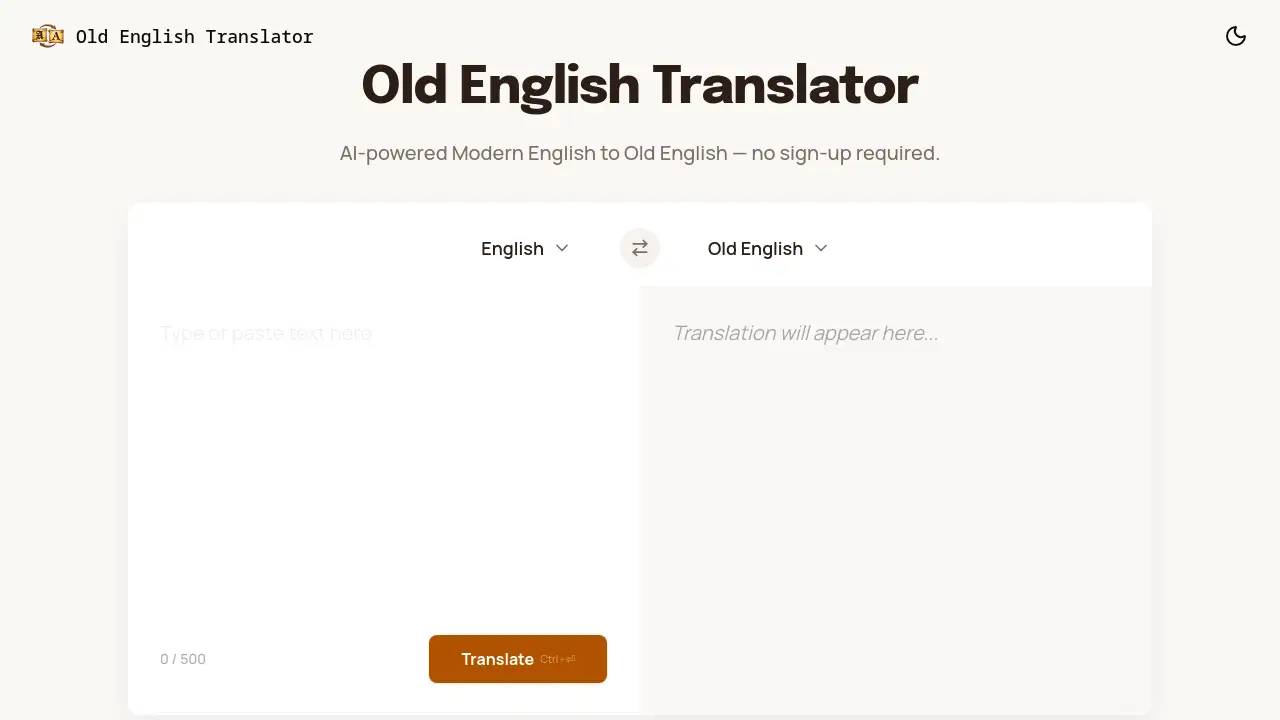
An AI-powered tool for translating between modern English and authentic Old English.
What is Old English Translator?
The Old English Translator is a free, web-based tool designed to bridge the linguistic gap between the modern world and the Anglo-Saxon era. It allows users to instantly convert contemporary English text into Old English, the Germanic language spoken in England from approximately 450 to 1150 AD. This solves a significant challenge for students, writers, and researchers who need access to authentic Old English phrasing without years of specialized study. The tool also functions bidirectionally, enabling the translation of Old English texts, like passages from Beowulf, back into modern English for comprehension. By leveraging AI for contextual understanding, it provides more than a simple word-for-word swap, aiming for historically grounded and natural-sounding results that are crucial for accurate creative writing and academic work.
Key Features of Old English Translator
Anglo-Saxon Specific Design
This translator is built specifically for Old English, focusing on the vocabulary, grammar, and syntax of the Anglo-Saxon period to ensure translations are contextually appropriate and historically accurate.
AI-Powered Contextual Translation
The underlying artificial intelligence analyzes full sentence structure and meaning, rather than translating individual words in isolation, to produce more authentic and natural Old English phrasing.
Bidirectional Functionality
Users can seamlessly switch the translation direction, converting modern English to Old English for creation or translating Old English to modern English for decoding and study purposes.
No Sign-Up Required
The tool is completely accessible directly in the web browser without requiring any account creation, login, or subscription, allowing for immediate and hassle-free use.
Future Image & File Support
An upcoming feature will allow users to upload images of manuscripts or text files for direct translation, eliminating the need for manual transcription of Old English content.
Part of a Broader Collection
This translator is presented among other planned AI-powered language tools, such as for Shakespearean English, Latin, and Old Norse, following a similar model of free, accurate access.
Use Cases for Old English Translator
Academic Research and Study
Students and scholars can use the tool to translate modern research notes into Old English for comparative analysis or to decipher original Anglo-Saxon manuscripts and historical documents for their coursework.
Creative Writing and World-Building
Authors of historical fiction or fantasy can craft authentic dialogue, inscriptions, and names for characters set in Viking-age or Anglo-Saxon Britain, adding depth and immersion to their narratives.
Historical and Genealogical Exploration
Historians and genealogists can translate modern commentary or explore the Old English origins of surnames and place names to gain deeper insights into family heritage and regional history.
Content Creation for Media
Game developers, filmmakers, and tabletop RPG creators can generate accurate Old English text for in-game lore, screenplay dialogue, or world-building elements to enhance historical authenticity.
Personal Language Learning
Language enthusiasts and hobbyists can experiment with translating modern phrases to see their Anglo-Saxon roots, facilitating a hands-on understanding of the evolution of the English language.
How to Use Old English Translator
Using the Old English Translator is a straightforward process that requires no technical expertise.
- Enter Your Text: Navigate to the Old English Translator website. In the input box, type or paste the modern English text you wish to translate. This can be a single sentence, a paragraph, or a longer phrase.
- Initiate Translation: Ensure the translation direction is set to "Modern English to Old English." Click the "Translate" button. The AI will process your text almost instantly.
- Review and Use Output: The translated Old English text will appear in the output box. You can copy this result for use in your project, document, or study.
- Switch Direction (Optional): If you have an Old English passage you need to understand, use the switch function to change the direction to "Old English to Modern English," paste the text, and click "Translate" again.
Target Audience for Old English Translator
- Students & Academics in linguistics, literature, or history
- Writers & Authors of historical fiction, fantasy, or epic poetry
- Historians & Researchers focusing on medieval or Anglo-Saxon studies
- Genealogists & Heritage Seekers exploring family roots
- Game Developers & Film Creators building historically-inspired worlds
- Language Enthusiasts & Hobbyists interested in etymology and ancient languages
Is Old English Translator Free?
Based on the available reference information, the Old English Translator is currently presented as a free tool. The homepage explicitly states "no sign-up required" and describes it as part of a "free and easy to use" collection. There is no mention of paid plans, tiers, or subscriptions in the provided content.
| Plan | Price | Key Features |
|---|---|---|
| Free Access | $0 | Instant AI translation, bidirectional functionality, no account required, use directly in browser. |
For the most current information on any potential future premium features, users should refer to the official Old English Translator website.
Old English Translator's Pros and Cons
| Aspect | Pros | Cons |
|---|---|---|
| Accessibility | Completely free with no sign-up process; instant use in any web browser. | Requires an internet connection to function. |
| Functionality | Specialized for authentic Old English; offers valuable bidirectional translation. | Accuracy may vary with complex or ambiguous modern phrasing. |
| Ease of Use | Very simple, three-step interface suitable for anyone. | Lacks advanced customization options for dialect or period variations within Old English. |
| Features | AI provides contextual translations better than simple word substitution. | Promised features like image translation are listed as "coming soon" and not yet available. |
Frequently Asked Questions about Old English Translator
What time period of Old English does this translator use?
The Old English Translator is designed for the language as spoken from roughly 450 to 1150 AD, often referred to as the Anglo-Saxon period. It aims for a general, authentic representation of the language from this era.
How accurate is the AI translation?
The AI translation is designed to understand context and produce natural phrasing, making it more accurate than basic dictionary look-ups for full sentences. However, for critical academic or publication purposes, results should be verified by consulting primary sources or scholarly references.
Can I translate Old English back to modern English?
Yes. A key feature of this Old English Translator is its bidirectional functionality. You can easily switch the translation direction to decode Old English passages from manuscripts, poetry, or historical documents into modern English.
Do I need to create an account to use it?
No. The tool emphasizes that no sign-up, login, or account creation is required. You can access the translator and use its core features immediately in your web browser.
What file formats can I translate?
Currently, translation works with text entered or pasted directly into the input box. A feature to translate text from uploaded images or files is mentioned as "coming soon" but is not currently active.
Is there a limit on how much text I can translate?
The reference information does not specify any character or word limits for the free version. Users can test the tool with both short phrases and longer paragraphs to assess its handling of different text lengths.
Old English Translator Tags
Old English Translator, Anglo-Saxon translator, modern English to Old English, Old English to modern English, free AI translator, Beowulf translator, historical language tool, Old English translation, Anglo-Saxon language, language learning tool, academic research tool, creative writing aid, historical fiction, genealogy research, Old English phrases