Introduction
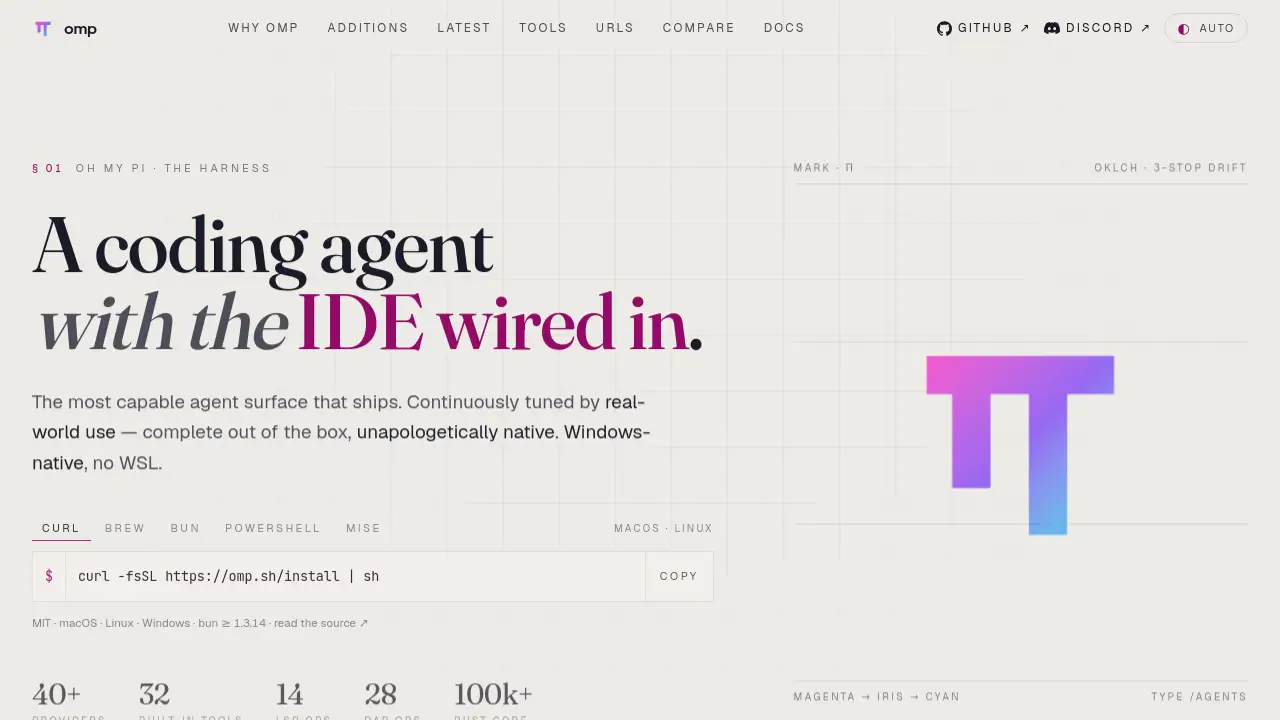
Oh My Pi (omp) is a powerful coding agent designed for the terminal, offering an advanced harness for developers. This oh my pi article explores its features, including subagents, a plan mode, and a native Rust engine, making it a versatile coding agent for modern workflows.
What is oh my pi?
Oh My Pi is a terminal-based coding agent built with a native Rust engine. It functions as a harness that integrates IDE-like capabilities directly into the command line. The tool solves the problem of context-switching between a terminal and a separate IDE for complex coding tasks, such as debugging, refactoring, and code review. It is suitable for developers who prefer a terminal-centric workflow, including systems programmers, Go developers, Python engineers, and anyone needing a high-performance, extensible coding agent. This project, built upon the original Pi, matters because it offers a unified, powerful interface for code interaction without sacrificing speed or platform compatibility, running natively on Windows without WSL.
Key Features of oh my pi
LSP Wired into Every Write
The coding agent integrates Language Server Protocol (LSP) operations directly into its writing process. A request for a rename goes through workspace/willRenameFiles, ensuring re-exports, barrel files, and aliased imports update before the file moves.
Drives a Real Debugger (DAP)
Oh My Pi drives a real debugger, not just print statements. Its Debug Adapter Protocol (DAP) capabilities allow the agent to attach to a C binary, step through frames in lldb, or walk goroutines in a stuck Go service using dlv.
Time-Traveling Stream Rules (TTSR)
Rules are defined that remain dormant until the model goes off-script. A regex match forces the stream to abort mid-token, injects a rule as a system reminder, and retries from the same point. This provides course-correction without large context costs.
First-Class Subagents
Tasks can be split across isolated workers. Each worker runs its own tool surface, and the final result is a schema-validated object. This avoids parsing prose or managing merge conflicts between siblings.
Advisor: A Second Model Watching Every Turn
A reviewer model can be assigned to the 'advisor' role. It reads every turn the main agent takes, injecting notes inline with severities like 'aside', 'concern', or 'blocker'. The main agent can then course-correct.
Hashline: Edit by Content Hash
Instead of retyping lines to change, the model points at anchors. This edits by hash, reducing whitespace battles and string-not-found loops. One benchmark showed a 61% reduction in output tokens for Grok 4 Fast.
Native Rust Engine
The core engineering is done in over 100,000 lines of Rust. This native engine implements operations like ripgrep, glob, and find in-process, avoiding the overhead of shelling out to external binaries. It runs natively on Windows without needing WSL.
GitHub is Just Another Filesystem
Other GitHub operations become simple path reads. The agent uses a single read interface for local files and remote GitHub issues, pull requests, and diffs via schemes like issue:// and pr://.
mnemopi: Local Memory System
The agent remembers the codebase between sessions using mnemopi, a local SQLite store with vector embeddings and graph tools. It can retain, recall, and reflect on facts, scoped globally, per-project, or per-tag.
ACP: Editor-Drivale Agent
Oh My Pi can run inside editors like Zed, reading the current buffer and writing through the editor's save path. This provides a coding agent experience directly within the development environment without needing plugins.
Use Cases for oh my pi
Debugging a Segfaulting C Binary
The agent can attach lldb via DAP, step to the bad pointer, and read the frame. This use case highlights the coding agent's direct debugger integration, a key feature for systems developers.
Refactoring a Large Codebase with Renames
Using LSP operations, a single rename command updates re-exports and aliased imports everywhere. This is incredibly useful for maintaining large projects without breaking dependencies.
Performing a Code Review on a Pull Request
With the /review command, the agent spawns reviewer subagents that sweep branches or commits. It issues a verdict and ranks issues by priority (P0-P3), making the review process organized and actionable.
Building a Complex Feature with Parallel Subagents
A developer can split a feature into tasks that fan out into isolated worktrees. Each worker runs its own tool surface, and the parent receives a typed result. This massively reduces the time for multi-step development.
How to Use oh my pi
- Installation: Install oh my pi via the provided curl command:
curl -fsSL https://omp.sh/install | sh. It supports macOS, Linux, and Windows. - Run the Agent: Launch the coding agent from your terminal to start interacting with it.
- Utilize Commands: Use key commands like
/reviewfor code reviews,/collabfor live session sharing, andomp commitfor atomic git commits. - Configure Models: Connect the agent to any of the 40+ supported model providers. It works with various models out of the box.
- Leverage Built-in Tools: Use built-in tools for debugging (DAP), editing (Hashline), and memory (mnemopi) without leaving the command line.
Target Audience for oh my pi
- Systems programmers and embedded developers who need direct DAP integration for debugging C, C++, and Rust binaries.
- Backend and full-stack developers working with Go, Python, or JavaScript who benefit from an agent that runs a persistent Python and JS worker.
- Developer teams that need structured code review processes and can use the /review command for prioritized feedback.
- Power users of the terminal who prefer a native, fast coding agent without the overhead of a full IDE.
- Developers seeking a unified workflow who want to manage GitHub issues, PRs, and local files through a single, consistent interface.
Is oh my pi Free?
Details on the exact pricing plans are not definitively listed on the main homepage. Oh My Pi is open-source under an MIT license, as indicated by mit in its reference. Users can read the source and install it for free. For advanced features like collaboration relays (e.g., my.omp.sh), users should check the official documentation for any associated costs. The base coding agent is freely available and functional.
| Plan | Price | Features |
|---|---|---|
| Community (Open Source) | $0 | Full MIT license, access to source, installable locally. |
oh my pi's Pros and Cons
| Aspect | Pros | Cons |
|---|---|---|
| Performance | Native Rust engine offers high speed; edits and searches are fast. | May have a steeper learning curve for developers new to terminal-based agents. |
| Platform Support | Runs natively on macOS, Linux, and Windows without WSL. | Requires understanding of terminal tools and shell commands. |
| Features | Highly advanced features like DAP, subagents, and time-traveling rules. | The sheer number of features (40+ providers, 32 built-in tools) can be overwhelming for beginners. |
| Integration | Inherits rules from 8 other tools (Cursor, Cline, Codex, etc.), easing migration. | Setting up and configuring all integrations might require initial effort. |
Frequently Asked Questions about oh my pi
Can oh my pi work with any model provider?
Yes, oh my pi supports 40+ model providers. The agent is model-agnostic, allowing users to pick any model for the task. The coding agent will optimize its performance based on the chosen model.
Does oh my pi require an IDE?
No, this is a terminal-based coding agent. It runs entirely in the command line. However, it offers an ACP mode that allows it to be driven from within editors like Zed, without requiring a separate plugin.
What is "Hashline" editing and why does it matter?
Hashline editing allows the agent to edit files using content hashes instead of retyping entire lines. This reduces token usage and prevents errors from whitespace or string mismatches. It makes edits more reliable and cost-effective, especially with models where output tokens are expensive.
Can I share a live coding session with oh my pi?
Yes, the /collab command generates a link and a QR code. Other users can join the session from another terminal or a browser. Sessions are encrypted end-to-end using AES-256-GCM.
How does oh my pi handle project-specific rules?
The agent inherits rules from 8 other tools like Cursor MDC and Cline .clinerules. It can also use Time-Traveling Stream Rules (TTSR) that trigger only when the model goes off-script, providing dynamic, context-aware constraints.
Is oh my pi available for Windows without WSL?
Yes, the coding agent runs natively on Windows (x64 and arm64). It does not require the Windows Subsystem for Linux (WSL) to operate, making it a true native application for Windows developers.
oh my pi Tags
coding agent, oh my pi, terminal AI, debugger integration, LSP tool, code review, subagents, native rust engine, hashline edits, mnemopi, memory system, code refactoring, developer tools