Introduction
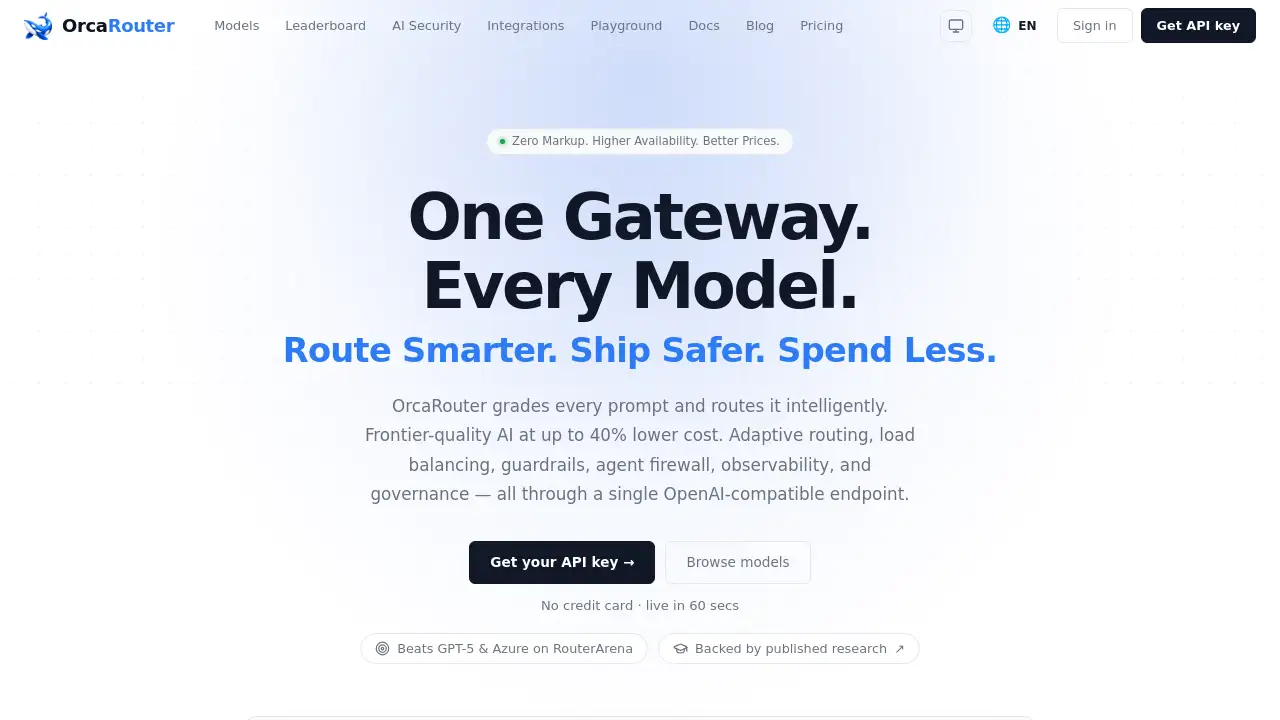
OrcaRouter is an AI gateway that provides adaptive routing, load balancing, guardrails, and observability across 200+ models through a single OpenAI-compatible endpoint. It helps teams reduce AI costs by up to 40% while maintaining frontier-level quality.
What is OrcaRouter?
OrcaRouter is a production-grade AI gateway that routes each prompt to the best model based on its content and context. Instead of hard-coding one provider, it embeds every prompt and selects the optimal model from over 200 options — including frontier models like Claude, Gemini, GPT, and open-source alternatives. It adds zero markup on token costs, charging only for optional team features.
The product solves a common problem: AI teams waste money sending simple queries to expensive frontier models, or sacrifice quality by using cheap models for complex tasks. OrcaRouter’s adaptive routing matches the right model to each request, so teams save money without lowering output quality. It also includes guardrails, an agent firewall, automatic failover, and governance — all through a single, OpenAI-compatible API endpoint. Anyone building production AI applications — from startups to enterprise teams — can benefit from simpler infrastructure and lower costs.
Key Features of OrcaRouter
Smart Adaptive Routing
Every prompt gets graded and routed to the most suitable model. OrcaRouter uses contextual embeddings and online learning from real traffic to improve routing accuracy over time.
Automatic Failover
When a provider rate-limits or returns a 5xx error, OrcaRouter retries the request against a healthy model among 200+ options. The failover happens in under 50ms, so users never notice an outage.
Zero Token Markup
OrcaRouter passes through provider pricing exactly — input and output tokens cost the same as buying directly. There is no added margin on tokens. Revenue comes from optional team features, not per-token fees.
Custom Routing Rules
Users can write routing rules in a YAML file. Rules use CEL expressions to check task type, difficulty, token count, or other conditions, then route to a specific model or a delegate strategy like cheapest or balanced.
Guardrails and Agent Firewall
Built-in guardrails check every prompt and response against safety and compliance policies. The agent firewall prevents unauthorized actions from AI agents, adding a security layer for production deployments.
Observability and Governance
A basic dashboard tracks usage, costs, and performance. Team plans add compliance reports, audit logs, and role-based access controls. Everything is metered and logged in one place.
Use Cases for OrcaRouter
Cost-Optimized Model Selection
A startup running chatbots can route simple FAQ queries to a cheap open-source model while sending complex reasoning questions to a frontier model. OrcaRouter handles the choice automatically, cutting costs without hurting user experience.
High-Availability AI APIs
An enterprise using AI for customer support needs uptime. With OrcaRouter, if one provider goes down, failover routes to another model instantly. No downtime, no manual switching.
Multi-Model Experimentation
A research team wants to test different models on the same prompt to compare quality and cost. OrcaRouter lets them send requests to any model through one endpoint and observe results side by side.
How to Use OrcaRouter
- Sign up at orcarouter.ai — no credit card needed, and you receive $5 in free tokens to start.
- Change one line of code in your existing SDK — set
base_urltoapi.orcarouter.ai/v1and swap your API key for an OrcaRouter key. - Use model
orcarouter/auto— the gateway grades your prompt and routes it to the best model. No other code changes required. - (Optional) Add custom routing rules — create a
routing.yamlfile with CEL-based logic to control exactly which models get used for which requests. - Monitor and govern — view the dashboard for cost and performance data, or upgrade to the Team plan for compliance reports and team management.
Target Audience for OrcaRouter
- AI startups that need to reduce inference costs while maintaining quality
- Enterprise development teams building production AI applications that require reliability and governance
- Midsize companies managing multiple AI models across different teams and projects
- Machine learning engineers who want to experiment with many models through a single API
- DevOps and platform engineers responsible for AI infrastructure and uptime
- Compliance and security teams needing guardrails and audit trails for AI usage
Is OrcaRouter Free?
| Plan | Price | Features |
|---|---|---|
| Hacker (Free) | $0 | 200+ models, auto-failover, basic dashboard, prompt versioning, 3 API keys, 0% token markup |
| Team | $499/month | Everything in Hacker + up to 10 seats, compliance reports, unlimited API keys, priority support |
| Enterprise | Custom | Private deployment, 99.99% uptime SLA, dedicated infrastructure, dedicated support |
Routing is always free. OrcaRouter earns revenue only from the Team and Enterprise plans.
OrcaRouter's Pros and Cons
| Aspect | Pros | Cons |
|---|---|---|
| Pricing | Zero markup on tokens — pay providers directly; free tier available | Team plan at $499/month may be expensive for very small teams |
| Features | Smart adaptive routing, automatic failover, custom rules, guardrails, observability | Some advanced guardrails and compliance features require Team plan |
| Ease of Use | One-line code change, works with existing SDK, drop-in OpenAI-compatible | Custom routing rules require learning YAML and CEL expressions |
| Model Access | 200+ models including frontier and open-source; models update frequently | Occasionally new models may appear before full documentation is updated |
| Reliability | Automatic failover under 50ms; enterprise offers 99.99% uptime SLA | Free tier does not include SLA guarantees |
Frequently Asked Questions about OrcaRouter
How does OrcaRouter decide which model to use?
OrcaRouter grades each prompt using contextual embeddings and an online learning model that improves from real traffic. The default mode orcarouter/auto routes to the best balance of quality and cost. Users can override this with per-workspace objectives or custom routing rules.
Is my data sent to third parties when using OrcaRouter?
Requests are routed directly to the chosen provider’s API. OrcaRouter processes prompt embeddings to determine the best model but does not store or sell customer data. Enterprise customers can request private deployment for full data control.
Can I use OrcaRouter with any programming language?
Yes. OrcaRouter exposes an OpenAI-compatible API endpoint. Any language or framework that supports the OpenAI SDK — Python, JavaScript, Go, Java, and others — can connect by changing the base URL and API key.
How long does it take to set up OrcaRouter?
Most users are live in under 60 seconds. The only change is updating the base URL and API key in the client code. No redeployment or model reconfiguration is needed.
What happens if all providers fail?
OrcaRouter retries against healthy models from the pool of 200+ providers. If no model is available, it returns an error. The failover happens in under 50ms, so transient outages are usually invisible to end users.
Does OrcaRouter support streaming and tool calls?
Yes. Streaming, tool calls, structured outputs, vision, embeddings, and audio are all supported across the models that offer them. The gateway passes through these capabilities unchanged.
OrcaRouter Tags
AI gateway, adaptive routing, load balancing, guardrails, agent firewall, observability, governance, OrcaRouter, zero markup, OpenAI-compatible, model failover, cost optimization, production AI, multi-model routing, LLM gateway