Introduction
Candor is a qualitative research platform that builds Candor synthetic users from real evidence. These synthetic participants help teams interview target audiences about problems, concepts, and pricing. With Candor synthetic users, product teams can gather findings in hours instead of weeks.
What is Candor?
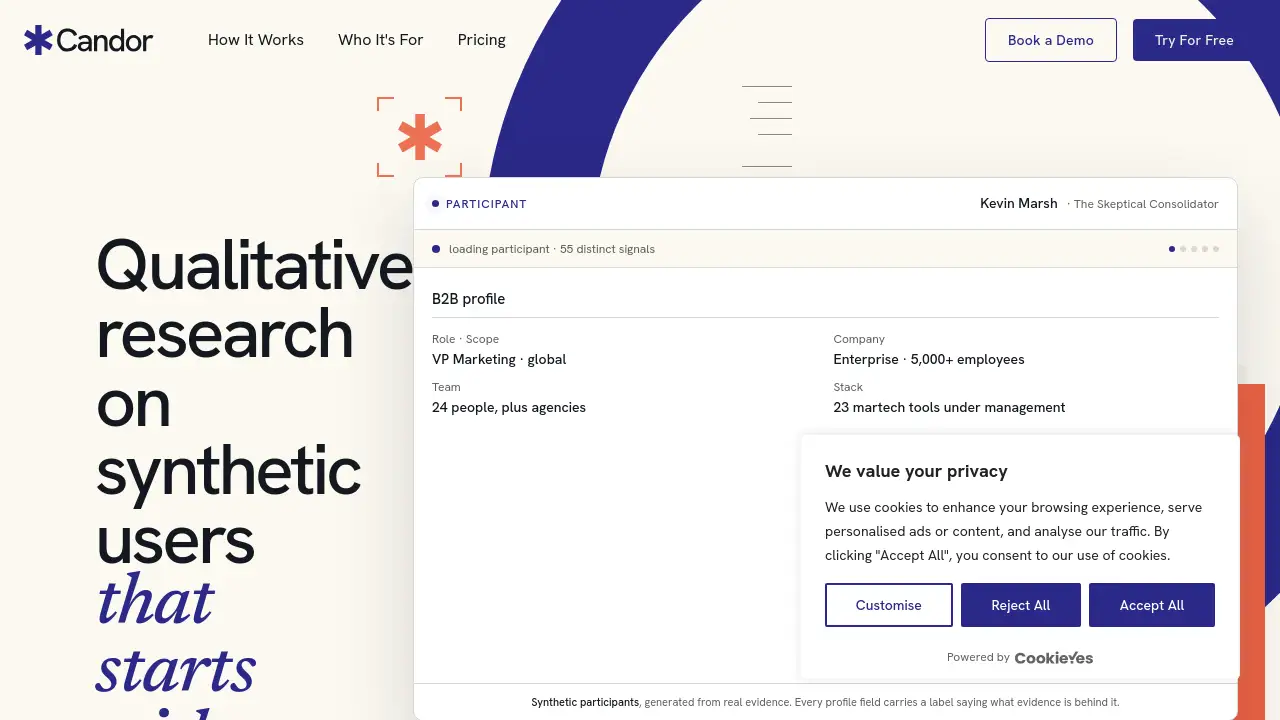
Candor is an AI user research tool for qualitative research with synthetic users. It creates synthetic participants from published evidence or from documents a team uploads, such as customer interviews, support tickets, survey data, market reports, or internal briefs. Each participant profile field carries a label showing what evidence is behind it, so users can see what is checkable.
The platform is designed to solve a common research bottleneck: recruiting real participants can take weeks and cost money, while teams often need faster feedback on problems, concepts, and pricing. Candor helps teams sharpen their questions before they spend a recruiting budget. It is suitable for product teams, startups, consultants, research and insights leaders, and innovation teams that need decision-grade signal quickly.
Candor also models business buyers and everyday consumers differently. A procurement lead evaluating enterprise software and a consumer making an impulse purchase are not treated the same way. Candor gives them distinct personality profiles, decision frameworks, and buying triggers. The result is a more realistic form of synthetic research, not generic AI guesswork.
Key Features of Candor
Evidence-Based Synthetic Participants
Candor builds synthetic participants from citable sources, such as government statistics, industry reports, peer-reviewed research, and professional association data. Users can also upload their own documents, which take priority over web evidence.
Adaptive Interviewing
Candor’s interviewer adapts to each synthetic participant. It follows up uniquely, lets go of the guide when a conversation goes somewhere interesting, and knows when a topic has been explored enough to move on.
Study Type Recommendations
Users describe what they want to learn, and Candor suggests the right study type. It builds the interview guide and adapts the synthesis to match the research goal, which helps teams without deep methodology training run better qualitative research.
Persistent Participant Memory
Synthetic participants remember what they shared in earlier interviews. A team can interview a participant today and return later with a new concept. The participant carries forward the stories, opinions, and decisions previously discussed.
Realistic Pushback and Critic Review
Candor’s participants hold positions, disagree with each other, and stay in character. A separate critic reviews every response against prior statements and the underlying evidence, catching contradictions before they reach the user.
Actionable Reports with Transcripts
Candor synthesizes every interview into a clear report. It shows what came through strongly, what did not, and where participants disagreed. Full interview transcripts are included, so any finding can be checked against what was said.
Use Cases for Candor
Problem Discovery
Teams can surface real pains, frustrations, and unmet needs before scoping a solution. Open-ended interviews with synthetic participants help challenge assumptions and reveal what an audience actually cares about.
Problem Validation
Candor helps pressure-test whether a specific problem is real, painful, and worth building for. It can help teams cut problems they are over-indexed on and surface ones they may have missed.
Concept Testing
Users can test a product, feature, name, value proposition, or message before committing. Candor helps identify which ideas resonate, which fall flat, and why, so unpromising concepts can be cut in hours.
Price Testing
Teams can test a new tier, packaging change, or launch price before it goes live. Candor shows how different synthetic participants react and where willingness-to-pay breaks.
Startup and Consultant Validation
Startups can move quickly without skipping validation work. Consultants can add Candor as a fast-validation layer inside client engagements for concepts, value propositions, and pricing.
How to Use Candor
- Describe the target audience. Explain who they are, what they do, and what matters for the research.
- Add context. Upload existing research documents or start from scratch. Candor searches for published evidence or uses the provided documents to build synthetic participants.
- State what to learn. Tell Candor what the team wants to understand. It recommends a study type and builds an interview guide.
- Run interviews. Candor’s adaptive interviewer follows up uniquely with each synthetic participant.
- Review the report. Read the synthesis and check findings against the full interview transcripts.
Target Audience for Candor
- Product teams and product managers
- Startups and consultants
- Research and insights leaders
- Innovation teams
- UX and market researchers who need faster early validation
- Teams testing concepts, value propositions, and pricing
Is Candor Free?
The reference information does not list full pricing details. Candor offers a free project and a free trial option, and users can book a demo for a guided walkthrough. For current plan pricing, check the official Candor website.
| Plan | Price | Features |
|---|---|---|
| Free Project | $0 | Start a free project and explore the platform |
| Paid Plans | Not listed | Team pricing and features require a demo or official pricing page |
Candor's Pros and Cons
| Aspect | Pros | Cons |
|---|---|---|
| Pricing | Free project available; helps reduce early recruiting costs | Paid pricing is not publicly listed in the reference information |
| Features | Evidence-based synthetic participants; adaptive interviews; critic review; transcripts | Output quality depends on available evidence and uploaded documents |
| Speed | Findings can arrive in hours, not weeks | Synthetic users are not real people and may not replace every primary research need |
| Usability | Suggests study types and builds interview guides | Teams still need to interpret evidence labels and research reports carefully |
| Audience Modeling | Separates B2B buyers and consumers with different profiles | Results should be checked against real-world research before major decisions |
Frequently Asked Questions about Candor
What are synthetic users in Candor?
Synthetic users in Candor are AI-generated research participants built from real evidence. They are designed to be interviewed about problems, concepts, and pricing. Each profile field includes evidence labels so users can see what supports it.
Does Candor replace real user research?
Candor is positioned as a way to sharpen questions before spending a recruiting budget. It can support early validation, concept testing, and price testing, but it does not have to replace all real user research. Teams should use it alongside other research methods when decisions require direct human input.
What types of research can be run with Candor?
Candor supports problem discovery, problem validation, concept testing, and price testing. It recommends a study type based on the research goal, then builds an interview guide and adapts the synthesis.
Can users upload their own research documents?
Yes. Users can upload customer interviews, support tickets, survey data, market reports, internal briefs, and other context. Uploaded documents take priority over web evidence, and more context can make the synthetic participants sharper.
How does Candor keep responses evidence-based?
Candor labels participant attributes with the kind of evidence behind them. A separate critic also reviews every participant response against prior statements and the underlying evidence. This helps reduce contradictions and unsupported claims.
Is Candor suitable for B2B and consumer research?
Yes. Candor models business buyers and everyday consumers differently. It gives them distinct personality profiles, decision frameworks, and buying triggers, which helps reflect how different audiences think and decide.
Candor Tags
Candor, synthetic users, synthetic participants, qualitative research, AI user research, concept testing, price testing, problem discovery, problem validation, evidence-based research, user interviews, B2B research