Introduction
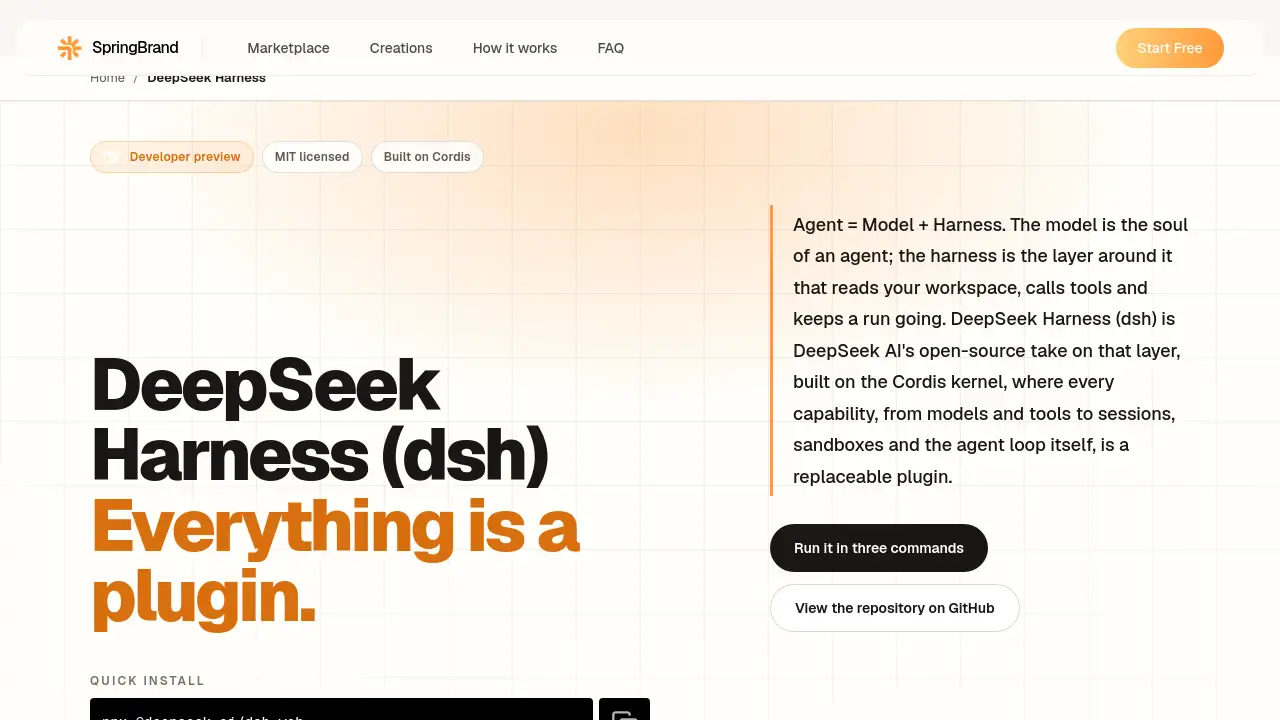
SpringBrand hosts DeepSeek Harness, an open-source agent harness from DeepSeek AI. DeepSeek Harness, also called dsh, is the layer that sits around a model and lets it read files, call tools, and keep a run going. It is built on Cordis, a plugin kernel, and every capability in DeepSeek Harness is a replaceable plugin. This DeepSeek Harness guide covers features, use cases, pricing, and more.
What is SpringBrand?
SpringBrand is the website that introduces DeepSeek Harness and provides installation notes, plugin details, and usage guidance. The product described on SpringBrand is not a new DeepSeek model. Instead, SpringBrand presents DeepSeek Harness as an open-source agent harness that helps users build and run AI agents on their own machines. It solves the problem of connecting a model to a workspace, tools, and memory. Teams and developers can use DeepSeek Harness to own their agent runtime and swap parts through configuration.
Key Features of SpringBrand
DeepSeek Harness brings together all the pieces of an agent harness in one configurable package.
Plugin-Based Architecture
DeepSeek Harness is built on the Cordis kernel. Models, tools, sessions, sandboxes, and the agent loop are all plugins. Users can add or remove capabilities without changing the core.
Local Runtime
DeepSeek Harness runs on a local machine at http://127.0.0.1:3080. It does not send runs to a DeepSeek server. A user only needs Node.js and one model API key.
Quick Install
No beta invite or waitlist is required. The command npx @deepseek-ai/dsh web starts the web UI. The project is MIT licensed and public.
Reversible Capability Seams
Each capability in DeepSeek Harness has a Service Definition, Service Providers, and Consumers. Because filesystem and subprocess providers share one execution world, swapping them moves Bash, PTY, and LSP together without forking consumers.
Model Agnostic Adapters
DeepSeek Harness supports DeepSeek models, catalog providers such as Anthropic and OpenAI, and custom OpenAI-compatible endpoints. All models arrive through the same adapter interface.
Plugin Categories
There are nine plugin categories: models, tools, skills, sessions, sandboxes, storage, agent loops, scheduling, and the user interface. Each category can be selected, swapped, or extended from configuration.
Use Cases for SpringBrand
DeepSeek Harness works well as an agent harness for several scenarios.
Building Custom Agent Runtimes
Teams that want their own agent runtime can use DeepSeek Harness instead of a closed service. The open-source agent harness lets them configure every part of the runtime.
Writing and Publishing Plugins
Plugin authors can build capabilities under the dsh-plugin topic. Since DeepSeek Harness treats every capability as a plugin, developers can publish model adapters, tools, and sandboxes.
Model Evaluation
DeepSeek Harness provides a stable, minimal tool surface across runs. This makes it useful for evaluating models with the same harness configuration.
Embedding an Inspectable Agent Loop
Internal platforms can embed DeepSeek Harness behind their own UI. The session log records every model-visible fact, and users can fork or replay from any point.
How to Use SpringBrand
To use DeepSeek Harness, visit SpringBrand and follow these steps. As an agent harness, DeepSeek Harness only needs Node.js and a model API key.
- Install Node.js on the machine where the agent will run.
- Get an API key from a model provider such as DeepSeek, Anthropic, or OpenAI.
- Run the command
npx @deepseek-ai/dsh webin a terminal. - Open http://127.0.0.1:3080 in a browser.
- Optionally run
dsh web --dump-configto inspect the plugin tree and create custom patches.
DeepSeek Harness does not require a beta invite, a waitlist, or an internal testing pass. The whole setup depends on Node.js and one model API key.
Target Audience for SpringBrand
Because DeepSeek Harness is an agent harness, the main audience includes:
- Developers who want to own their agent runtime
- Plugin authors building capabilities under the dsh-plugin topic
- Researchers doing model evaluation with a stable tool surface
- Internal platform teams embedding an inspectable agent loop
- Users who need to swap model adapters, sandboxes, or storage through configuration
Is SpringBrand Free?
This agent harness is free and open source under the MIT license. The SpringBrand page does not list a paid plan. Users need a model API key, and the model provider may charge for API usage.
| Plan | Price | Features |
|---|---|---|
| Free | $0 | MIT licensed DeepSeek Harness, local web UI, plugin system, headless runner |
| Model API | Variable | Required for model access; can use DeepSeek or third-party providers |
SpringBrand's Pros and Cons
This agent harness has clear strengths and some limits. The table below compares the advantages and disadvantages of DeepSeek Harness.
| Aspect | Pros | Cons |
|---|---|---|
| Pricing | Free and open source under MIT | No hosted service or managed support |
| Features | Plugin-based, model-agnostic, local runtime | Developer preview with breaking changes expected |
| Usability | One-command install with npx | Web UI cannot be served to a network; CLI rejects --host 0.0.0.0 |
| Architecture | Built on Cordis with swappable seams | Requires understanding plugins, patches, and configuration |
Frequently Asked Questions about SpringBrand
What is DeepSeek Harness?
DeepSeek Harness is DeepSeek AI's open-source agent harness built on Cordis. It gives a model workspace, tools, permissions, and a session log so the model can complete tasks.
How does DeepSeek Harness differ from an AI model?
A model generates text and decides what to do next. DeepSeek Harness is the layer around the model that reads files, calls tools, and keeps a run going. It does not train or host a model; it ships no weights. This separation is what makes an agent harness useful.
Can DeepSeek Harness work with models from other providers?
Yes. DeepSeek Harness uses model adapters registered on ctx.llm. It supports DeepSeek models, Anthropic, OpenAI, and custom OpenAI-compatible endpoints.
Is the Python package named deepseek-harness the same as DeepSeek Harness?
No. The official DeepSeek Harness is a TypeScript project installed with npx and runs a local web UI. The Python deepseek-harness is an unrelated community client for the DeepSeek V4 API.
Is DeepSeek Harness free?
Yes, DeepSeek Harness is MIT licensed and free to use. Users still need a model API key, and the model provider may charge for API usage.
Is DeepSeek Harness ready for production?
DeepSeek Harness is in developer preview. Core plugins and APIs are still changing, and compatibility-breaking changes are expected, so production use may require careful version pinning.
SpringBrand Tags
DeepSeek Harness, agent harness, dsh, DeepSeek AI, open-source agent framework, Cordis plugin kernel, local AI agent runtime, plugin-based AI agent, DeepSeek Harness dsh, MIT license AI agent, DeepSeek agent harness, SpringBrand DeepSeek Harness