Introduction
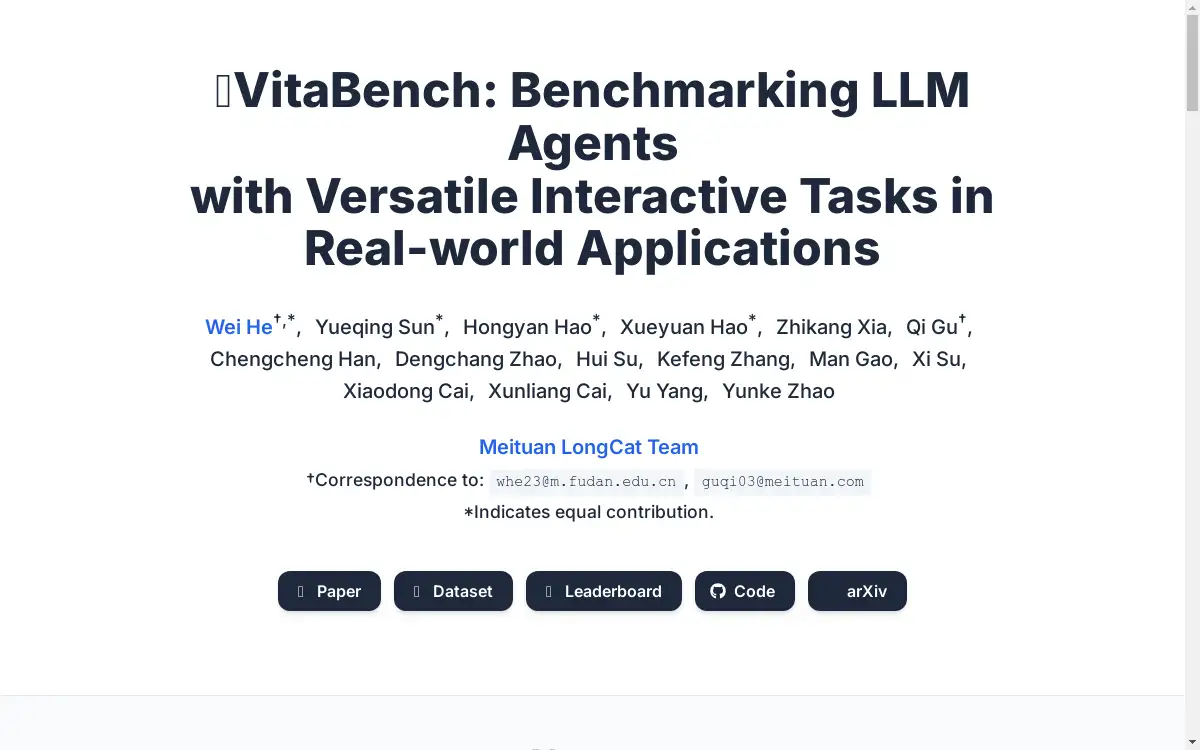
VitaBench is a challenging benchmark for evaluating AI agents on versatile interactive tasks grounded in real-world applications.
What is VitaBench?
VitaBench is a comprehensive benchmark designed to evaluate the performance of large language model (LLM) based agents. It addresses a significant gap in the AI landscape: existing benchmarks often fail to capture the full complexity of real-world scenarios where agents must handle extensive information, leverage diverse tools, and manage dynamic, multi-turn user interactions. This benchmark is crucial for researchers and developers aiming to build robust AI agents for practical, life-serving applications. By simulating complex environments from sectors like food delivery, in-store consumption, and online travel services, VitaBench provides a rigorous testing ground to measure an agent's true capabilities.
Key Features of VitaBench
Real-World Scenario Simulation
VitaBench grounds its evaluation in authentic, daily life applications, creating the most complex life-serving simulation environment available for benchmarking AI agents.
Extensive Tool Integration
The benchmark comprises a comprehensive suite of 66 distinct tools, requiring agents to demonstrate proficiency in tool selection, usage, and complex orchestration to complete tasks successfully.
Diverse Task Portfolio
With a total of 400 tasks, including 100 challenging cross-scenario tasks and 300 single-scenario tasks, VitaBench offers a vast and varied set of challenges derived from multiple real user requests.
Multi-Dimensional Reasoning
Tasks are designed to force agents to reason across both temporal and spatial dimensions, track shifting user intent, and proactively clarify ambiguous instructions throughout multi-turn conversations.
Flexible Composition Framework
The underlying framework eliminates domain-specific policies, enabling the flexible composition of different scenarios and tools, which facilitates the creation of complex, cross-domain evaluations.
Robust Evaluation Methodology
VitaBench employs a rubric-based sliding window evaluator, allowing for a robust assessment of diverse and valid solution pathways even within complex, stochastic environments.
Use Cases for VitaBench
AI Agent Development and Research
Researchers and AI developers can use VitaBench to train, test, and compare the performance of different LLM-based agents, identifying strengths and weaknesses in their interactive capabilities.
Model Performance Benchmarking
Organizations can utilize the benchmark to objectively evaluate and rank various AI models, providing clear metrics on their ability to handle versatile interactive tasks.
Real-World Application Testing
Companies building AI for practical applications in e-commerce, customer service, and logistics can test their agents against realistic scenarios to ensure reliability before deployment.
Academic Study of AI Capabilities
Academics can leverage VitaBench to study the frontiers of AI reasoning, tool usage, and multi-step problem-solving in environments that closely mirror human daily life.
How to Use VitaBench
Using VitaBench typically involves a structured process for researchers and developers. First, access the benchmark dataset and documentation, often available through academic channels or the project's homepage. Next, integrate your AI agent with the benchmark's framework, which involves connecting to the defined set of 66 tools. Then, run your agent against the selected tasks, which may include single-scenario or more complex cross-scenario challenges. Finally, utilize the provided rubric-based sliding window evaluator to score your agent's performance, analyzing the results to identify areas for improvement.
Target Audience for VitaBench
- AI and Machine Learning Researchers
- Large Language Model Developers
- AI Product Teams in E-commerce and Service Platforms
- Academic Institutions Studying AI Capabilities
- Companies Implementing AI Customer Service Agents
- Developers of Autonomous AI Systems
Is VitaBench Free?
Based on the available information, VitaBench appears to be a research-oriented benchmark developed by an academic and industry team. Such benchmarks are typically available for free to the research community to foster advancement in the field. Users can likely access the dataset, methodology, and evaluation framework without cost by referring to the associated arXiv paper and project resources. There is no indication of premium or paid versions, aligning with standard practices for academic benchmarks aimed at propelling open scientific progress.
Frequently Asked Questions about VitaBench
What types of tasks does VitaBench include?
VitaBench includes 400 tasks spanning real-world scenarios like food delivery, in-store consumption, and online travel services. These range from 300 single-scenario tasks to 100 more complex cross-scenario tasks that require agents to switch between domains and coordinate long-horizon actions.
How does VitaBench evaluate AI agent performance?
The benchmark uses a rubric-based sliding window evaluator. This methodology allows for the robust assessment of diverse solution pathways, accommodating the fact that there can be multiple valid ways to complete a task in complex, interactive environments.
What makes VitaBench more challenging than other benchmarks?
VitaBench stands out due to its grounding in real-world applications, its extensive set of 66 tools, and its focus on cross-domain tasks that require agents to reason across temporal and spatial dimensions while managing multi-turn conversations with shifting user intent.
Which AI models perform best on VitaBench?
According to the latest leaderboard, even the most advanced models achieve only a 30% success rate on cross-scenario tasks and less than 50% on single-scenario tasks, indicating the benchmark's high difficulty and the substantial headroom for improvement in current AI agents.
Can VitaBench be used for models operating in English?
While the initial tasks are grounded in real-world platforms where data is primarily in Chinese, the project team has indicated that an English version of the dataset is in preparation to facilitate broader international research use.
How often is the VitaBench leaderboard updated?
The leaderboard is periodically refreshed to correct errors, replace outdated samples, and add new challenging tasks. All evaluation metrics are updated concurrently to reflect these changes, ensuring the benchmark remains current and relevant.
VitaBench Tags
VitaBench, AI benchmark, LLM agent evaluation, versatile interactive tasks, real-world AI testing, tool integration, cross-scenario tasks, AI agent performance, life-serving simulation, multi-turn conversation, AI reasoning, robust evaluation, AI development tool