Introduction
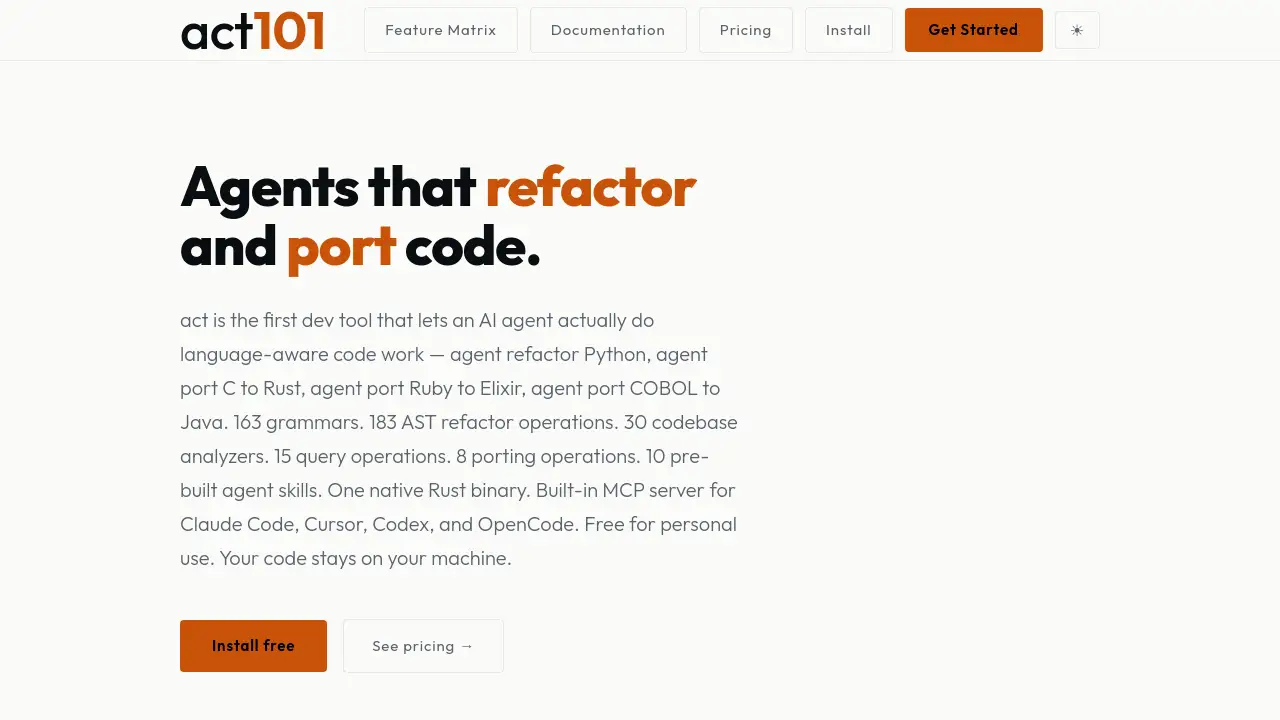
act101 is the first dev tool that lets an AI agent actually refactor and port code, transforming how developers automate complex codebase work.
What is act101?
act101 is a developer tool designed to empower AI coding agents with language-aware capabilities for code refactoring, analysis, and cross-language porting. It solves the problem of AI agents being limited to chat-based suggestions or error-prone whole-file rewrites, which often lose formatting and lack undo functionality. By acting as a Model Context Protocol (MCP) server, act101 exposes 183 precise AST refactor operations, 30 codebase analyzers, and 8 porting operations across 163 programming languages. This makes it suitable for developers and teams looking to automate significant refactoring tasks, assess codebase health, or execute complex language migrations with precision and control, all while keeping their code securely on their local machine.
Key Features of act101
163 Language Grammars in One Binary
A single native Rust binary supports operations across 163 different programming language grammars, eliminating the need for multiple plugins or runtime dependencies.
183 AST Refactor Operations
The tool provides AI agents with 183 Abstract Syntax Tree-aware operations, such as extract-function, rename, move-symbol, and inline, enabling precise and consistent refactoring across entire codebases.
8 Porting Operations for Cross-Language Migration
act101 includes a suite of 8 porting operations (port_contract, port_inventory, etc.) that drive end-to-end language migrations through a structured state machine, facilitating moves like C to Rust or Ruby to Elixir.
30 Codebase Analyzers
Developers and agents can analyze structural codebase health with 30 different analyzers, covering coupling, cycles, dead code, hotspots, module boundaries, and migration readiness.
10 Pre-built Agent Skills
Common engineering workflows are streamlined through 10 pre-built skills like architecture-audit, code-review, refactoring, and migration-assessment, which can be invoked directly in compatible AI coding clients.
Built-in MCP Server
The tool integrates seamlessly with popular AI-powered development environments like Claude Code, Cursor, Windsurf, and OpenCode through its built-in Model Context Protocol server.
Token-Efficient Operations
act101's query operations return only the necessary AST-derived code slices, using approximately 85% fewer tokens than reading entire files, helping AI agents stay within their context window limits.
Instant Undo and Automatic Checkpointing
Every operation is automatically checkpointed, allowing for instant undo if the AI agent's changes produce an unexpected result, providing a safety net for automated refactoring.
Use Cases for act101
Automated Large-Scale Refactoring
Developers can use AI agents powered by act101 to safely and consistently execute widespread refactoring tasks, such as renaming a symbol across a large TypeScript monorepo or extracting functions in a Python codebase.
Cross-Language Code Porting
Teams undertaking language migrations, such as moving a legacy C library to Rust or transitioning a Ruby on Rails application to Elixir, can leverage the structured porting workflow to manage the complex process.
Proactive Codebase Health Analysis
Before starting a major project, engineers can use the codebase analyzers to identify architectural issues like tight coupling, circular dependencies, or dead code, informing better planning decisions.
AI-Assisted Code Review and Audit
The pre-built agent skills enable automated, structural code reviews and architecture audits, providing developers with deep insights that go beyond simple linting or style checks.
How to Use act101
- Download and Install: Obtain the native Rust binary from the act101 website. The installation process is typically straightforward, involving a single command-line step.
- Start the MCP Server: Run the built-in MCP server using the command
act mcp servefor stdio connections (compatible with Claude Code) oract mcp httpfor HTTP+SSE connections. - Configure Your AI Agent Host: In your preferred AI coding environment (like Claude Code or Cursor), configure it to connect to the local act101 MCP server. This is often done through the host's settings or marketplace.
- Invoke Operations: Once connected, you or your AI agent can invoke refactoring commands (e.g.,
/refactor rename), analysis tools, or porting workflows directly through the chat interface of your AI coding assistant. - Review and Undo: After any operation, review the changes. If necessary, use the instant undo feature to revert the last action, ensuring safe experimentation.
Target Audience for act101
- Software Developers and Engineers seeking to automate repetitive refactoring tasks.
- Engineering Teams and Tech Leads responsible for managing large-scale code migrations or maintaining codebase health.
- AI Tooling and Platform Developers looking to integrate advanced code manipulation capabilities into their products.
- Legacy System Modernization Teams tasked with porting applications from older languages like COBOL or C to modern ones like Java or Rust.
Is act101 Free?
act101 offers a tiered pricing model, including a substantial free tier for personal use.
| Plan | Price | Key Features |
|---|---|---|
| Free | $0 forever | 15 query operations, 3 analysis tools, rename & fix-auto refactoring, support for 163 grammars, MCP server. For personal, non-commercial, and open-source use. |
| Pro | $19/month or $159/year | Everything in Free, plus 10 analysis tools, full mutation toolkit (extract, inline, wrap, introduce, generate). Commercial license for a single developer. |
| Teams | $39/seat/month or $299/seat/year | Everything in Pro, plus 9 deep analysis tools, structural operations, and the full generate suite. Team license seats. |
| Elite | $99/seat/month or $759/seat/year | Everything in Teams, plus adds 25 premium languages including COBOL, Fortran, Ada, Verilog, and Solidity. |
| Enterprise | Contact Sales | Unlocks the full porting toolkit and migration analyzers for end-to-end, large-scale language migration projects. |
A 7-day free trial with all features is available for the paid plans.
act101's Pros and Cons
| Aspect | Pros | Cons |
|---|---|---|
| Capability | Unprecedented AI agent access to precise, AST-level code operations and cross-language porting. | The advanced features may have a steeper learning curve for users unfamiliar with refactoring concepts or MCP. |
| Efficiency | Dramatically reduces AI context window usage (~85% fewer tokens) by returning precise code slices. | Benefits are maximized on larger codebases; savings are less significant on very small projects or single files. |
| Security & Control | Code stays entirely on the user's machine with no telemetry, addressing privacy and security concerns. | License verification requires an occasional connection to the vendor's servers, which may be a constraint in fully air-gapped environments. |
| Integration | Seamless integration with popular AI coding assistants via the standard MCP protocol. | Requires the user to be operating within an MCP-compatible AI coding environment. |
| Pricing | A generous free tier makes powerful refactoring tools accessible to individuals and open-source projects. | The cost for Teams and Elite tiers can be significant for smaller teams or individual professional developers. |
Frequently Asked Questions about act101
What is an MCP server, and do I need one to use act101?
MCP stands for Model Context Protocol, a standard that allows AI applications to connect securely with tools and data sources. act101 functions as an MCP server. To use it, you need an AI coding client that supports MCP, such as Claude Code, Cursor, Windsurf, or OpenCode. The client connects to the local act101 server to access its refactoring and analysis tools.
Can act101 really port code from one language to another automatically?
act101 provides the structured operations and state machine (port_contract, port_inventory, port_order, port_manifest) that guide an AI agent through the porting process. It doesn't perform a fully automatic, one-click translation. Instead, it breaks down the migration into manageable, ordered steps, extracts behavioral contracts, and tracks progress, enabling the AI agent to execute the porting work much more reliably and completely than it could alone.
How does the token efficiency work?
Traditional AI agents working on code often need to read entire files into their context window to understand them. act101's query operations (like references, callers, graph) analyze the code's AST and return only the specific, relevant parts needed (e.g., just the function signatures or the list of calling functions). This targeted data transfer results in the reported ~85% median reduction in token usage, allowing the agent to work on larger codebases without hitting context limits.
Is my code safe when using act101?
Yes. According to the product information, your code stays on your machine. The act101 binary runs locally, and all parsing, analysis, and refactoring operations happen on your hardware. The tool states it has no telemetry, meaning it does not send your code to external servers. The only external communication mentioned is for optional license verification.
What is the difference between the Free and Pro plans?
The Free plan includes core query operations, basic analysis tools (3 analyzers), and two refactoring operations (rename and fix-auto). It is licensed for personal, non-commercial, and open-source use. The Pro plan unlocks the full suite of refactoring mutations (extract-function, inline, etc.), more analysis tools (10 total), and the generate operations. It also includes a commercial license for a single professional developer.
Which programming languages are supported?
act101 supports 163 language grammars in its core and free tiers. The Elite plan adds an additional 25 "premium" languages, which include legacy and specialized languages like COBOL, Fortran, Ada, Verilog, and Solidity, which are crucial for enterprise migration projects.
act101 Tags
AI code refactoring, AI agent tools, MCP server, cross-language porting, code migration tool, AST refactor operations, Claude Code integration, Cursor AI tool, token-efficient AI, codebase analyzer, legacy code modernization, Rust developer tool, automated refactoring, programming language grammar, dev tool automation