Introduction
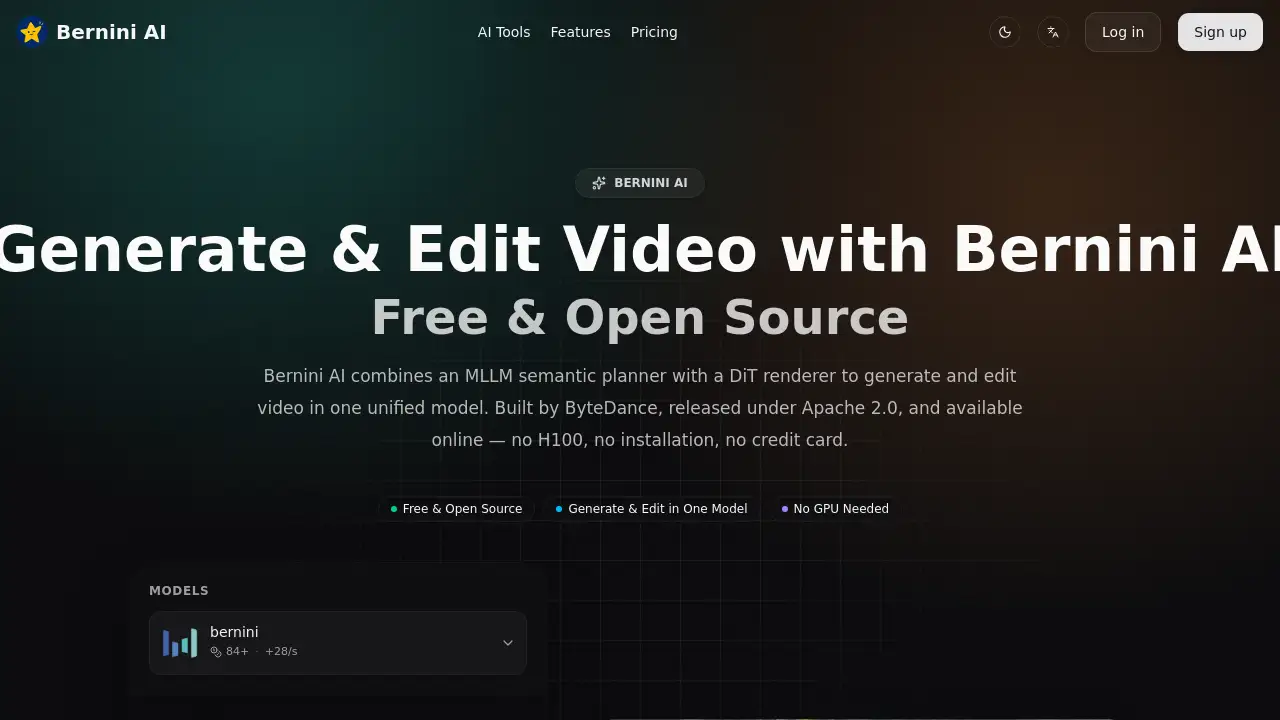
Bernini AI is a free, open-source video generator.
What is Bernini AI?
Bernini AI is ByteDance's open source video generation and editing model. It combines an MLLM semantic planner with a DiT renderer to create and edit video in one unified framework. The product addresses a common gap in AI video tools: many systems specialize in either text to video, image animation, or prompt-based editing, but Bernini AI covers generation and editing in a single model. It is released under Apache 2.0, with weights on Hugging Face and code on GitHub, according to the product information. Users can try hosted online access without a GPU, or self-host the model on suitable hardware.
Why does it matter? Bernini AI can turn a text prompt into a short video, edit existing footage by describing a change, or use reference images to guide a new clip. This makes it relevant for creators who want an open source video generator, teams testing AI video editing workflows, and developers who need a modifiable foundation. Because the model uses semantic planning before rendering, it aims to follow multi-part instructions and keep unedited regions consistent. The project is also backed by ByteDance and published on arXiv, which gives researchers and builders a documented baseline to inspect.
Key Features of Bernini AI
Text to Video
Bernini AI generates video from natural language prompts, using the MLLM planner to reason about composition, motion, and style before the DiT renderer produces frames.
Prompt-Based Video Editing
Users can upload source footage and describe an edit, such as swapping an object or changing the weather, while Bernini AI preserves unedited areas.
Reference-to-Video
The model accepts up to five reference images to anchor subject, material, style, or weather, helping create a coherent AI video generator output that matches a visual direction.
Reference-Guided Editing
Bernini AI combines a source video with reference images to guide material swaps, object replacement, style transfer, or weather changes while keeping fine details intact.
Content Insertion
The platform can place a supplied image or video into an existing scene, which is useful for product placement, logo insertion, and compositing.
Text to Image and Image Editing
Bernini AI also supports text-to-image generation and image-to-image editing, so still-image and motion workflows share the same semantic planning pipeline.
Open Source and No GPU Needed
Bernini AI is released under Apache 2.0. Hosted online access lets users start without an H100 or installation, while self-hosting remains available for teams with Hopper GPUs.
Use Cases for Bernini AI
Social Media Content
Creators can use Bernini AI to generate short clips for TikTok, Instagram Reels, and YouTube Shorts, or remix existing footage with a one-line edit instruction.
Marketing and Advertising
Teams can test video variations by changing backgrounds, swapping products, or adjusting visual style with AI video editing prompts instead of reshooting.
Product Placement and Branding
Content insertion helps place logos, products, or visual elements into existing footage, supporting cleaner compositing for campaigns and product demos.
Independent Development
Builders can integrate Bernini AI into their own apps, modify the weights, or self-host the open source video generation model under Apache 2.0.
Research and Learning
Students and AI researchers can use the open weights, code, and published benchmarks as a reproducible baseline for video generation and editing experiments.
Design and Visual Art
Designers can use reference-to-video and reference-guided editing to lock in a subject, material palette, or visual style across generated clips.
How to Use Bernini AI
- Open the Bernini AI online service in a browser. No GPU or installation is required for hosted use.
- Describe the video to create or the edit to apply. For reference-based tasks, upload source images or video clips.
- Choose a task type, such as text to video, reference-to-video, or prompt-based video editing.
- Generate the result and review it. The MLLM semantic planner sets the scene plan, then the DiT renderer synthesizes frames.
- Download the video for social media, marketing, client work, or creative projects. The Apache 2.0 license covers commercial use.
Target Audience for Bernini AI
- Social media creators who need a free AI video generator for short-form content
- Marketing and advertising teams testing fast video variations
- Indie developers and builders who want an open source video generation model
- AI researchers and students exploring reproducible video AI
- Designers and visual artists working with reference images and style control
- Teams with suitable GPUs that prefer self-hosted video editing tools
Is Bernini AI Free?
Bernini AI is free and open source under Apache 2.0. The model weights and code are available for use, modification, distribution, and commercial projects. Hosted online access is also available with free trial credits and no credit card required to start, according to the product information. The hosted plans use monthly credits, and the reference content lists 1,200, 3,000, and 8,000 credit tiers with advanced models, no watermark, and commercial rights. Specific plan prices are not shown in the reference content, so users should check the official Bernini AI website for current pricing.
| Plan | Price | Features |
|---|---|---|
| Open Source / Self-Hosted | $0 under Apache 2.0 | Model weights, code, modification, distribution, commercial use; suitable hardware needed for self-hosting |
| Hosted Online Access | Free trial credits; paid tiers listed on site | 1,200 to 8,000 monthly credits, advanced video and image models, no watermark, commercial rights |
| Credit Top-Up | $9.9 for 600 credits | 30-day validity; unlocks advanced models alongside a plan |
Bernini AI's Pros and Cons
| Aspect | Pros | Cons |
|---|---|---|
| Pricing | Open source and free to use under Apache 2.0; hosted free trial available | Hosted advanced use relies on credit plans and top-ups |
| Features | Unified generation and editing; text, image, and video tasks in one model | Typical clips are short, around 2 to 15 seconds |
| Access | Hosted use needs no GPU; self-hosting is possible | Self-hosting requires suitable Hopper-class GPU hardware |
| Output | Up to 720p at 24fps; commercial use allowed | Resolution and frame rate are limited compared with high-end production formats |
| Transparency | ByteDance-backed, Apache 2.0, weights and code available | Users should review current hosted terms and pricing before relying on the service |
Frequently Asked Questions about Bernini AI
What is Bernini AI?
Bernini AI is ByteDance's open source video generation and editing model. It combines an MLLM semantic planner with a DiT renderer to handle text to video, video editing, reference-to-video, content insertion, and image tasks in one framework.
Is Bernini AI really free and open source?
Yes. Bernini AI is released under Apache 2.0, with weights on Hugging Face and code on GitHub. The open source model can be used, modified, and deployed commercially, while the hosted online service offers free trial credits and paid credit tiers.
Do I need a GPU to use Bernini AI?
No GPU is needed for hosted online use. Users can open the service in a browser, enter a prompt, and generate video. Self-hosting is available for teams with Hopper GPUs, but it is not required to start.
What can I create with Bernini AI?
Bernini AI supports text to video, reference-to-video, prompt-based video editing, reference-guided editing, content insertion, text to image, and image editing. It is useful for short social clips, marketing variations, product placement, and creative experiments.
Can I use Bernini AI videos commercially?
Yes. The Apache 2.0 license covers commercial use, and the hosted plans listed in the reference content include full commercial use rights. Users should still review the current official terms before publishing client or brand work.
What resolution and length does Bernini AI support?
Bernini AI supports configurable resolution up to 720p and frame rates up to 24fps. Video length is set by frame count, typically around 2 to 15 seconds per generation.
Bernini AI Tags
Bernini AI, Bernini AI video generator, open source video generation, AI video editing, text to video, reference-to-video, ByteDance AI, Apache 2.0 video model, free AI video generator, no GPU video generation, AI video editor, content insertion AI