Introduction
Engramic: organisational memory for teams.
What is Engramic?
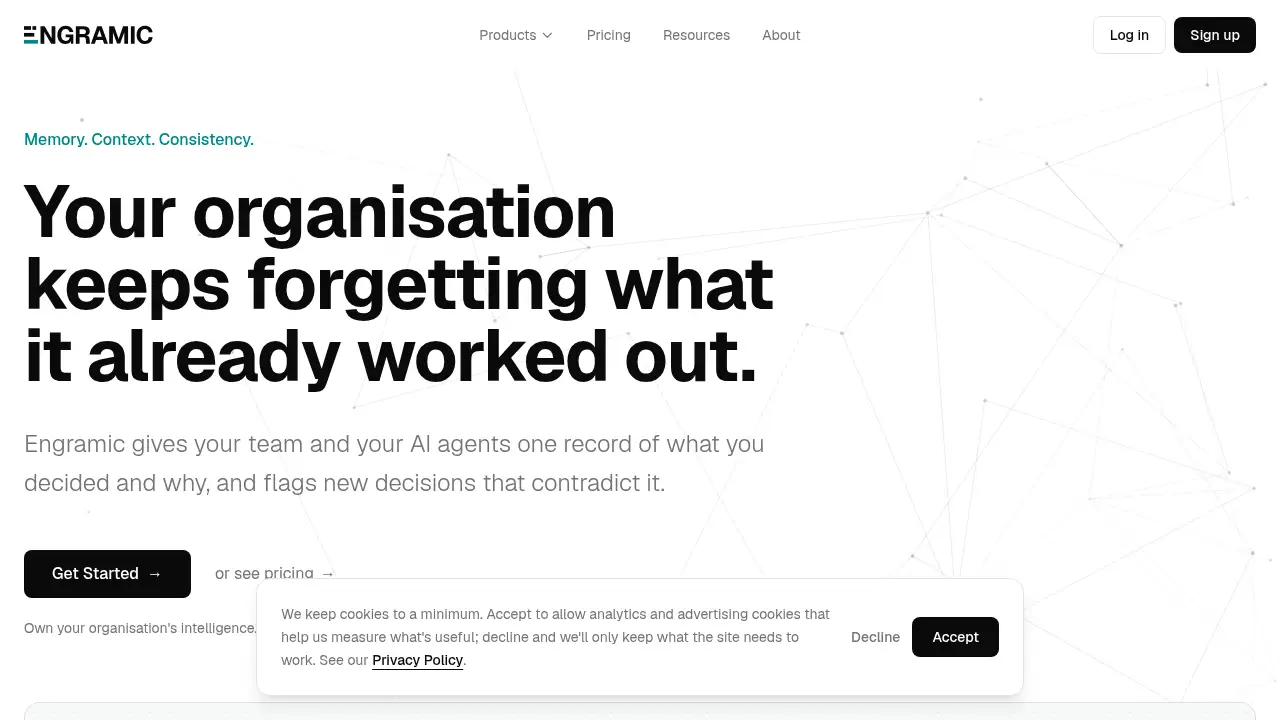
Engramic is a platform that creates a shared organisational memory for teams and their AI agents. It records decisions, goals, and constraints as work happens, along with the reasoning behind each choice. The problem it solves is simple: teams forget what they decided and why, so they repeat mistakes or make contradictory calls. AI agents also lack context about past decisions, which leads to inconsistent outputs. Engramic gives both people and AI agents one organisational memory record to work from, and it flags new decisions that conflict with earlier ones. This matters because organisational memory improves consistency, reduces repeated debates, and helps AI agents act with the right context. The platform suits teams that use AI tools regularly and want a reliable organisational memory layer they control.
Key Features of Engramic
MCP Connection for AI Agents
Connect Engramic to Claude, Claude Code, and other MCP clients so AI agents can read and add to the same organisational memory record after a short setup. This keeps AI agents aligned with team decisions and strengthens the AI memory they use.
Save Decisions as You Work
An agent can draft a decision entry from an existing conversation, and a person reviews and publishes it. This makes organisational memory capture practical without extra meetings or manual note-taking.
Shareable Pages and Timelines
Share a topic as a link that shows the reasoning and history behind each decision. Every topic has a timeline of what was decided, what replaced it, and when, so everyone sees the current version.
Ask Alia in Plain English
Ask questions like “What did we decide about support hours?” and get an answer from the team’s own organisational memory, with the reasoning attached. Alia helps surface AI memory without digging through old threads.
Conflict Detection
Engramic connects decisions across time and flags contradictions within the organisational memory while they are fresh. For example, a new decision about 24/7 live chat can be flagged against an earlier decision about weekday support hours. The platform flags; people settle.
Gaps Raised Early
Alia spots a goal with no constraint or a topic left half-specified, then asks the right person. This supports better decision making and keeps the organisational memory complete.
Data Ownership and No Training Use
Nothing recorded in Engramic trains any model, including the vendor’s own models. The organisational memory stays with the team if they change AI model providers.
Use Cases for Engramic
Team Decision Tracking
Record decisions from calls, chats, and threads in one organisational memory, so team members can see what was agreed and why. This reduces repeated debates and contradictory choices.
AI Agent Context
Give AI agents a reliable AI memory layer that holds past decisions and constraints. Agents can start tasks with the right context instead of guessing or relying only on documents.
Client and Stakeholder Handoffs
Share a topic link with a client or colleague so they can read the reasoning and history behind a decision. This keeps external stakeholders aligned without replaying every meeting.
Onboarding New Team Members
New hires can ask Alia about past decisions and read timelines in the organisational memory. They learn why things are done, not just what is done.
Conflict Resolution Across Projects
When a new decision quietly pulls against an old one, Engramic flags the conflict early in the organisational memory. Teams can settle it before a colleague or an agent acts on the wrong version.
Knowledge Management for AI Tools
Use Engramic alongside a vector database or RAG pipeline. RAG retrieves documents, while Engramic holds the decisions and constraints that AI memory should include.
How to Use Engramic
- Sign up free and connect Claude or another MCP client to Engramic. The setup takes a few minutes.
- Record decisions, goals, and constraints as work happens. A person or an AI agent can draft entries from existing conversations.
- Review and publish each entry so the organisational memory stays accurate and trusted.
- Share topic links or use Alia to answer questions from the team’s decision record.
- Check flagged conflicts and settle them with a later decision, keeping the organisational memory timeline clear.
Target Audience for Engramic
- Teams that use Claude, Claude Code, or other MCP-compatible AI tools
- Organisations that need a shared organisational memory for decisions and reasoning
- Product, operations, and client-facing teams that make frequent decisions
- Teams looking for an AI memory layer they own and control
- Small and mid-sized companies that want a simple decision record without a heavy rollout
- Knowledge-heavy teams that already use RAG or vector databases and need decision context
Is Engramic Free?
Engramic offers a free plan for one person forever. Paid plans are priced per seat per month, and agents never count as seats. Prices exclude VAT. The official pricing page has full details.
| Plan | Price | Features |
|---|---|---|
| Free | £0 | For one person forever; MCP tools with full history; unlimited agents; agent-ready share links; Alia-lite |
| Standard | £9.99 per seat/month | Full Alia agent; web search; external MCP connections; artefacts and templates |
| Pro | £24.99 per seat/month | Resolving conflicts with Alia; document analysis; own model providers; priority support |
Engramic's Pros and Cons
| Aspect | Pros | Cons |
|---|---|---|
| Pricing | Free plan for one person forever; paid plans per seat; agents do not count as seats | Advanced conflict resolution requires Pro plan |
| Features | Shared organisational memory; MCP connection; conflict detection; Alia Q&A | Claude and Claude Code are fully tested; other MCP clients may need more testing |
| Data control | Nothing recorded trains a model; workspace data stored in London | Alia model processing runs with Anthropic in the US; EU processing is on the roadmap |
| Setup | No rollout programme; connect over MCP in minutes | Teams need to review and publish entries to keep the record accurate |
| Use with AI | AI agents can read and add to the same decision record | Value depends on consistent use by team members and agents to keep organisational memory accurate |
Frequently Asked Questions about Engramic
What counts as a conflict in Engramic?
A conflict is a new decision that cannot hold alongside a decision already in the organisational memory, such as 24/7 live chat when support hours were agreed as 9:00 to 17:30. Engramic flags it, and a person settles it. The conflict stays open until a later decision resolves it.
What is organisational memory for AI?
Organisational memory for AI is the record of decisions, constraints, and reasoning that a team has deliberately authored and ordered in time. It differs from personal AI memory, which tracks preferences, and from RAG, which retrieves documents. Engramic is designed to hold this organisational memory and give it to every AI agent at the start of a task.
What is the difference between AI memory and RAG?
AI memory persists what happened in a session, and RAG retrieves what has already been written down. Neither captures a trade-off agreed on a call if it was never documented or said to an assistant. Engramic records those decisions once, in a form every AI agent can read, so AI memory includes the why behind the what.
Does anything recorded in Engramic become training data?
No. Nothing a team records in Engramic is used to train any model, including the vendor’s own models. The organisational memory remains owned by the team.
Which AI tools does Engramic work with?
Engramic connects over MCP. Claude and Claude Code are fully tested, and other clients that follow the MCP specification can connect too. This makes it usable as an AI memory layer across different AI agents.
Where is Engramic data kept?
Workspace data and backups are stored in London. Alia’s model processing runs with Anthropic in the US, with EU processing on the roadmap.
Engramic Tags
organisational memory, AI memory, decision record, team memory, AI agents, MCP, Claude, decision tracking, conflict detection, knowledge management, AI context, decision making