Introduction
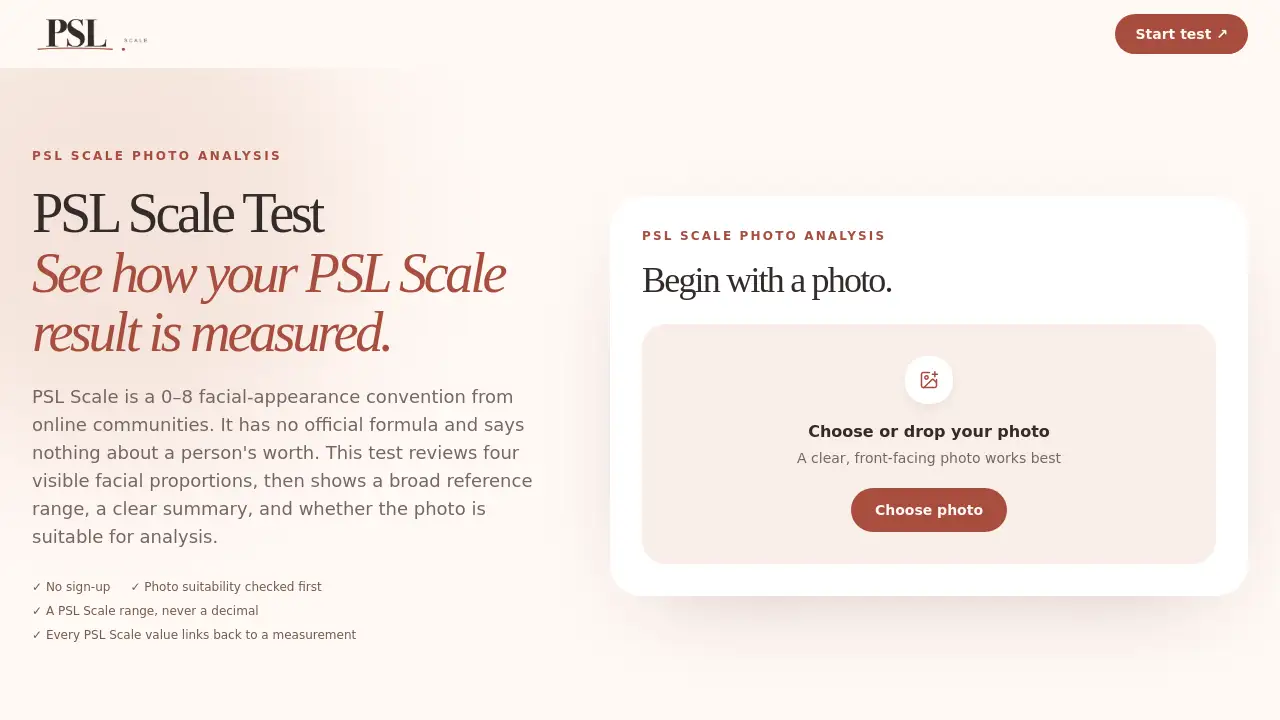
PSL Scale is a free photo-based facial proportion test. It reports a broad range from 0–8, four measurement summaries, and practical photo guidance without requiring an account. The test is designed for people who want to understand how a photo is measured, not to receive a medical or scientific verdict. It checks photo suitability first and keeps the final result as a band, not a decimal. This makes the tool useful for reading online scores, comparing photos under similar conditions, and seeing which visible facial proportions inform an estimate.
What is PSL Scale?
PSL Scale is a community convention for describing facial appearance on a roughly 0–8 scale. The name comes from three online forums—PUAHate, SlutHate and Lookism—and later spread through looksmaxxing circles. There is no official formula, and no medical or psychological body publishes it. That means different PSL Scale charts can use different band boundaries, so a score from one site may not match another.
The test turns that convention into a structured photo review. It examines four visible relationships: left-to-right balance, vertical proportions, horizontal spacing, and face length and width. Rather than giving a precise decimal, it returns a broad PSL Scale range. Every value links back to a measurement summary, helping users see why a range was shown.
This approach solves a common problem: raw PSL Scale scores often look more scientific than they are. A PSL Scale photo analysis can be useful for comparing photos, but it cannot describe a person's worth or provide a clinical diagnosis. The tool is suitable for people who have seen PSL Scale results online and want a clearer, more neutral explanation. It is also useful for anyone curious about facial proportion measurement, photo conditions, and the limits of 2D images.
Key Features of PSL Scale
Photo Suitability Check
The tool checks whether the uploaded photo is suitable before giving a result. This step reduces misleading readings caused by angle, lighting, filters, or distance.
Four Measurement Summaries
The test reviews left-to-right balance, vertical proportions, horizontal spacing, and face length and width. Each measurement includes a plain-language meaning and a note about what it cannot tell.
Broad PSL Scale Range
Instead of a decimal score, PSL Scale reports a broad range on the 0–8 convention. This reflects the uncertainty of a single photo and avoids false precision.
No Sign-Up Required
Users can access the test without creating an account. The basic result is free and available after a suitable photo is selected.
Practical Photo Guidance
The tool provides a photo checklist and one concrete suggestion after the analysis. This helps users improve consistency when comparing readings.
Clear Privacy Handling
The selected photo is used for the current photo analysis and is cleared when the test is reset or the page is left. This session-based approach keeps the process simple.
Plain-Language Limits
The test explains what a frontal photo can and cannot support. Side-view features such as chin projection are not scored, which keeps the result within realistic limits.
Use Cases for PSL Scale
Reading a PSL Scale Score
Someone who has seen a score online can use the test to understand which visible proportions may have informed it. This makes the chart easier to interpret.
Comparing Photos Under Similar Conditions
Users can compare different photos, hairstyles, or lighting setups while keeping camera distance and angle similar. The measurement then shows which changes come from the photo itself.
Learning Facial Proportion Basics
The test introduces vertical thirds, horizontal fifths, and face length-to-width ratios in simple terms. It treats these rules as descriptive tools, not beauty targets.
Checking a Photo Before Sharing
A user can run a photo through the tool to see whether it is usable for facial proportion analysis. This is helpful before posting in forums or comparing results with others.
Understanding the Limits of PSL Scale
The tool clearly states that PSL Scale is a community convention, not a validated standard. This helps users avoid treating a result as a medical or scientific fact.
How to Use PSL Scale
- Choose one clear, front-facing photo with even light and no beauty filters. A distance of about 1.5 meters, cropped to the face, is recommended.
- Start the test. The tool first checks whether the photo is suitable for photo analysis.
- Read the broad range, the four measurement summaries, and the plain-language notes. Each value should link back to visible evidence.
- If comparing another photo, keep distance, angle, expression, and lighting as similar as possible. Then compare the measurements rather than only the final band.
- Reset the test or leave the page to clear the photo. No account is needed.
Target Audience for PSL Scale
- People who have seen PSL Scale scores and want to understand how they are formed.
- Users in looksmaxxing or appearance-focused communities who want a neutral photo analysis.
- Anyone comparing photos, lighting, or styling choices under consistent conditions.
- People curious about facial proportions, vertical thirds, horizontal fifths, and face length-to-width ratios.
- Users who prefer a free, no-sign-up tool with clear limits and privacy notes.
Is PSL Scale Free?
| Plan | Price | Features |
|---|---|---|
| Free | $0 | Broad range, four measurement summaries, photo suitability check, one suggestion, no sign-up required |
The reference information lists no paid plan or subscription. The test is free to use, and no account is required. If pricing changes, users should check the official page for current details.
PSL Scale's Pros and Cons
| Aspect | Pros | Cons |
|---|---|---|
| Pricing | Free to use with no sign-up | No premium features are described |
| Features | Four measurement summaries, photo check, broad range | Does not provide an official or clinically validated score |
| Privacy | Photo is cleared on reset or page exit | Long-term report saving is not mentioned |
| Usability | Simple three-step process with a checklist | Results can change with angle, light, lens, and expression |
| Interpretation | Explains limits in plain language | PSL Scale remains a community convention, not a standard |
| Scope | Focuses on visible 2D proportions | Side-view and bone structure are not fully assessed |
Frequently Asked Questions about PSL Scale
What is PSL Scale, and does it have an official formula?
PSL Scale is a 0–8 facial-appearance convention that spread through online communities. The name comes from three forum names, and no official body publishes a formula. Different charts can use different band boundaries, so scores are not directly convertible.
Is the PSL Scale test free?
Yes. The basic test is free. One suitable photo provides a broad range, four measurement summaries, a photo check, and one suggestion. No account is required.
Does PSL Scale keep my photo?
No. The selected photo is used for the current photo analysis and is cleared when the test is reset or the page is left. This is stated in the reference information.
Is a PSL Scale result accurate?
A result is a geometric reading of one photo, not a measurement of a person. It is not clinically or scientifically validated, and the tool does not claim an accuracy percentage. It should be treated as a consistent photo-based reference.
Why does my PSL Scale result change between photos?
Distance, angle, expression, lighting, and lens choice all affect readings. A close selfie can change apparent nose-to-face-width proportions. To compare results, keep shooting conditions as similar as possible.
What is the difference between PSL Scale 5 and 6?
Each band is a label on a continuous convention. A small numeric change does not mean a person has changed. This is why the test publishes a broad range instead of a precise decimal.
PSL Scale Tags
PSL Scale, PSL Scale test, PSL Scale chart, PSL Scale range, PSL Scale photo analysis, PSL Scale result, PSL Scale measurement, PSL scale 0-8, facial proportion test, looksmaxxing PSL Scale, free PSL Scale test, PSL Scale calculator