Introduction
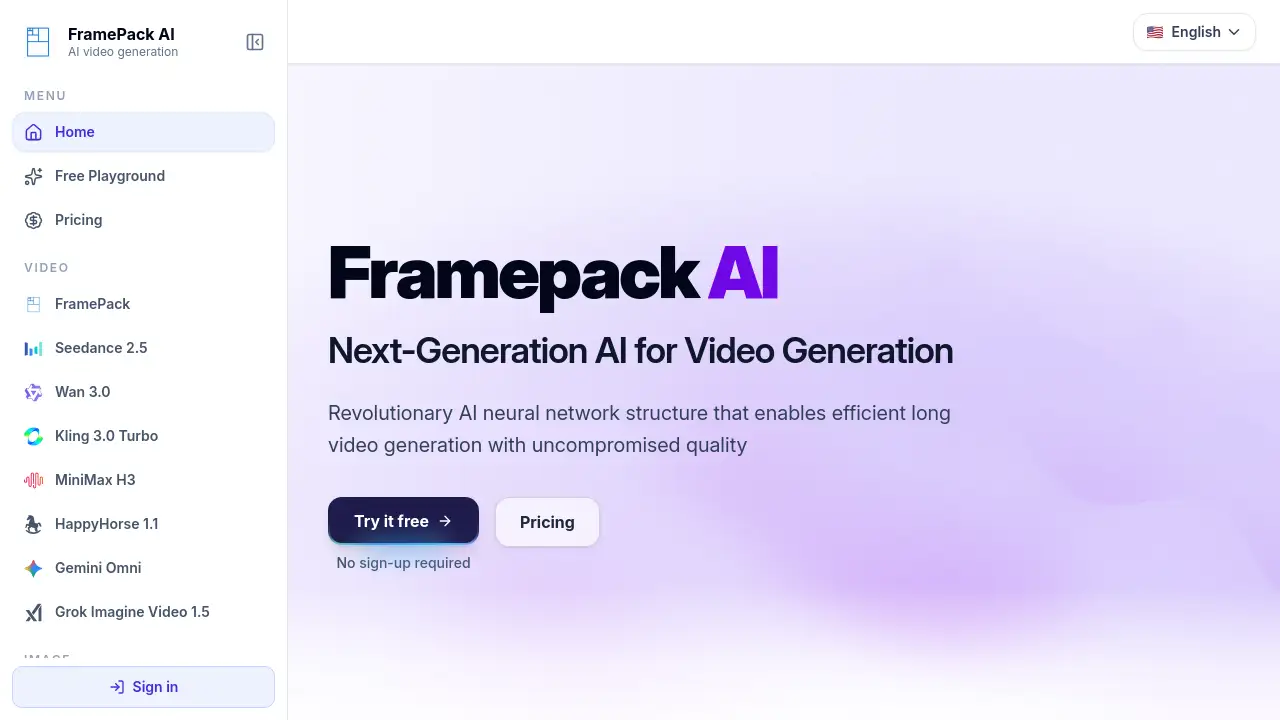
FramePack AI is a neural network framework for efficient long video generation. It helps AI video models create longer, consistent clips without a huge rise in computing needs. This review explains FramePack AI features, use cases, and who it suits.
What is FramePack AI?
FramePack AI is a groundbreaking neural network structure developed by researchers at Stanford University. It is designed to improve how AI video generation models handle long-form content. The system targets the "forgetting-drifting dilemma" that often limits long video generation. Forgetting means a model loses memory of earlier frames. Drifting means visual quality degrades as errors build over time. FramePack AI addresses both issues with progressive compression and anti-drifting sampling.
Unlike many AI video generation tools, FramePack AI is not just a simple app. It is an architecture and sampling method that can work with existing video diffusion models. It maintains a fixed transformer context length regardless of video duration. This fixed context length allows the system to process more frames without increasing computational requirements in the same way. As a result, FramePack AI makes long video generation more practical for research and development teams. It is suitable for AI researchers, machine learning engineers, and studios exploring advanced AI video generation.
Key Features of FramePack AI
Fixed Context Length
FramePack AI keeps a constant computational bottleneck no matter how long the input video is, enabling efficient long video generation on compatible hardware.
Progressive Compression
It applies higher compression rates to less important frames, optimizing memory usage while preserving critical visual information for long video generation.
Anti-Drifting Sampling
This novel sampling approach generates frames with bi-directional context to prevent quality degradation over time, a common issue in long video generation.
Compatible Architecture
FramePack AI works with existing pretrained video diffusion models through fine-tuning rather than requiring retraining from scratch.
Balanced Diffusion
It supports more balanced diffusion schedulers with less extreme flow shift timesteps, helping improve visual quality in generated videos.
Higher Batch Sizes
FramePack AI enables training with batch sizes comparable to image diffusion models, which can significantly accelerate the training process for long video generation.
Use Cases for FramePack AI
Extended Video Generation
FramePack AI helps create longer, high-quality videos without computational explosion or quality degradation, supporting consistent multi-minute narratives and long video generation.
Image-to-Video Conversion
The framework can transform still images into smooth, consistent video sequences with natural motion, making image-to-video generation more reliable.
Text-to-Video Generation
FramePack AI supports text-to-video generation from prompts with enhanced consistency and temporal coherence, reducing visual degradation across scenes.
AI Video Research and Fine-Tuning
Researchers can fine-tune compatible video diffusion models with FramePack AI to study long video generation, sampling methods, and training efficiency.
How to Use FramePack AI
FramePack AI is a research-oriented framework, so usage often involves model setup and fine-tuning rather than a one-click web tool.
- Review the technical resources and model variants. FramePack AI offers base, lite, and extended configurations with different parameter counts and context lengths.
- Choose a compatible base model, such as HunyuanVideo or Wan, if supported by the implementation.
- Fine-tune the selected video diffusion model using the FramePack AI method, including progressive compression and anti-drifting sampling.
- Set hardware according to the requirements. Training may need multiple A100-80GB GPUs, while inference can run on a single A100-80GB or two RTX 4090 cards in some setups.
- Generate video and evaluate clarity, motion smoothness, semantic consistency, and drifting error over longer durations.
Target Audience for FramePack AI
- AI researchers studying video diffusion models and neural network architectures
- Machine learning engineers who work with long video generation pipelines
- Video generation developers building image-to-video or text-to-video systems
- Content studios exploring advanced AI video generation for longer narratives
- Teams with access to high-memory GPUs for training and inference
Is FramePack AI Free?
Pricing information for FramePack AI is not provided in the available reference content. The product homepage focuses on the technical architecture and performance rather than subscription plans. There is no clear indication of a free plan or trial in the reference. Users should visit the official FramePack AI website to check current access options, licensing, and any available pricing details. Because FramePack AI is presented as a research-driven neural network structure, access may depend on code releases, model weights, or cloud GPU services rather than a simple monthly plan.
FramePack AI's Pros and Cons
| Aspect | Pros | Cons |
|---|---|---|
| Innovation | Solves forgetting and drifting in long video generation | Requires technical understanding to implement |
| Efficiency | Fixed context length and progressive compression reduce memory pressure | Still needs high-memory GPUs for best results |
| Compatibility | Works with existing video diffusion models via fine-tuning | Not a simple consumer video editor |
| Training | Higher batch sizes can accelerate training | Full training may require multiple A100-80GB GPUs |
| Access | Technical resources and model variants are described | Pricing and public access details are unclear |
Frequently Asked Questions about FramePack AI
What is FramePack AI?
FramePack AI is a neural network structure for efficient long video generation. It was developed by researchers at Stanford University and is designed to improve AI video generation quality over longer durations.
How does FramePack AI solve forgetting and drifting?
FramePack AI uses progressive compression to prioritize important frames and anti-drifting sampling to reduce error accumulation. Together, these methods help maintain consistency and visual quality in long video generation.
What hardware is needed to run FramePack AI?
The reference lists training requirements of around 8× A100-80GB GPUs. Inference can use a single A100-80GB or 2× RTX 4090, with memory usage around 40GB for 480p video generation.
Is FramePack AI compatible with existing video models?
Yes. FramePack AI is described as compatible with pretrained video diffusion models such as HunyuanVideo and Wan through fine-tuning. It does not necessarily require training a model from scratch.
Can FramePack AI create image-to-video and text-to-video content?
FramePack AI supports image-to-video conversion and text-to-video generation. It aims to improve temporal coherence, identity preservation, and consistency across generated scenes.
Is FramePack AI free?
The available reference does not confirm a free plan or pricing. Users should check the official FramePack AI website for current licensing, access, and cost information.
FramePack AI Tags
FramePack AI, long video generation, AI video generation, video diffusion models, neural network, image-to-video, text-to-video, progressive compression, anti-drifting sampling, fixed context length, AI video generator, Stanford University