Introduction
Siebly.io simplifies crypto exchange API integration.
What is Siebly.io?
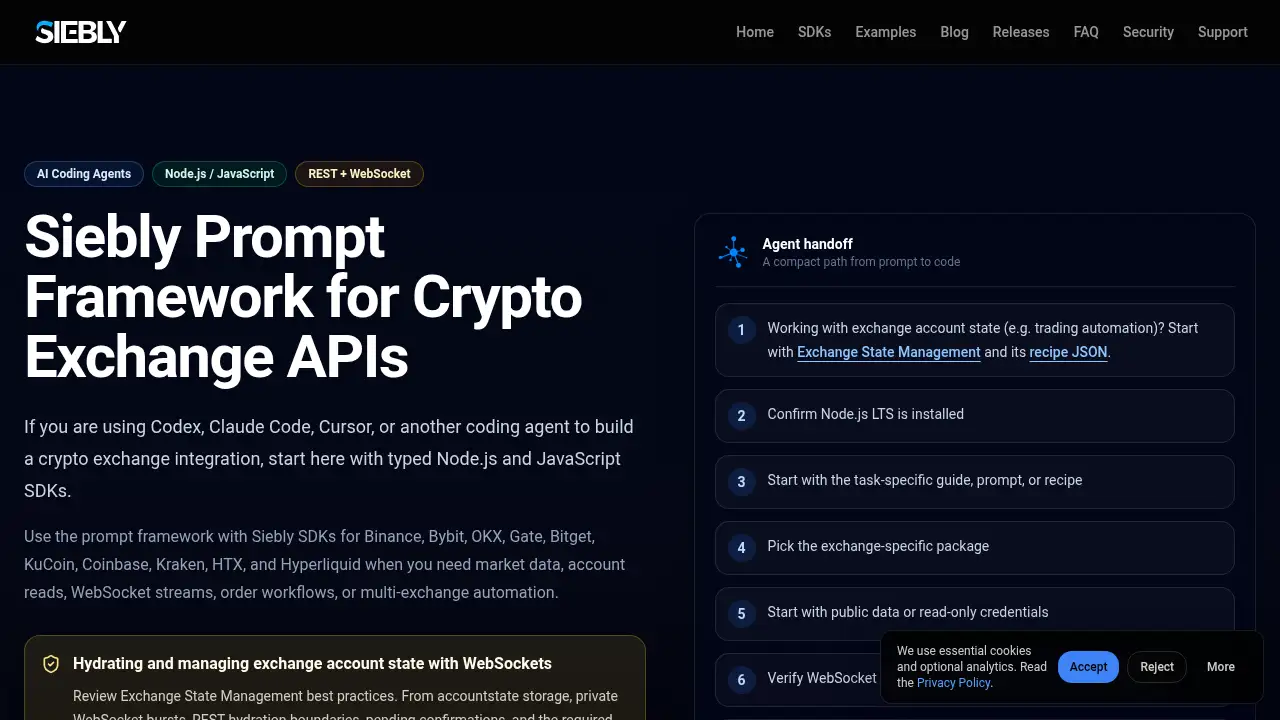
Siebly.io is a developer resource for crypto exchange API integration with AI coding agents. It combines structured prompts, recipes, patterns, examples, and typed Node.js and JavaScript SDKs for exchanges such as Binance, Bybit, OKX, Gate, Bitget, KuCoin, Coinbase, Kraken, HTX, and Hyperliquid. The product is designed for workflows that use Codex, Claude Code, Cursor, or similar tools to build REST and WebSocket integrations for market data, account reads, order workflows, and multi-exchange automation. Instead of asking an AI agent to infer exchange behavior from scattered documentation, users can start with task-specific guidance and SDK types. It matters because crypto integrations involve credentials, reconnect logic, state hydration, and exchange-specific rules; Siebly.io gives those tasks a clearer starting point while still requiring review and testing.
Key Features of Siebly.io
Prompt Framework for AI Coding Agents
Build focused prompts for an exchange integration by choosing a recipe, exchange, product scope, data path, and execution boundary. The prompt generator adds sequencing, safety gates, and acceptance criteria for AI coding agents.
Typed Node.js and JavaScript SDKs
Use exchange-specific JavaScript SDKs to expose REST request shapes, WebSocket event payloads, subscription helpers, and shutdown APIs before runtime. The Node.js packages help coding agents write code against types rather than assumptions.
Broad Exchange Coverage
Target supported markets such as Binance, Bybit, OKX, Gate, Bitget, KuCoin, Coinbase, Kraken, HTX, and Hyperliquid. This coverage supports multi-exchange automation and adapter-based projects.
REST and WebSocket Workflow Support
Plan market data reads, account reads, private streams, order workflows, and reconnect handling with REST and WebSocket patterns. Verify readiness gates such as subscription acknowledgement and backfill completion before enabling live processing.
Exchange State Management Guidance
Follow guidance for account state storage, private WebSocket bursts, REST hydration boundaries, pending confirmations, and fixtures. This is useful for correctness-sensitive crypto exchange API integration work.
Recipes, Patterns, and Examples
Start from reusable recipes, patterns, and browseable examples instead of a blank prompt. These resources help AI coding agents move from task description to an implementation draft.
Review and Safety Checkpoints
Review generated files, tests, README instructions, environment variables, logs, and agent warnings before connecting credentials or enabling exchange-facing behavior. For order-capable projects, use explicit runtime controls such as DRY_RUN_PRIVATE by default.
Use Cases for Siebly.io
Market Data and Historical-Live Pipelines
Use Siebly.io to guide AI coding agents through public market data, historical backfill, live streams, and replay-aware processing. This fits dashboards, research tools, and monitoring jobs.
Order Workflow Prototyping
Prototype order workflows with typed SDK support and safety gates before enabling private trading paths. Review execution boundaries, state changes, and failure handling carefully.
Multi-Exchange Automation
Build adapter-based projects that compare or route data across multiple exchanges. Siebly.io’s exchange-specific SDKs and prompt framework can reduce repeated setup work for AI coding agents.
Exchange State Management
Implement readable local account state with REST hydration, private WebSocket updates, pending confirmations, and reconnect resynchronization. This use case matters for systems that depend on correct balances and order status.
AI-Assisted Crypto Exchange API Integration Learning
Use task-specific prompts and examples to help developers learn exchange API patterns inside Codex, Claude Code, Cursor, or another coding agent. The output remains a draft that needs professional review.
How to Use Siebly.io
- Confirm Node.js LTS is installed before opening a coding agent.
- On Siebly.io, use the prompt generator to shape a focused crypto exchange API integration task by selecting a recipe, exchange, product scope, data path, and execution boundary.
- Copy the structured prompt into Codex, Claude Code, Cursor, or another AI coding agent, then choose the exchange-specific JavaScript SDK.
- Start with public market data or read-only credentials, and verify WebSocket lifecycle semantics before coding private workflows.
- Review the generated project, tests, README, and startup logs; keep private trading behind explicit runtime controls and default to DRY_RUN_PRIVATE for order-capable work.
Target Audience for Siebly.io
- JavaScript and TypeScript developers building crypto exchange integrations
- Developers using Codex, Claude Code, Cursor, or similar AI coding agents
- Quant developers and trading tool teams working with market data and order workflows
- Backend engineers implementing REST, WebSocket, and exchange state management
- Teams exploring multi-exchange automation and adapter-based architecture
Is Siebly.io Free?
The reviewed Siebly.io pages do not publish plan prices, trial terms, or usage limits. Public resources described on the site include the AI page, prompt generator, patterns, examples, and SDK documentation. Free or paid availability is not confirmed in the provided content, so users should check the official Siebly.io site or contact the team for current commercial terms before relying on the service in production.
Siebly.io's Pros and Cons
| Aspect | Pros | Cons |
|---|---|---|
| Focus | Clear support for crypto exchange API integration with AI coding agents | Narrow focus on Node.js, JavaScript, and crypto exchange workflows |
| SDK design | Typed JavaScript SDKs for REST, WebSocket events, and exchange-specific packages | Requires developer knowledge of exchange APIs, credentials, and deployment |
| Workflow guidance | Recipes, prompts, patterns, and review checkpoints | AI-generated output still needs testing, security review, and compliance review |
| Exchange coverage | Multiple major exchanges and multi-exchange automation support | Pricing and commercial terms are not clear from reviewed pages |
| Safety | Emphasizes read-only starts, readiness gates, and DRY_RUN_PRIVATE defaults | Users remain responsible for trading risk, credentials, and exchange rules |
Frequently Asked Questions about Siebly.io
What is Siebly.io used for?
Siebly.io helps developers and AI coding agents start crypto exchange API integration projects with structured prompts, recipes, typed JavaScript SDKs, and REST and WebSocket guidance. It is not a trading strategy service.
Which AI coding agents can use Siebly.io?
The site is written for Codex, Claude Code, Cursor, and similar AI coding agents. Users copy structured prompts into the agent and then review the generated project.
Which crypto exchanges are covered?
The reviewed material lists Binance, Bybit, OKX, Gate, Bitget, KuCoin, Coinbase, Kraken, HTX, and Hyperliquid. Availability can change, so check the official SDK list for current coverage.
Does Siebly.io execute trades or manage funds?
No. Siebly.io provides prompts, SDK documentation, examples, and implementation guidance. Any order workflow, credential handling, and live trading logic must be built and reviewed by qualified professionals.
Is Siebly.io suitable for beginners?
It can help beginners follow structured steps, but users should understand Node.js, REST and WebSocket APIs, exchange credentials, and risk controls before enabling private or order-capable workflows.
Is Siebly.io free?
The reviewed pages do not publish pricing, trial terms, or plan limits. Free or paid availability is not confirmed, so users should check the official Siebly.io site or contact the team for current terms.
Siebly.io Tags
Siebly.io, crypto exchange API integration, AI coding agents, JavaScript SDKs, Node.js crypto API, REST WebSocket crypto, crypto exchange automation, exchange state management, Binance API SDK, Bybit API SDK, prompt framework for coding agents, multi-exchange automation