Introduction
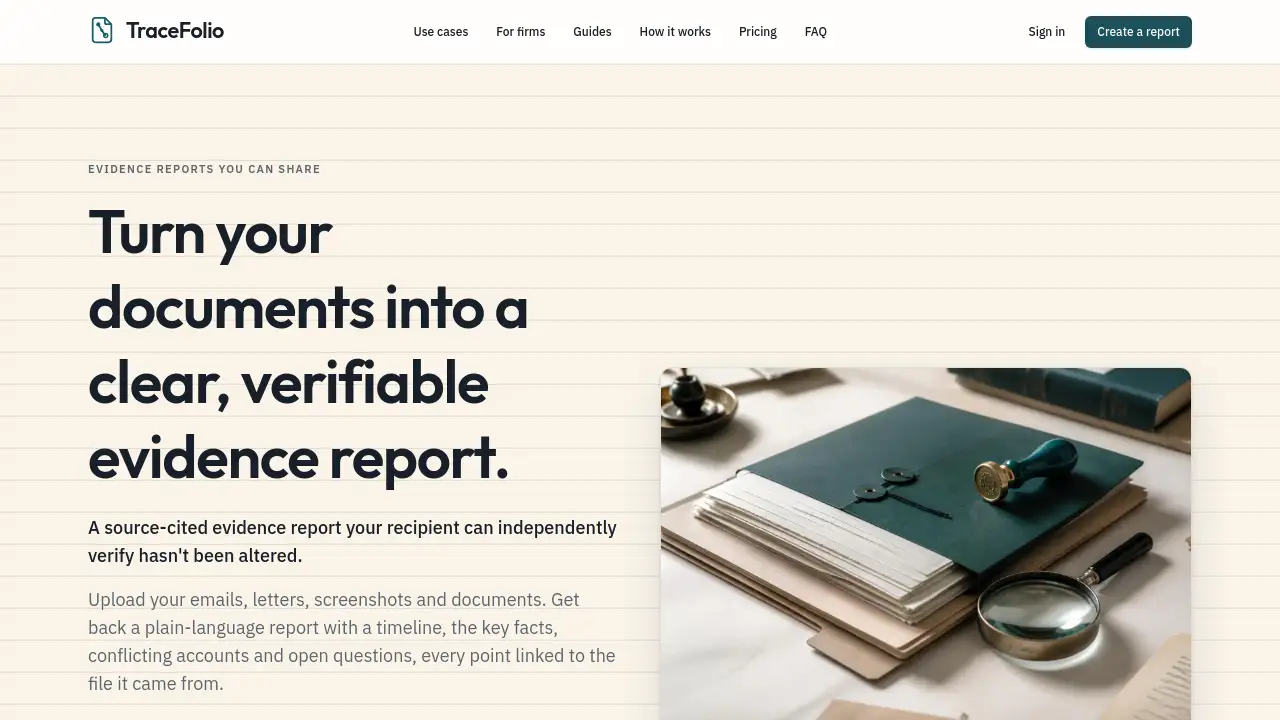
TraceFolio is an online evidence organisation service that converts uploaded emails, letters, documents, and screenshots into a source-cited evidence report. The report includes a clear timeline, key facts, contradictions, open questions, and every claim is linked back to the file where it came from. Because the final PDF carries a verification record, recipients can check that the evidence report has not been changed after it was issued. This makes TraceFolio a practical option for anyone preparing material for a dispute, complaint, or claim.
What is TraceFolio?
TraceFolio is a document-to-report tool designed for people who need to turn messy correspondence into an organised, readable record. It addresses the common problem of having dozens of emails, photos, contracts, and letters spread across different places. Instead of asking readers to wade through the original files, TraceFolio produces a plain-language evidence report with a timeline and key facts, all annotated with source references. This matters because disputes often fail on poor presentation. A clear, verifiable evidence report can make it easier for landlords, insurers, adjudicators, or solicitors to understand what happened. TraceFolio does not act as a judge or decide who is telling the truth; it simply organises what the documents say and highlights where accounts conflict.
Key Features of TraceFolio
Build a source-cited evidence report
Every fact, date, and open question in the report names its source file and page. This source-cited approach allows the reader to check each detail against the original documents without guessing where evidence came from.
Create a chronological document timeline
TraceFolio extracts dates from the uploaded files and arranges them into a dated timeline. A chronological document timeline helps show the order of events, which is often essential in a dispute or complaint.
Surface contradictions
The tool compares across documents and flags where accounts disagree. Highlighting conflicting accounts early can save time when preparing a claim or answering a challenge.
Add independent verification
The finished PDF includes a cryptographic integrity record. Anyone who receives the report can independently check that the report file matches the one issued by TraceFolio, proving it was not altered afterwards.
Support multiple file types
Users can upload PDFs, DOCX files, TXT files, and JPG or PNG screenshots and scans. Up to 20 files can be included in a single report, and the service accepts images of paperwork, making it flexible for different evidence-gathering situations.
Keep documents private
Reports are visible only to the user's account. Uploaded documents are deleted about 24 hours after the report is finished, while the fingerprints needed to keep the report verifiable are retained.
Use Cases for TraceFolio
Landlord repair disputes
Tenants can bring together repair photos, emails, and letters into one dated evidence record. A chronological document timeline can help show how long a repair issue has been reported.
Tenancy disputes
Notices, emails, and letters from a tenancy disagreement can be combined into a clear timeline. TraceFolio helps a tenant or landlord present their side in an orderly way.
Consumer complaints
Order confirmations, receipts, and support chats can be turned into a single complaint record. An evidence report with source citations makes it easier for a customer service team to review the issue.
Insurance claims
Policyholders can pull correspondence, photos, and assessor reports into one dated claim timeline. This helps show the sequence of events when a claim is disputed.
Workplace grievances
Employees can turn emails, meeting notes, and messages into a factual timeline for a grievance process. The report can be shared with HR or an external investigator.
Ombudsman complaints
Consumers preparing to escalate to an ombudsman scheme can create a dated timeline of their complaint history. TraceFolio helps organise prior contacts and evidence before the escalation.
How to Use TraceFolio
Using TraceFolio to create a verifiable evidence report is straightforward:
- Create an account and select the type of issue you are dealing with, such as a landlord dispute or consumer complaint.
- Upload up to 20 files, including emails, letters, screenshots, scans, and images. Each file is checked and fingerprinted as it arrives.
- Let TraceFolio process the documents. The system extracts text, indexes it by file and page, and organises the findings into a timeline, key facts, contradictions, and open questions.
- Download the finished PDF report. The downloaded report comes with a verification link.
- Share the report and the link with any recipient. The recipient can check that the report file they hold has not been changed since TraceFolio issued it.
Target Audience for TraceFolio
- Tenants and landlords involved in housing disputes
- Consumers preparing complaints about products or services
- Employees handling workplace grievances
- Small business owners in contractor or supplier disputes
- Insurance policyholders appealing a claim decision
- Individuals preparing for ombudsman complaints or court proceedings
- Anyone who needs to share a clear document timeline with a third party
Is TraceFolio Free?
TraceFolio is not a free tool. It uses a pay-per-report model with no subscription. Users choose a plan based on the size and complexity of their evidence set.
| Plan | Price | Features |
|---|---|---|
| Quick Report | £9.99 | Up to ~15 pages; core source-cited evidence report |
| Detailed Report | £29 | Up to ~50 pages; deeper cross-source review |
| Extended Report | £79 | Up to ~150 pages; comprehensive review for large evidence sets |
Prices are in British pounds. There is no mention of a free trial on the referenced homepage, so users should check the official TraceFolio pricing page for any updates or special offers.
TraceFolio's Pros and Cons
| Aspect | Pros | Cons |
|---|---|---|
| Pricing | No subscription, pay per report; suitable for one-off disputes | Costs can add up if used frequently |
| Report quality | Every point source-cited; plain-language evidence report | Does not determine who is right or provide legal advice |
| Verification | Independent verification link proves the PDF has not been altered | Verification does not authenticate the original documents' truth |
| Privacy | Uploads deleted after about 24 hours | Report is only visible on the user's account; no team sharing mentioned |
| Usability | Simple upload process and clear output | Users must supply all relevant documents themselves |
Frequently Asked Questions about TraceFolio
What is TraceFolio?
TraceFolio is an online service that turns documents into a source-cited evidence report. It creates a timeline, summarises key facts, identifies contradictions and open questions, and links every point to the original file.
What types of documents can I upload?
You can upload PDFs, Word documents (DOCX), plain text files (TXT), and images such as PNG or JPG screenshots and scans. Up to 20 files can be included in one report.
Does TraceFolio decide who is telling the truth?
No. TraceFolio does not judge the truthfulness of any account. It organises what the documents say and highlights where accounts agree or disagree, so the reader can reach their own conclusion.
How long are the source documents kept?
Source documents are deleted about 24 hours after processing is complete. TraceFolio keeps only the fingerprints needed to support the verification process for the finished report.
What does the verification link prove?
The verification link proves that the delivered PDF is cryptographically linked to the recorded evidence manifest and the exact report file generated. In simple terms, it shows the report has not been altered since it was issued.
Is TraceFolio legal advice?
No. TraceFolio is not legal advice and not a substitute for a qualified professional. It organises and summarises evidence; it does not explain legal rights or recommended actions.
TraceFolio Tags
TraceFolio, evidence report, source-cited report, document timeline, dispute evidence, independent verification, plain-language report, tracefolio review, evidence organisation tool, document verification, pay per report, dispute documentation