Why AI Search Optimization Consultants Start With Your Reputation, Not Your Keywords
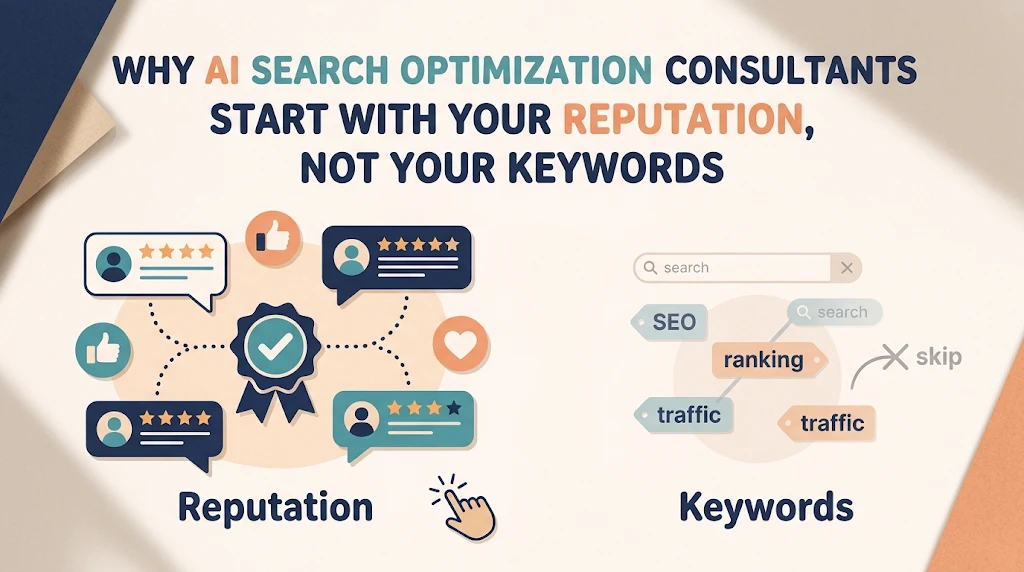
Ask ChatGPT who the best accountant in your city is, or which project management platform fits a 40-person agency, and you'll get a short list with reasons attached. Nobody typed a keyword to get there. The model read reviews, forum threads, comparison articles, and news coverage, then decided which names deserved to be in the answer and what to say about them.
That's the reason good AI search optimization consultants open an engagement by pulling your reputation apart, not your keyword rankings. The keyword list still matters. It just isn't the thing an AI model consults when it decides whether to recommend you.
What is an AI search optimization consultant?
An AI search optimization consultant is a specialist who improves how often, and how accurately, a brand appears in answers generated by tools like ChatGPT, Google AI Overviews, AI Mode, Gemini, Claude, and Perplexity. The work combines generative engine optimization (GEO), answer engine optimization (AEO), technical SEO, and reputation management, because AI models build answers from what independent sources say about a brand.
That last clause is where most of the field splits. Some consultants treat AI search as SEO with a new label: same keyword research, same on-page checklist, maybe some FAQ schema bolted on. Others treat it as a reputation problem with a technical layer underneath. The second group is right, and the data says so.
Keywords tell a model what you want to rank for. Reputation tells it whether to believe you.
Classic search matched a query to a page. If your page used the right terms, earned enough links, and loaded fast, you ranked. The page you wrote was the thing being judged.
Large language models don't work that way. When someone asks "is [company] legit" or "best reputation firm for a CEO," the model pulls from a set of sources, weighs them, and writes one answer. Your own website is one voice in that set, and usually not the loudest.
Muck Rack's May 2026 What Is AI Reading? report, which analyzed more than 25 million links cited by ChatGPT, Claude, and Gemini across 17 industries, found that 84% of AI citations came from earned media. Paid and advertorial content accounted for 0.3%. Journalism alone made up 27% of cited sources.
Ahrefs found the same pattern from a different angle. In its study of 75,000 brands (published May 2025, updated in 2026), branded web mentions had a 0.664 correlation with appearing in Google AI Overviews. That was the strongest factor measured. Backlinks came in at 0.218, the weakest of the five. Brand mentions out-correlated links roughly three to one.
Put those two findings next to each other and the strategy writes itself. The signal that moves AI visibility is how often credible third parties talk about you, and what they say when they do. That is the definition of reputation.
A consultant who starts with a keyword gap analysis is optimizing the part of the system with the least leverage.
Where AI models go looking when they research your brand
Peec AI analyzed roughly 30 million cited sources across ChatGPT, Google AI Mode, Gemini, Perplexity, and AI Overviews in March 2026. The ten most-cited domains in the U.S. were Reddit, YouTube, LinkedIn, Wikipedia, Forbes, G2, Yelp, Facebook, Medium, and TechRadar.
Look at that list. Two are review platforms. One is a forum where strangers argue about which vendors are worth it. One is an encyclopedia with strict notability rules. Several are publishers. Exactly zero of them are your website.
This is what a reputation-first consultant maps in week one:
- Review platforms: Your ratings, review volume, recency, and response patterns on Google, Yelp, G2, Trustpilot, Clutch, or whatever matters in your category. AI summaries quote these directly.
- Community discussion: Reddit and niche forums where people describe their actual experience with you, including the threads you'd prefer didn't exist.
- Editorial coverage: Trade press, local news, and industry publications that mention you by name, and whether those mentions are favorable, neutral, or tied to a problem.
- Reference sources: Wikipedia, Wikidata, Crunchbase, and business directories that models use to confirm basic facts like founding date, leadership, and location.
- Comparison and listicle content: "Best X for Y" articles where you either appear, appear badly, or don't appear at all.
If those sources are thin, outdated, or negative, no amount of on-page optimization fixes the answer. The model is quoting the web, and the web hasn't said enough good things about you yet.
Your customers already trust the AI's version of you
This would be an academic point if buyers ignored AI answers. They don't.
BrightLocal's 2026 Local Consumer Review Survey found that 45% of consumers now use ChatGPT or other generative AI tools for local business recommendations, up from 6% the year before. Forty-two percent trust those AI recommendations as much as traditional reviews. And 82% read AI-generated review summaries, with 23% saying they'd rely on the summary alone to make a decision.
L.E.K. Consulting's 2026 research shows 46% of AI users now begin purchase research on a standalone AI platform, up from 25% in 2024, while the share starting on traditional search dropped from 43% to 24%. Almost a third of AI users say they had largely decided before ever reaching a brand's website.
Read that last stat twice. For a growing share of your buyers, the decision happens inside a chat window, based on a summary of your reputation that you didn't write. Your homepage copy, your keyword-optimized service pages, your carefully structured H2s: many buyers never see them before they've already ruled you in or out.
What a reputation-first engagement actually looks like
Strong AI search optimization consultants follow a sequence. The order matters more than any single tactic.
Step one: Ask the models what they think
Before anything else, run the prompts your buyers run. "Who is the best [service] in [city]?" "Is [brand] trustworthy?" "[Brand] vs [competitor]." "What are complaints about [brand]?" Run them across ChatGPT, Gemini, Perplexity, Claude, and Google AI Mode, and log every answer.
This baseline tells you three things a keyword tool can't: whether you appear at all, what the model says about you when you do, and which sources it cites to justify that answer. Tools like Ahrefs Brand Radar, Peec AI, and Profound can automate the tracking over time, but the first pass should involve a human reading every response.
Step two: Trace each claim back to its source
When ChatGPT says your firm "has mixed reviews about responsiveness," something on the web said that. Find it. It might be a 2022 Reddit thread with four upvotes. It might be a pattern across 30 Google reviews. It might be a competitor's comparison page that's wrong.
This source tracing is the core skill that separates reputation-first consultants from everyone else. You can't change an AI answer by arguing with the model. You change it by changing what the model reads.
Step three: Fix the inputs, starting with the worst ones
Now the work branches. Negative or inaccurate sources get addressed through review response, review generation from real customers, correction requests to publishers, or suppression with stronger content. Gaps get filled through earned media, expert contributions, podcast appearances, and accurate directory listings. Factual errors in reference sources like Wikidata or Crunchbase get corrected through the proper channels.
This is slow work. It's also the only work that compounds, because every credible third-party mention keeps paying out every time a model re-reads the web.
Step four: Make your own site easy to quote
Only now does owned content take center stage. Once the third-party record supports your claims, your website's job is to make the facts easy to extract: clean entity data, Organization and FAQPage schema, direct-answer paragraphs, and pages that render without heavy JavaScript so AI crawlers can actually read them.
Notice where keywords show up in this sequence. They're inside step four, informing which questions your pages answer. They're a supporting tool, not the starting point.
The keyword-first trap, and why it's so common
If reputation drives AI visibility, why do so many consultants still lead with keywords?
Partly habit. A lot of firms now selling AI search services were SEO shops eighteen months ago, and keyword research is the muscle they've built. Partly it's that keyword work is easy to scope, easy to report on, and produces a deliverable on day one. Reputation work is messier. It means telling a client that their Glassdoor reviews are hurting their AI visibility, or that a three-year-old news story is the first thing Perplexity cites about them.
There's also a measurement problem. Rank tracking is mature and familiar. AI visibility tracking is newer, and answers can vary from one run to the next. A consultant who reports keyword positions can always show movement. A consultant who reports AI share of voice has to explain variance.
None of that makes keyword-first the right call. It just makes it the comfortable one.
How to tell if an AI search consultant actually works this way
You'll hear a lot of confident pitches. These questions sort them quickly:
- Current AI answers: Ask what ChatGPT and Gemini say about you right now. A serious consultant has already checked before the first call, or will offer to. If they can't answer, they haven't started where the work starts.
- Source tracing: Ask which sources those answers pull from. Look for specifics: named review sites, specific threads, particular articles. Vague talk about "authority signals" is a warning sign.
- Negative content: Ask how they handle negative or inaccurate sources. If the answer is "we'll outrank them with new content," they're thinking in blue links. You want to hear about review strategy, correction requests, and earned coverage.
- Effort split: Ask what share of the plan targets third-party sources versus your own site. Given that 84% of AI citations come from earned media, a plan that spends 90% of its effort on your pages is upside down.
- Measurement: Ask how they'll report progress. Expect AI share of voice, citation frequency, sentiment in AI answers, and accuracy of brand facts, tracked across multiple models over months. Keyword rankings can be part of the report. They shouldn't be the headline.
Reputation firms had a head start on this
The shift has created an odd reversal. For years, online reputation management sat slightly apart from SEO: related, overlapping, but a separate discipline. Now reputation work is the foundation AI visibility is built on, and the firms that spent a decade auditing review profiles, tracing negative content to its source, and earning third-party coverage were already doing the hardest part of the job.
NetReputation is one example. Its AI search work grew out of reputation monitoring and review management rather than the other way around, which means the first deliverable is usually a map of what models currently say about a client and why, not a keyword spreadsheet.
That's the model to look for, whoever you hire. Pick a consultant who wants to read your reviews before your analytics.
The bottom line on hiring AI search optimization consultants
AI search didn't make keywords useless. It demoted them. The question a model is answering is less "which page matches this query" and more "which brands do credible sources trust, and what do those sources say?"
That's a reputation question. The consultants getting results in 2026 treat it like one: they audit the answers, trace the sources, fix the inputs, and only then tune the site. Everyone else is polishing the one source the model trusts least.
FAQ
What do AI search optimization consultants do?
AI search optimization consultants improve how often and how accurately a brand appears in AI-generated answers from ChatGPT, Gemini, Perplexity, Claude, and Google AI Overviews. Their work covers auditing current AI answers, tracing which sources those answers cite, strengthening reviews and earned media, correcting inaccurate information, and structuring the brand's own site so models can extract facts cleanly.
Why does reputation matter more than keywords for AI search visibility?
AI models build answers from what independent sources say about a brand, not from keyword matching on its website. Muck Rack's 2026 research found 84% of AI citations come from earned media, and an Ahrefs study of 75,000 brands found brand mentions correlate with AI Overview visibility about three times more strongly than backlinks.
What sources do AI models cite most often?
Peec AI's March 2026 analysis of roughly 30 million citations found the most-cited domains across major AI engines were Reddit, YouTube, LinkedIn, Wikipedia, Forbes, G2, Yelp, Facebook, Medium, and TechRadar. That mix of forums, review platforms, reference sites, and publishers explains why reviews and third-party coverage carry so much weight in AI answers.
How long does AI search optimization take to show results?
Expect three to six months for meaningful movement in AI share of voice, with fixes to factual errors sometimes showing up sooner. Changes depend on how quickly new reviews, earned coverage, and corrected sources get indexed and picked up by each model, and results vary across ChatGPT, Gemini, Perplexity, and Google's AI features.
Is AI search optimization the same as GEO or AEO?
They overlap heavily. Generative engine optimization (GEO) focuses on visibility in AI-generated answers, while answer engine optimization (AEO) focuses on being the direct answer to a question. AI search optimization is the broader umbrella, typically combining both with technical SEO and reputation management, since all three affect what AI models say about a brand.
What should I ask before hiring an AI search optimization consultant?
Ask what ChatGPT and Gemini currently say about your brand, which sources those answers come from, how the consultant handles negative or inaccurate content, how much of the plan targets third-party sources versus your own site, and which metrics they'll report. Strong consultants answer with specifics, not general claims about authority.
Leave your comment
- No comments yet.
Recommended AI Tools
Carefully selected AI tools to improve your work, study, and live efficiency.

Related Articles
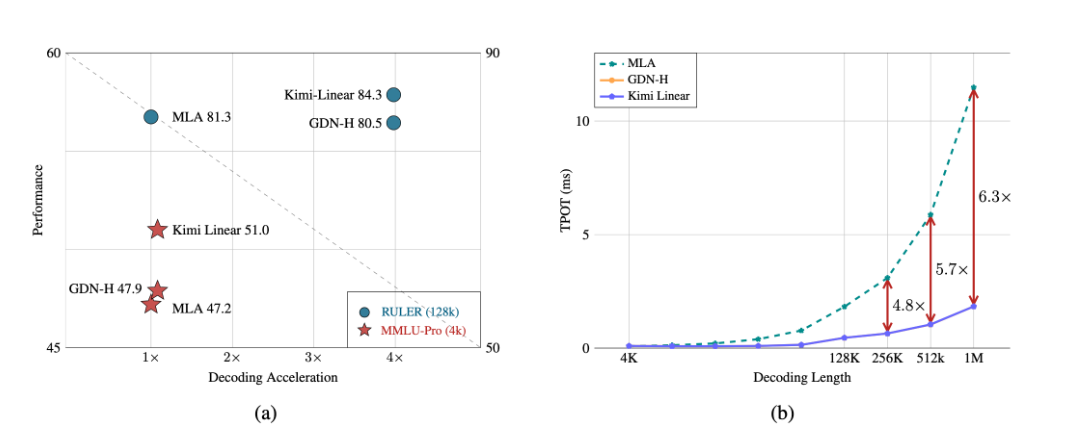
A major breakthrough has been achieved in the core architecture of large-scale models! The release of Kimi Linear marks the first time that linear attention technology has comprehensively surpassed and significantly outperformed the traditional Transformer full-attention model in both performance and efficiency. This "win-win" achievement is expected to significantly reduce the computational barriers and costs for long text processing, complex reasoning, and AI agent applications, potentially changing the competitive landscape of underlying technologies for large-scale models.
Over the past week, the AI community's attention has been drawn to a mysterious model that quietly emerged on the OpenRouter platform—Polaris Alpha. As a direct continuation of yesterday's discussion of the GPT-5.1 leak, this suddenly appearing model brings more technical details and strategic signals worthy of in-depth exploration.
Alibaba open-sources Qwen-Image-2.1: a 7B unified image model with native RGBA transparency and 10-reference editing.