Deep Dive into ChatGPT Image: Besides 'describing images,' what else can it do?
ChatGPT Images: A New Era in Image Generation
On December 16, 2025, OpenAI released a new version of ChatGPT Images, completing the GPT Image 1.5 model. This is not just a routine feature iteration, but more like a market battle. With competitors like Google Gemini, Anthropic, and Stability AI closing in, OpenAI has used a two-pronged approach of performance upgrades and cost optimizations to re-establish its competitiveness in the image generation field.
This release is worth careful consideration for AI tool developers and users. It's not just about how impressive the data looks, but also about understanding the underlying real-world implications—what it has actually changed and how it will affect your workflow.
Breakthroughs in Core Functionality
1. A New Level of Instruction Understanding
GPT Image 1.5 has taken a significant leap forward in text understanding. Nine out of ten prompts result in the expected generation, with instruction alignment reaching the vast majority. This may not sound remarkable, but in practical application, it becomes clear—what used to require a dozen rounds of revisions can now be finalized in two or three rounds.
What's even more interesting is the model's ability to understand complex scenes. Inputting "hippie dancers at the Bethesda Music Festival in New York, August 1969," the model can accurately capture the era's characteristics, clothing style, and environmental atmosphere. This reasoning ability based on historical background knowledge is the dividing line between consumer-grade toys and production-grade tools.
2. Controllability of Image Editing
This is the most noteworthy improvement in this update. Previously, modifying AI-generated images was a nightmare—trying to change a detail resulted in reinterpreting the entire image. Changing the color of a model's clothes completely altered their appearance.
GPT Image 1.5 breaks this deadlock. Through a more refined editing mechanism, it can preserve key elements such as lighting, composition, and the identity of individuals when modifying specific areas. The accuracy of single-round editing is significantly improved, which is crucial for professional workflows requiring multiple iterations.
For designers and e-commerce operators, the significance is direct—multiple fine-tuning adjustments can be made to the same base image. Change the pose but not the image; change the background but not the product's lighting and shadows—no need to start from scratch every time.
3. Breakthrough in Text Rendering
Writing text in AI-generated images has always been a problem. Garbled characters, pseudo-symbols, and spelling errors are commonplace. Now, ChatGPT Images can generate clear text, including dense typography and small font sizes, which is crucial for scenarios requiring large amounts of text, such as posters, infographics, and design drafts.
4. Upgraded User Experience
The newly added Images entry has given the interface a "creative studio" style. No more struggling to write excessively long prompts; the interface offers dozens of preset filters and trend indicators, lowering the learning curve for users with no prior experience.
The Practical Significance of Performance Metrics
Several Times Faster
This isn't just about saving time; it's a qualitative leap in experience. What used to take 30 seconds to generate now takes only 8 seconds, meaning real-time interaction is possible. During design review meetings, teams can instantly see the effects from different angles, instead of waiting until afterwards to see the results.
Cost Reduction of Nearly 20%
API prices have come down. For an e-commerce platform that generates tens of thousands of images daily, this reduction translates directly into substantial monthly cost savings. This also dispels the impression that "AI generation tools are just money-burning," making more business models feasible.
Overall Quality Approaching 90%
Combined with the alignment rate of the vast majority of instructions, ChatGPT Images achieves a combination of "high accuracy and high aesthetic appeal"—it can generate on demand, and the generated results can be directly used in commercial scenarios.
Market Landscape
Understanding ChatGPT Images requires an understanding of the entire industry. The current image generation market exhibits a vertically segmented structure. Below is a comparison of the major platforms:
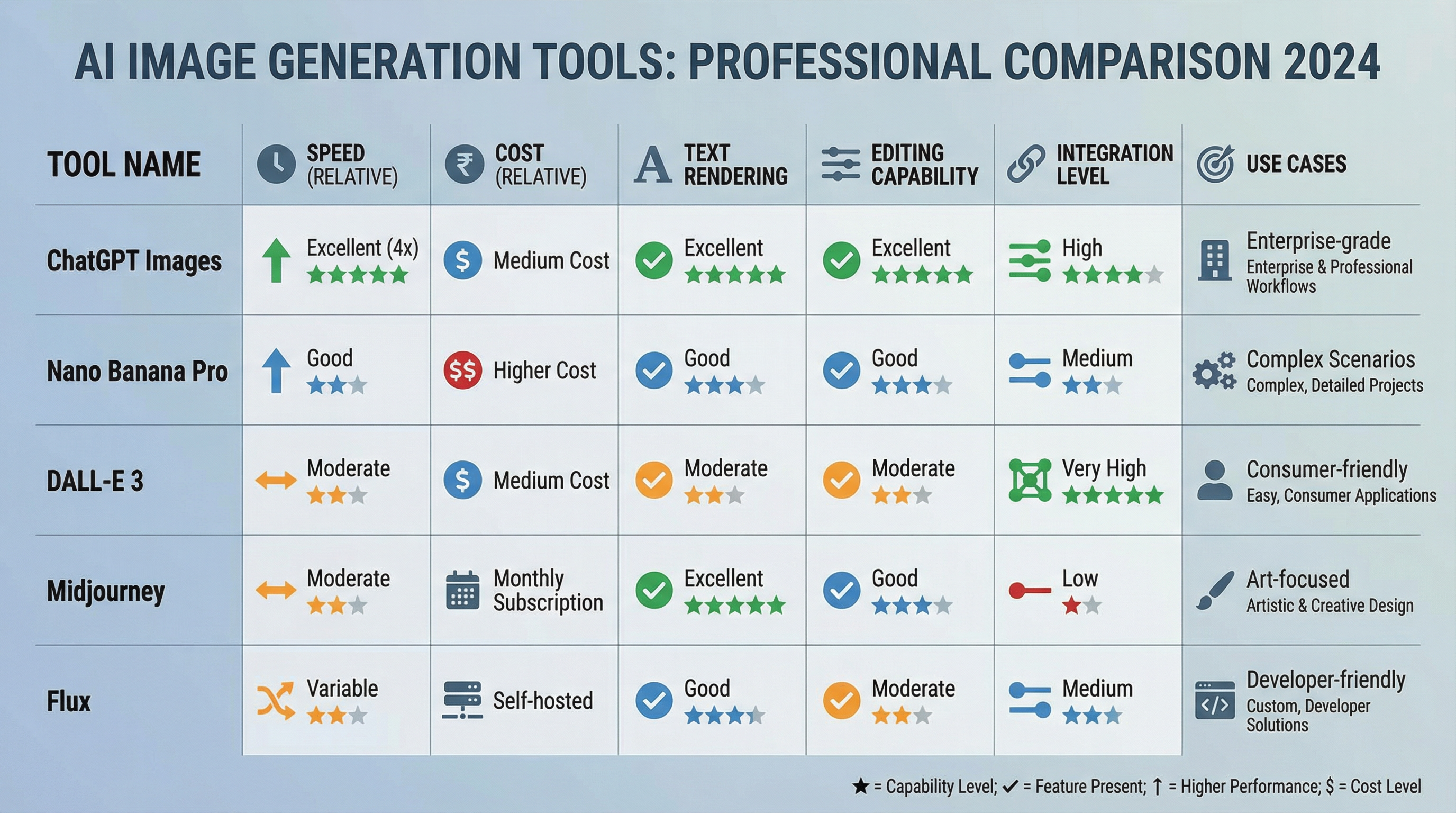
Table Description: This table shows a comparative analysis of five major image generation platforms. ChatGPT Images excels in speed, text rendering, and editing, while Midjourney excels in artistic styles, Flux in open-source flexibility, and Nano Banana Pro in high-resolution applications.
ChatGPT Images' strategy is "integration"—leveraging the scale advantage of the ChatGPT ecosystem through the integration of its WebUI and API to provide complete solutions for different users, from consumer to enterprise levels. This differs from Midjourney's "art-first" approach or Flux's "open-source-first" approach; instead, it prioritizes "integration."
vs. DALL-E 3: Essentially a complete version of DALL-E 3. It inherits the understanding of complex semantics, but its core breakthrough is solving the "can draw but can't edit" problem, especially in text rendering and local editing, upgrading it from a toy to a tool.
vs. Midjourney: Midjourney excels in artistic aesthetics, making it suitable for game concept art and design. However, it has shortcomings in semantic accuracy and text processing, and Discord's interaction method is relatively cumbersome. ChatGPT Images, like a "compliant designer," is more suitable for commercial applications.
vs. Nano Banana Pro: While its multiple reference images and high resolution are selling points, OpenAI has a clear advantage in versatility and ecosystem integration. It also offers greater stability and security for enterprise applications.
vs. Flux: While open-source and highly customizable, ChatGPT Images offers attractive local deployment, its out-of-the-box convenience makes it more user-friendly, especially for those who don't want to tinker with their environment.
How to Use
For Regular Users
Access the ChatGPT imagery by clicking the Images entry in the sidebar of the ChatGPT webpage or mobile app. The left side displays text commands and history, while the right side shows the live canvas. After entering prompts, the system instantly displays the generation progress and results, supporting online editing and downloading.
For Developers and Enterprises
The API is publicly available. Generation and editing functions are invoked via standard HTTP requests. The official SDK provides support in multiple languages, including Python and JavaScript, making integration relatively easy. Companies like Wix have already integrated this API into their design tools, providing automatic marketing material generation.
Real-World Application Scenarios
E-commerce and Marketing
Adding new products often involves high costs for shooting and retouching. Upload a product image with a white background, add prompts to place it in a beach or living room background, and directly render "Summer Sale" or "50% OFF" on a poster. Material production time has been reduced from "days" to "minutes," significantly reducing reliance on studios and models.
Design Prototype Iteration
Early stages of industrial and fashion design require rapid validation of ideas. Using local editing functions, while maintaining the product's outline, instructions can quickly switch materials ("frosted black aluminum" to "walnut wood grain") or change lighting, making "instant feedback" a reality and drastically shortening the decision-making cycle.
Content Automation
Brands with numerous social media accounts can build automated content pipelines. Input an article in the backend, and the system automatically extracts a summary, generates images, and renders the title on the cover—a fully automated content platform transforms the efficiency of brand communication.
Summary
ChatGPT Images, by addressing the two major pain points of "controllability" and "text rendering," has transformed AI painting from a "card game" into a true "productivity tool."
For marketers and content creators who need precise expression, ChatGPT Images is now the best choice, capable of understanding complex instructions and spelling correctly.
For illustrators pursuing the ultimate artistic style, Midjourney may still be the first choice, but ChatGPT Images can serve as an aid for inspiration and brainstorming.
For developers, OpenAI's API ecosystem remains the most robust, with improved cost and speed making it even more cost-effective.
In the competition of generative AI multimodalities, tool evolution has never stopped. The most important thing is to understand the boundaries of each tool and precisely embed it into your own workflow.
References
Leave your comment
- No comments yet.
Recommended AI Tools
Carefully selected AI tools to improve your work, study, and live efficiency.
Related Articles
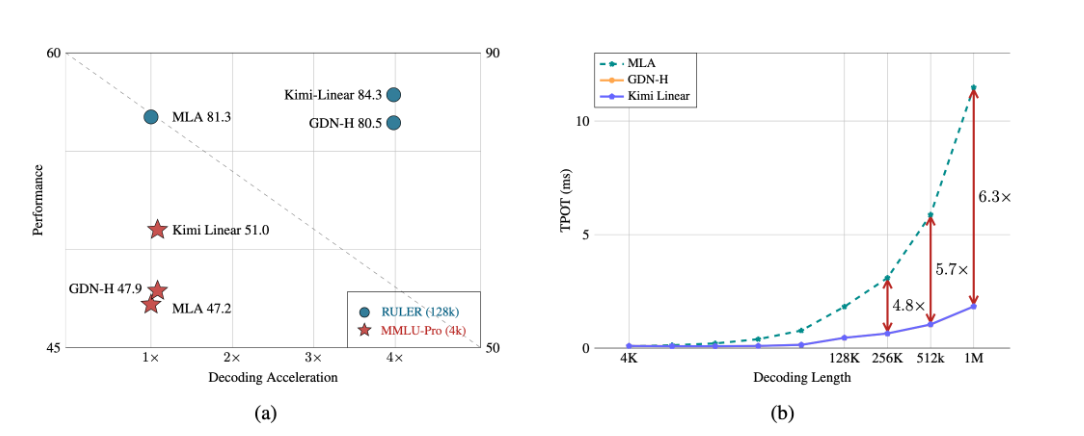
A major breakthrough has been achieved in the core architecture of large-scale models! The release of Kimi Linear marks the first time that linear attention technology has comprehensively surpassed and significantly outperformed the traditional Transformer full-attention model in both performance and efficiency. This "win-win" achievement is expected to significantly reduce the computational barriers and costs for long text processing, complex reasoning, and AI agent applications, potentially changing the competitive landscape of underlying technologies for large-scale models.
Over the past week, the AI community's attention has been drawn to a mysterious model that quietly emerged on the OpenRouter platform—Polaris Alpha. As a direct continuation of yesterday's discussion of the GPT-5.1 leak, this suddenly appearing model brings more technical details and strategic signals worthy of in-depth exploration.
Alibaba open-sources Qwen-Image-2.1: a 7B unified image model with native RGBA transparency and 10-reference editing.