Meta Releases WorldGen: Technological Practices for Generating Interactive 3D Worlds from Text.
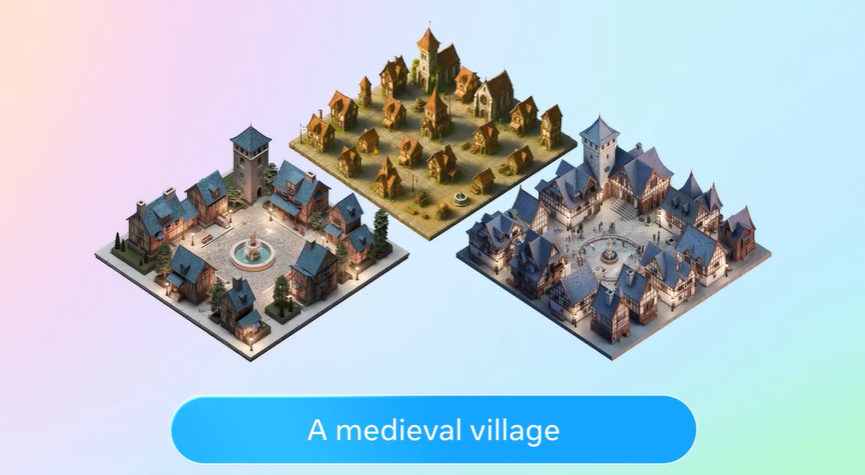
Imagine this scenario: you're preparing to develop an indie game, or simply want to build your own "secret base" in virtual space. While the image in your mind is vivid—perhaps a cyberpunk back alley or moss-covered ruins—the moment you open 3D software and face the empty viewport and complex modeling tools, your enthusiasm instantly dwindles.
This is why I've been watching Meta's newly released WorldGen for the past couple of days.
As someone who tests various AI tools on navigation sites every day, I've seen quite a few products from Wensheng 3D models. Most of them can only generate single objects, like a chair or a vase; anything slightly more complex often becomes a "paper doll"—it can only look at but not move. But WorldGen takes a different approach this time. Their official blog (published November 21, 2025) defines it directly as:
"A state-of-the-art end-to-end system for generating interactive and navigable 3D worlds from a single text prompt."
(A state-of-the-art end-to-end system that can generate interactive and navigable 3D worlds from a single text prompt.)
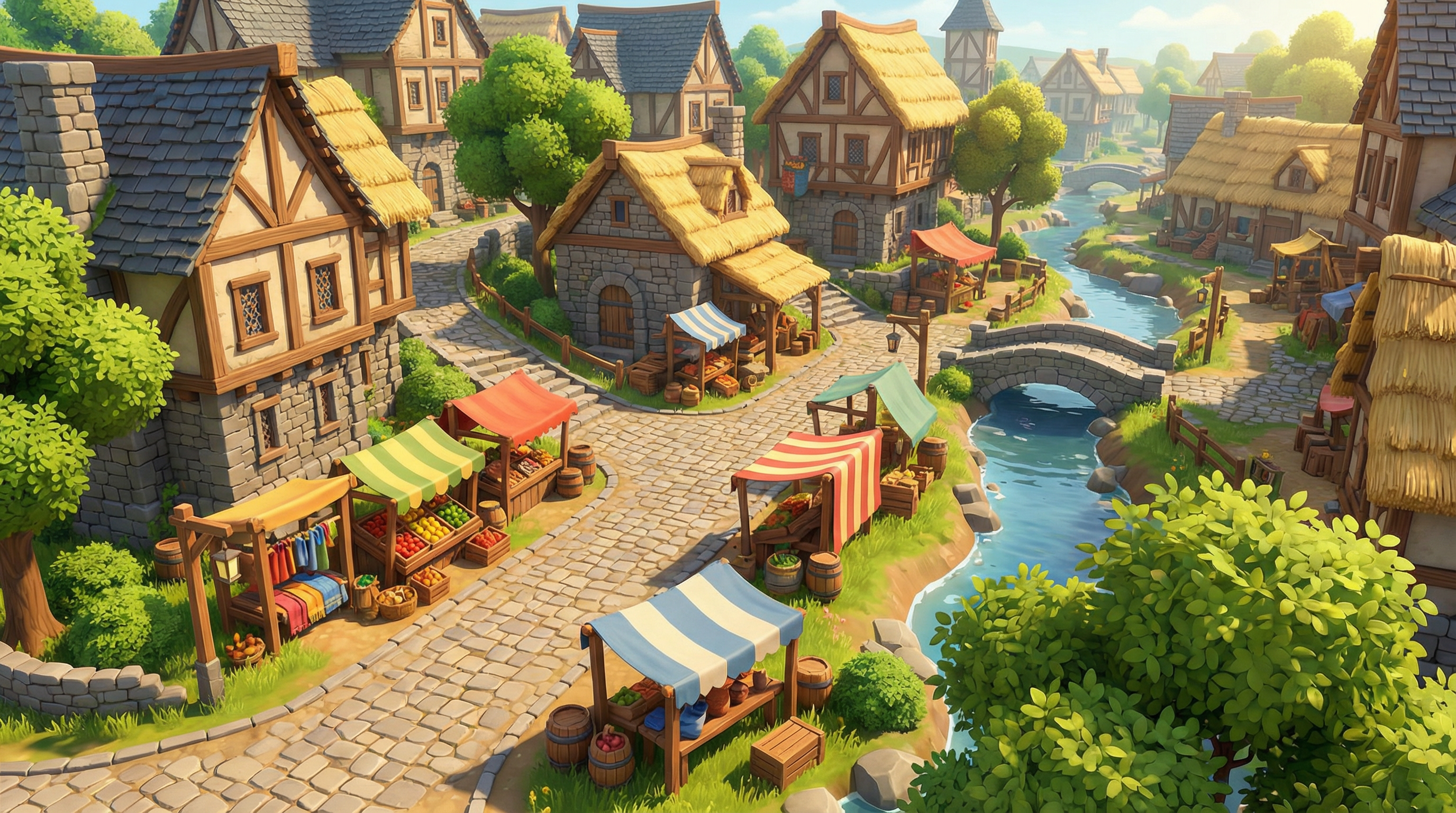
Figure 1: WorldGen can generate complete interactive 3D scenes from simple text prompts, containing rich details and navigable spatial structures.
How does it do this? I carefully read their technical report and found that they didn't try to "brute force" and generate everything at once. Instead, they broke down the process very systematically, combining procedural reasoning and diffusion generation techniques.
In short, WorldGen's technical implementation is divided into four stages, and this logic is very valuable for understanding AI generation:
Planning
The system doesn't immediately start drawing textures; instead, it first plans like an architect. It generates a procedural blockout and a navigation mesh. This is like drawing blueprints and outlining the layout before building a house, ensuring the generated space is functional and not just a jumble of geometric shapes.
Reconstruction
With the skeleton in place, the next step is to fill in the details. This step uses the image-to-3D model, combined with the previously generated navigation mesh, to construct the initial scene.
Decomposition
This is the most practical step in my opinion. Many generators produce a single, rigid model that cannot be edited. WorldGen uses an accelerated version of AutoPartGen technology to decompose and extract objects from the scene (part extraction). This means that tables and walls in the scene can be independent, facilitating subsequent adjustments.
Refinement
Finally, there's the refinement. Specialized models optimize the mesh and textures (Mesh refinement & Texturing) to clarify blurry details.
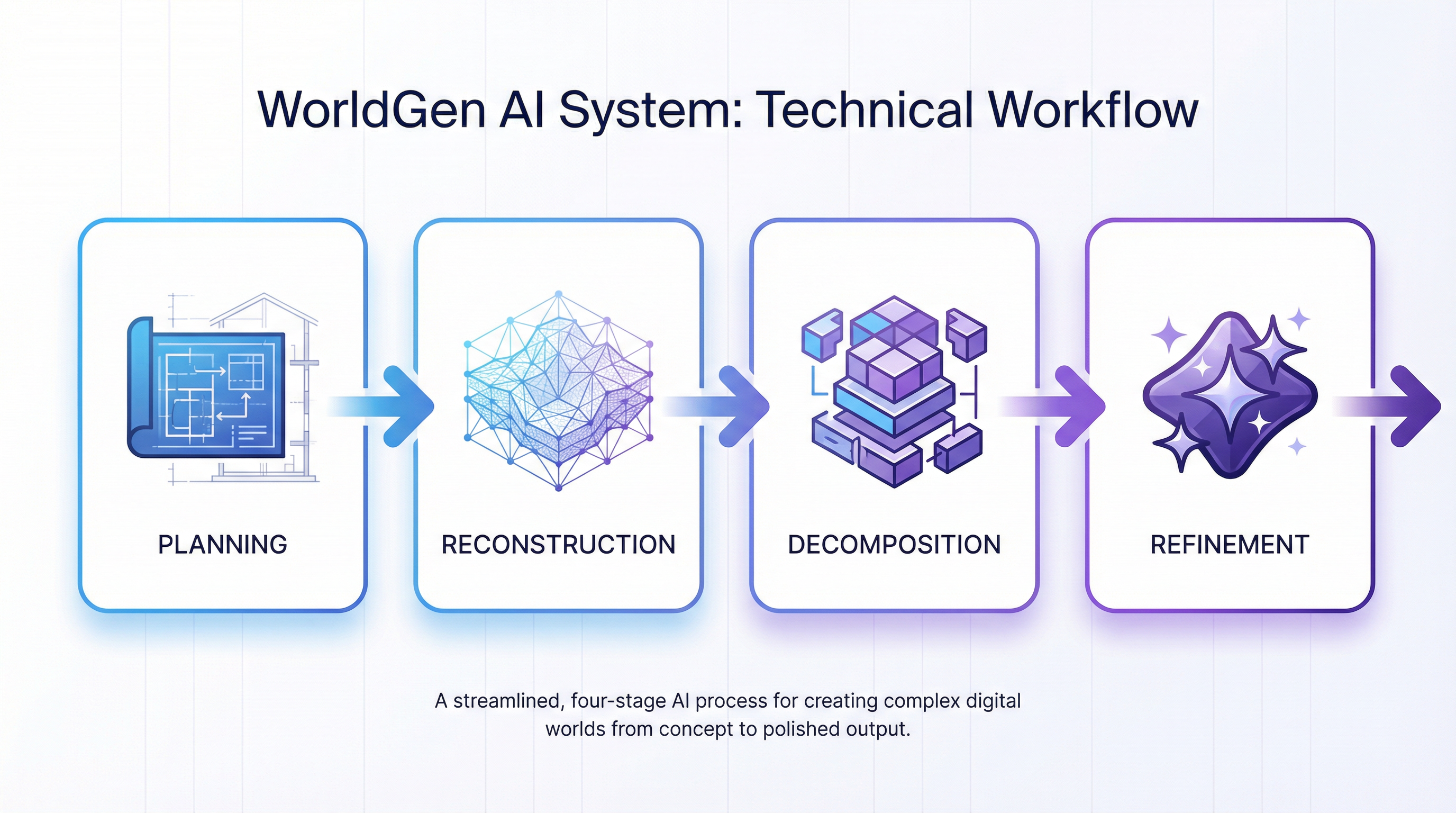
Figure 2: WorldGen's technology pipeline includes four stages: Planning, Reconstruction, Decomposition, and Refinement.
Why go through all this trouble?
Many methods on the market generate data from a single viewpoint. This leads to a problem: it looks fine within 3-5 meters, but once you move further away or turn around, the perspective and details collapse. Turning around, it's even worse.
WorldGen solves this problem. According to the official description, it can generate a complete scene covering an area half the size of a football field while maintaining geometrically consistent, visually rich, and render-efficient performance. For current technology, maintaining style consistency at this scale is quite remarkable.
What's the use for us?
The most direct benefit is compatibility. The content it generates can be directly imported into standard game engines like Unity and Unreal Engine without complex format conversions. This saves time on creating white models.
This also aligns with Meta's vision presented at the Connect conference: a future where anyone, even without writing code, can build their own virtual world.
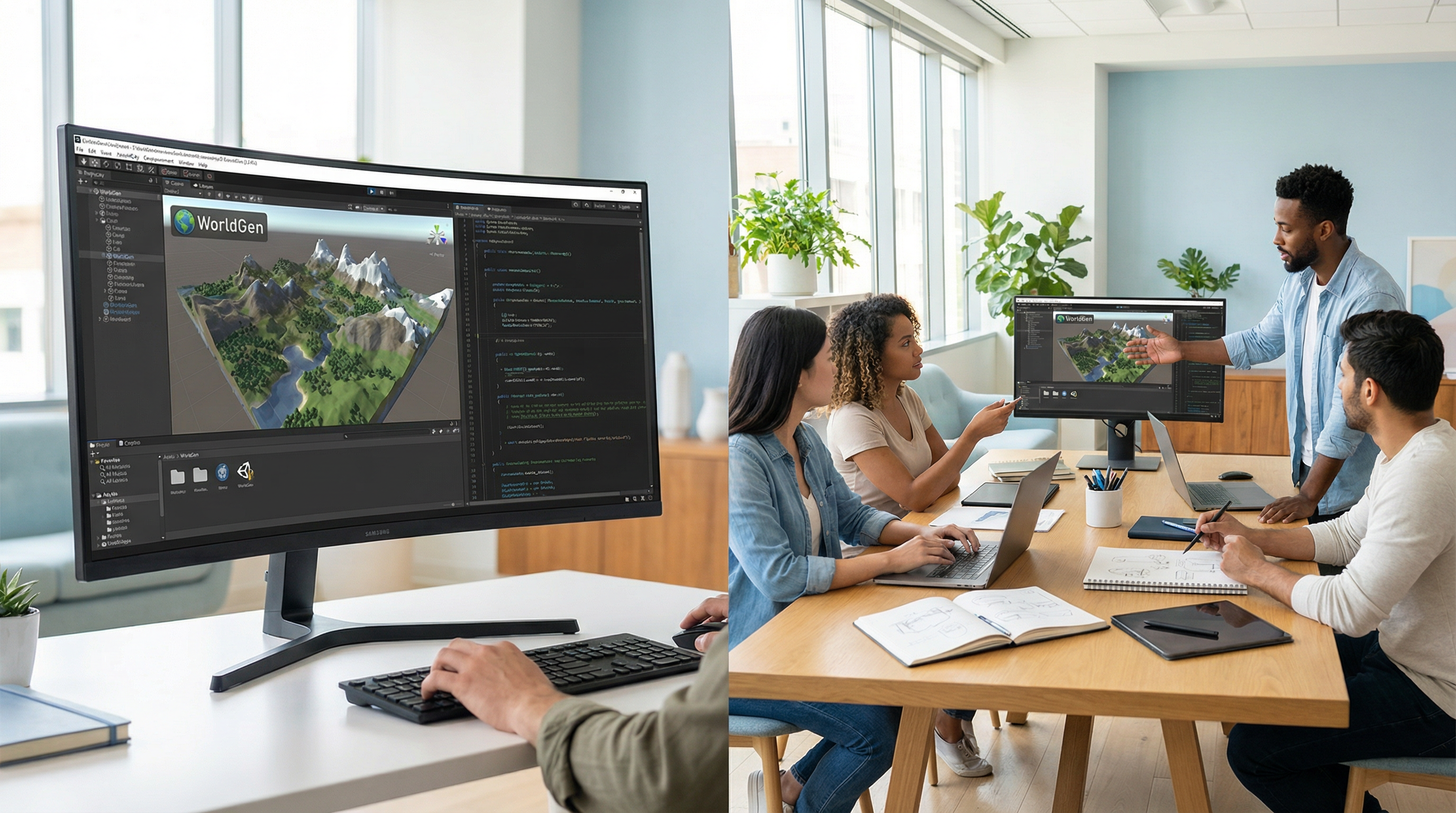
Figure 3: Content generated by WorldGen can be directly imported into Unity and Unreal Engine, significantly lowering the content creation threshold for developers.
Potential Value for Developers
For small and medium-sized teams, WorldGen's value lies in rapid prototyping:
-
Game developers can quickly build testable level prototypes using text descriptions.
-
Virtual simulation teams can generate basic training scenes (such as fire drill sites).
-
Note: Generated scenes require manual refinement of details and cannot currently replace professional modeling.
A Final word of caution
Don't rush to search for download links. WorldGen is currently in the research phase and is not publicly available. The team itself acknowledges that the current version still has much work to do in generating larger spatial areas (over 50 meters) and reducing computational latency.
This "generate structure first, then fill in details" approach is highly likely to be the mainstream direction for future 3D generation tools. I will continue to monitor this project, and I will update the site as soon as a demo version or API is released.
Official reference:
https://www.meta.com/blog/worldgen-3d-world-generation-reality-labs-generative-ai-research/
Leave your comment
- No comments yet.
Recommended AI Tools
Carefully selected AI tools to improve your work, study, and live efficiency.



Related Articles
A major breakthrough has been achieved in the core architecture of large-scale models! The release of Kimi Linear marks the first time that linear attention technology has comprehensively surpassed and significantly outperformed the traditional Transformer full-attention model in both performance and efficiency. This "win-win" achievement is expected to significantly reduce the computational barriers and costs for long text processing, complex reasoning, and AI agent applications, potentially changing the competitive landscape of underlying technologies for large-scale models.
Over the past week, the AI community's attention has been drawn to a mysterious model that quietly emerged on the OpenRouter platform—Polaris Alpha. As a direct continuation of yesterday's discussion of the GPT-5.1 leak, this suddenly appearing model brings more technical details and strategic signals worthy of in-depth exploration.
Alibaba open-sources Qwen-Image-2.1: a 7B unified image model with native RGBA transparency and 10-reference editing.