Introduction
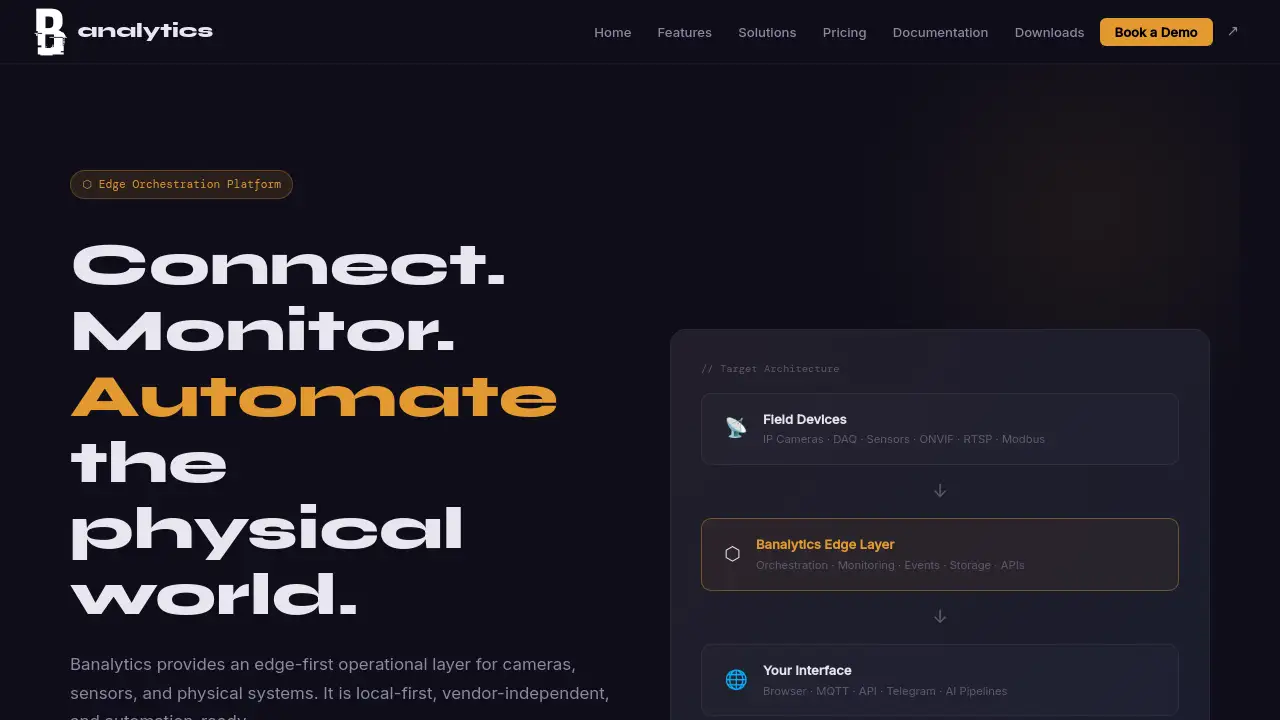
Banalytics is an edge orchestration platform designed to connect, monitor, and automate physical systems like cameras and sensors, all without vendor lock-in.
What is Banalytics?
Banalytics is a local-first, vendor-independent edge orchestration platform that brings together IP cameras, sensors, data acquisition (DAQ) systems, and other physical devices into a single operational layer. Instead of forcing users to rely on cloud subscriptions or proprietary ecosystems, it keeps raw data on local hardware while providing orchestration, monitoring, event-based workflows, and alerting. This makes Banalytics suitable for teams and individuals who need reliable, automation-ready edge computing without giving up control of their infrastructure. Whether you are managing a few USB cameras on a Raspberry Pi or scaling across industrial PCs with ONVIF and Modbus devices, Banalytics offers a unified interface to observe and control the physical world. As an edge computing platform, it emphasises data privacy, low latency, and integration flexibility – key advantages for anyone needing camera monitoring, sensor monitoring, or system health tracking at the edge.
Key Features of Banalytics
Universal Device Integration
Connect IP cameras (ONVIF, RTSP), USB devices, DAQ systems, and sensors all from one console. Mixed brands work together without compatibility headaches.
Local-First Storage
Recordings and sensor data stay on your NAS, local disk, edge node, or industrial PC. There is no forced cloud dependency, ensuring your data remains yours.
Event-Based Workflows
Define triggers, filters, and automations. Route events to MQTT, APIs, Telegram, or other external systems. Capture only what matters instead of blind recording.
Browser-Based Remote Access
Live feeds, dashboards, event history, and system health are accessible from any modern browser. No heavy client software required.
Actionable Alerts
Receive Telegram notifications with video context. Alerts explain what happened, not just that something happened – and you can act directly from the notification.
System Health Monitoring
Get visibility into camera status, compute load, storage usage, DAQ chains, and processing modules. Detect degradation before a failure occurs.
API & Integration Layer
Publish events, metadata, and results to external systems via open APIs. Connect to AI pipelines, SCADA, cloud storage, or your own tooling.
Modular Architecture
Your processing code and intellectual property remain yours. Banalytics wraps the system operationally without requiring you to rebuild what already exists.
Vendor-Independent Design
No lock-in to a single camera brand, cloud platform, or ecosystem. Mix and evolve your hardware without starting over.
Use Cases for Banalytics
Industrial Edge Monitoring
Use Banalytics as an edge orchestration platform to monitor production lines, environmental sensors, and IP cameras across a factory floor. Events can trigger alerts or feed into SCADA systems.
AI Data Pipeline Infrastructure
Feed camera streams and sensor data into local AI models. Banalytics handles the orchestration, storage, and event routing, so the AI team focuses on model development.
Self-Hosted Home Monitoring
Deploy Banalytics on a Raspberry Pi with USB cameras and motion sensors. Keep all recordings local while receiving Telegram alerts with video clips.
Business Operations Observation
Monitor retail spaces, parking lots, or building entry points with a mix of ONVIF and RTSP cameras. Dashboards and alerts help manage security and operations without cloud fees.
How to Use Banalytics
- Download and install Banalytics on a Linux machine (x86_64 or ARM) – industrial PC, mini server, or Raspberry Pi. No cloud account needed.
- Connect your devices – add IP cameras via ONVIF or RTSP, attach USB sensors, or configure Modbus and MQTT endpoints.
- Define workflows – create event triggers, filters, and automation rules. Set up alerts (Telegram, email, MQTT) and selective recording schedules.
- Access remotely – open any browser to view live feeds, dashboards, event history, and system health. No additional software.
- Integrate outward – use the API to send metadata to AI pipelines, SCADA, or cloud storage. Extend with your own processing code.
Target Audience for Banalytics
- Engineering teams needing vendor-independent camera monitoring for industrial or research settings
- IoT developers building automation-ready edge computing solutions
- IT managers who want local-first storage and no cloud dependency
- Researchers prototyping with cameras and sensors at scale
- Hobbyists self-hosting home monitoring systems on Raspberry Pi
Is Banalytics Free?
Yes, Banalytics offers a free Community plan that includes all core modules. Users only pay when they run paid component instances beyond the first free instance. The pricing is transparent and per-component, with no per-camera cloud fees.
| Plan | Price | Key Features |
|---|---|---|
| Community | Free forever | All core modules, 1 free instance of paid components, ONVIF/RTSP/USB cameras, recording, dashboards, remote console, Telegram/email/SMS alerts, MQTT & basic API |
| Basic | $15/month | Everything in Community plus 30% discount on all paid components |
| Pro | $50/month | Everything in Community plus 50% discount on all paid components |
| Enterprise | Contract-based | Custom edge deployments, commercial scope, custom integration, pilot-to-production support |
For the most current pricing, visit the official Pricing page.
Banalytics's Pros and Cons
| Aspect | Pros | Cons |
|---|---|---|
| Architecture | Local-first, vendor-independent, automation-ready | Requires Linux experience for initial setup |
| Features | Universal device integration, event workflows, alerts, system health monitoring | Some advanced paid components may increase cost for large deployments |
| Pricing | Free Community plan, no per-camera cloud fees, transparent component-based pricing | Paid plans add cost if running many paid component instances |
| Ease of Use | Browser-based remote access, simple workflow definition | Default documentation may be limited during early access phase |
| Scalability | Runs on Raspberry Pi to industrial PCs, modular architecture | Enterprise support requires contract negotiation |
Frequently Asked Questions about Banalytics
Can Banalytics replace my cloud-based camera monitoring platform?
Yes, for many use cases. Banalytics provides local-first storage, event-based recording, and remote access without cloud dependency. However, if you need built-in cloud AI analytics, you may need to integrate external AI pipelines via the API.
Which cameras and sensors are supported?
Banalytics supports IP cameras via ONVIF and RTSP, USB cameras, DAQ systems, and sensors using Modbus and MQTT. It is vendor-independent, so mixed brands work in one place.
Is Banalytics safe for industrial environments?
Yes. Because it is edge-first and local-first, data never leaves your network unless you choose to forward it. System health monitoring also helps detect hardware issues before failures occur.
Do I need programming skills to use Banalytics?
Basic setup and device connection are straightforward through the browser interface. Defining advanced event workflows and API integrations may require some technical background, but the platform is designed to be accessible.
Can I run Banalytics on a Raspberry Pi?
Absolutely. Banalytics has a Linux ARM64 build that runs on Raspberry Pi. It is suitable for self-hosted home monitoring or small-scale edge orchestration.
How does Banalytics handle scaling from a few cameras to hundreds?
Banalytics runs on the hardware you choose – from a single Raspberry Pi to multiple industrial servers. Its modular architecture allows you to add edge nodes and manage them from the same console, scaling as needed.
Banalytics Tags
edge orchestration platform, local-first monitoring, vendor-independent camera monitoring, edge computing platform, automation-ready IoT, ONVIF RTSP integration, sensor monitoring software, edge AI infrastructure, self-hosted video monitoring, system health monitoring, Modbus MQTT platform, Banalytics review